I realised today that I have no patience for statting out a roleplaying adventure.
I love designing the plot, writing the story, creating the characters and fleshing out the adventure, but when it comes to giving the main NPCs and monsters statistics based on the system and the experience of the characters the adventure is designed for, I simply slump my shoulders and press on. To me, statistics are a part of designing adventures that feel like a chore.
All I'm interested in is the situation and how the players react to it. I like introducing new elements to a story as it progresses, twists and incidents that might bring out the player's characters, create in-game tension around a table, or get a few pulses racing.
But when it comes to statting a character... I always leave it to the end as I don't want the wind taken out of my sails as I'm writing. They're usually adjusted after playtesting, anyway. I guess it's because of my background of fiction writing and, of course, you don't have to worry about a character's stats. You just want to get on with the story.

Your destination for fast, simple TTRPGs - home of Fireteam, Deep Space, Cyber Streets and adventures for the Those Dark Places RPG from Osprey Games
Sunday, 15 October 2017


Saturday, 14 October 2017
ZWEIHÄNDER Grim & Perilous RPG - First Impressions
I'm a huge Warhammer Fantasy Roleplay fan. I wrote an article a few years ago about my top ten RPGs, and WFRP's position at the top hasn't changed since then.
'Number 1:
Warhammer Fantasy Roleplay (1st Edition)
The original rulebook was a mighty tome and had absolutely everything you needed to run a game in Warhammer’s Old World – character creation, careers, a full magic system, histories, location details, a bestiary, even charts and tables on insanity, phobias and random magical items. This one book alone was enough to keep a gaming candle burning for years, and indeed it did. I ran WFRP games for years and in all that time I could simply refer to the rulebook for everything I needed, even inspiration for new games and adventures. I bought some supplements, sure, but they were never used. In time the adventures, campaigns and extras I gathered were sold but I never parted with the main solid rulebook, which has been on my shelf for over twenty five years and still gets some use. To me, WFRP is what a RPG rulebook should be – it contains every detail you need to run a succesful campaign, and it’s atmospheric and a pretty good read to boot. I love the system and I even like the idea and implementation of careers. With more than 8 years of continuous campaigning with many, many player characters, and delving into the Old World’s history and possible futures, WFRP is, by far, my game of choice.'
I'm really excited that Cubicle 7 are going to release a new Warhammer RPG, using elements of the first two editions. They're also doing a game for the new Age of Sigmar which I will no doubt purchase as I'd love to see how they handle the RPG aspect of such a huge setting. I'm still not happy about the whole End Times thing, and the destruction of the Old World and pretty much everything and everyone in it was just ridiculous, but the Age of Sigmar wargame is really good and very playable, and the setting itself is pretty good, if not to my taste of fantasy setting.
1st Edition will always be my favourite for the reasons above, and as much as I liked 2nd Edition - especially the rules changes - it never had the same atmosphere as the original. The 3rd Edition I never owned but I played a few times and it was fun, but there was never any longevity in the games and it felt more about the components of the box than the actual story, and that belongs in a boardgame.
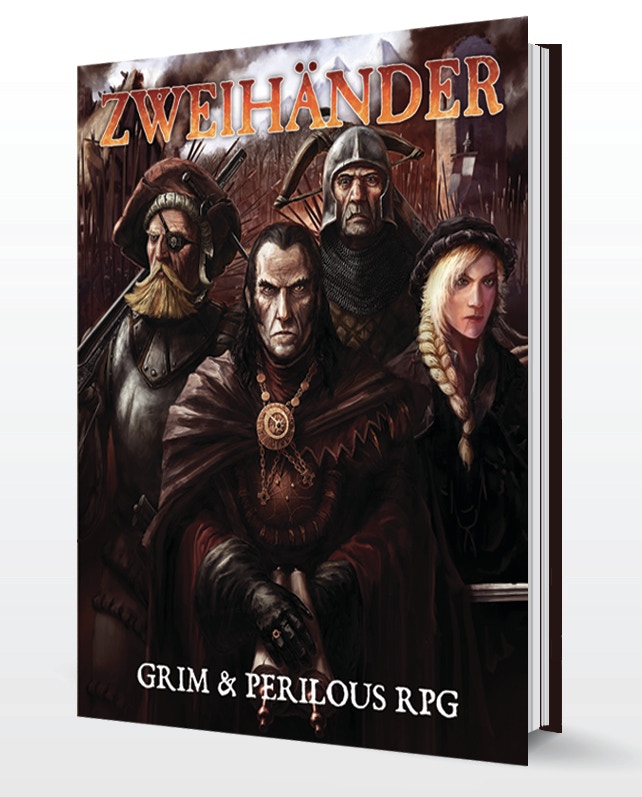 Until that happens we have a Warhammer-esque game created by Warhammer fans, a retrocolone-homage-restyle-oldschool-heartbreaker-fan version of the game I hold very dear to my heart: ZWEIHÄNDER. I've been reading the PDF of the game with clenched jaw and nervous twitches, wondering just how the guys at Grim and Perilous have changed the game to my dissatisfaction but up to yet I've been really, really pleased... no, impressed by what they've accomplished. The art choice, the design, the details, the rules have all been heavily redone. It's not a reskin or a filing off of serial numbers, it's a full game of a professional quality. I don't review PDFs, but I will have the physical book soon so I'll have a proper review done in next few weeks once I've had time to digest it and try it out.
Do I have issues with it, being the Warhammer fan I am? Yes, of course I do, but I'm reserving final judgement for when I have the book in my hands to make sure that my issues are justified, and not just confused by initial reading or the problems I have with PDFs. Safe to say that I think any problems I do have are going to be outweighed by the good things I have to say, but I'll save all of that detail for my review.
ZWEIHÄNDER is a game to get excited about, whether you're a Warhammer fan or not, and Grim & Perilous should be proud.
Check back regularly for my full review.
'Number 1:
Warhammer Fantasy Roleplay (1st Edition)
The original rulebook was a mighty tome and had absolutely everything you needed to run a game in Warhammer’s Old World – character creation, careers, a full magic system, histories, location details, a bestiary, even charts and tables on insanity, phobias and random magical items. This one book alone was enough to keep a gaming candle burning for years, and indeed it did. I ran WFRP games for years and in all that time I could simply refer to the rulebook for everything I needed, even inspiration for new games and adventures. I bought some supplements, sure, but they were never used. In time the adventures, campaigns and extras I gathered were sold but I never parted with the main solid rulebook, which has been on my shelf for over twenty five years and still gets some use. To me, WFRP is what a RPG rulebook should be – it contains every detail you need to run a succesful campaign, and it’s atmospheric and a pretty good read to boot. I love the system and I even like the idea and implementation of careers. With more than 8 years of continuous campaigning with many, many player characters, and delving into the Old World’s history and possible futures, WFRP is, by far, my game of choice.'
I'm really excited that Cubicle 7 are going to release a new Warhammer RPG, using elements of the first two editions. They're also doing a game for the new Age of Sigmar which I will no doubt purchase as I'd love to see how they handle the RPG aspect of such a huge setting. I'm still not happy about the whole End Times thing, and the destruction of the Old World and pretty much everything and everyone in it was just ridiculous, but the Age of Sigmar wargame is really good and very playable, and the setting itself is pretty good, if not to my taste of fantasy setting.
1st Edition will always be my favourite for the reasons above, and as much as I liked 2nd Edition - especially the rules changes - it never had the same atmosphere as the original. The 3rd Edition I never owned but I played a few times and it was fun, but there was never any longevity in the games and it felt more about the components of the box than the actual story, and that belongs in a boardgame.
Until that happens we have a Warhammer-esque game created by Warhammer fans, a retrocolone-homage-restyle-oldschool-heartbreaker-fan version of the game I hold very dear to my heart: ZWEIHÄNDER. I've been reading the PDF of the game with clenched jaw and nervous twitches, wondering just how the guys at Grim and Perilous have changed the game to my dissatisfaction but up to yet I've been really, really pleased... no, impressed by what they've accomplished. The art choice, the design, the details, the rules have all been heavily redone. It's not a reskin or a filing off of serial numbers, it's a full game of a professional quality. I don't review PDFs, but I will have the physical book soon so I'll have a proper review done in next few weeks once I've had time to digest it and try it out.Do I have issues with it, being the Warhammer fan I am? Yes, of course I do, but I'm reserving final judgement for when I have the book in my hands to make sure that my issues are justified, and not just confused by initial reading or the problems I have with PDFs. Safe to say that I think any problems I do have are going to be outweighed by the good things I have to say, but I'll save all of that detail for my review.
ZWEIHÄNDER is a game to get excited about, whether you're a Warhammer fan or not, and Grim & Perilous should be proud.
Check back regularly for my full review.
Wednesday, 11 October 2017
Farsight Blogger 2 - The Sequel
I've had a long time away from Farsight Blogger. I never intended to get fully back into it but with major things going on in the industry, and my own work starting to take on a life of it's own, I've decided to start it up again.
So what have I been up to? Well, I did some work on Advanced Fighting Fantasy 'Stellar Adventures' which was released earlier in the year and did well. A lot of my work wasn't used, but the game has my name on it and it was gratifying to see that; it was Fighting Fantasy that got me into this hobby and to see my name on an official product is just amazing.

As far as the wider hobby is concerned, there's a lot going on that I'm excited about. Primarily, my favourite fantasy RPG is getting all kinds of love. Warhammer Fantasy Roleplay is making a return in more than one iteration.
First, there's the retroclone ZWEIHÄNDER, a huge tome giving us classic WFRP rules with a twist, but setting neutral. It positively drips grimness and I love what I've seen up to yet. There'll be a full review of this soon.
On top of that, Cubicle 7 are releasing their own WFRP under license from Games Workshop, allegedly a mix of first and second edition. Not only that, they're doing a seperate RPG for Age of Sigmar, the epic wargame setting that replaced the Old World after it was utterly destroyed, something I'm not bitter about at all. The bastards.
I'll be following these developments. and others, as well as getting new reviews in as well as interviews, three of which I already have planned and hope to share soon.
I'm happy to be back on Farsight Blogger. Hopefully I'll be able to mix things up a bit but I'm not making any solid plans. I'll just set out, and see where it takes me.
After all, it's about the journey, not the destination.
So what have I been up to? Well, I did some work on Advanced Fighting Fantasy 'Stellar Adventures' which was released earlier in the year and did well. A lot of my work wasn't used, but the game has my name on it and it was gratifying to see that; it was Fighting Fantasy that got me into this hobby and to see my name on an official product is just amazing.
I'm also working on other writing projects, and getting back into my art, and that's another reason I'm restarting this blog. I'd like to share what I'm working on, give progress reports, and explain why I make certain decisions during the process.
As far as the wider hobby is concerned, there's a lot going on that I'm excited about. Primarily, my favourite fantasy RPG is getting all kinds of love. Warhammer Fantasy Roleplay is making a return in more than one iteration.
First, there's the retroclone ZWEIHÄNDER, a huge tome giving us classic WFRP rules with a twist, but setting neutral. It positively drips grimness and I love what I've seen up to yet. There'll be a full review of this soon.
On top of that, Cubicle 7 are releasing their own WFRP under license from Games Workshop, allegedly a mix of first and second edition. Not only that, they're doing a seperate RPG for Age of Sigmar, the epic wargame setting that replaced the Old World after it was utterly destroyed, something I'm not bitter about at all. The bastards.
I'll be following these developments. and others, as well as getting new reviews in as well as interviews, three of which I already have planned and hope to share soon.
I'm happy to be back on Farsight Blogger. Hopefully I'll be able to mix things up a bit but I'm not making any solid plans. I'll just set out, and see where it takes me.
After all, it's about the journey, not the destination.
Get back on the horse...
There's far too much going on in the hobby for me to stay away from blogging. There's people I want to interview, things I want to review, and my own material I want to show off.
Time to get Farsight Blogger back in the game.
Time to get Farsight Blogger back in the game.
Monday, 2 October 2017
Hints & Tips - Modern Gaming Tips
On the first Monday of every month, read a new hint or tip from Jonathan
Hicks, as featured on www.rpg.net and available on Kindle as 'The
Book of Roleplaying Hints, Tips and Ideas'.
A lot of gamers want to game in the fantastical, but gaming in a contemporary setting is a mirror of real life, so you have to ask the question - what's the point? I've combated that by placing the players in a setting they hardly know from experience, such as a Vietnam game and special ops in South America. Removing the players as far as possible from their real life environment can be as effective as placing them in a fantasy world.
Because the world you are in does not require a lot of imagination (as the details/settings/items are all provided for you) it can be difficult for the GM to maintain that suspension of disbelief. In a fantasy setting, the players know none of it is true and they allow themselves to be immersed in the setting. With contemporary games, the real world can pretty much drag the players 'back to reality', and they can feel the limitations and constrictiveness of normality.
To combat this, I try to keep the game moving at a good pace. This is possible because I don't have to spend time describing the appearance and function of many of the items and locations. If you can't keep the game going with atmosphere then keep it going with plot and action. The problem is, burn-out usually tends to come sooner rather than later because of the pace.
The players may feel restricted in their actions and capabilities because they are within a real world environment where all those real world rules and regulations are going to apply. So, the players will have to be wary of actions involving the police, their own skills, and the impact of their actions (because the GM is more likely to realise the effects in a world they know inside-out). Also, most gaming systems I've come across reflect this real world feel, where there is great danger in over-zealous actions and a high payment (death) for certain mistakes in judgement or hits from weapons. With these kind of restrictions, the players will soon get bored, tired, or frustrated.
My answer to that is to throw out the rule books. Be more forgiving to the players, allow them to do James Bond-style stunts and Indiana Jones-style rescues. The more latitude they are given, the more 'into' the game they will get.
Most games in contemporary settings are a mixture of the real world and the fantastical, involving alien conspiracies, vampires, magic, and great old gods come back to reclaim their world. This is good news because it puts the players within a familiar environment whilst allowing their imaginations to work on the fantasy elements of the game.
However, the game can be limited because the game world limits the exploration of the chosen genre. How many vampires can you dust in different ways before it gets repetitive? How many times can the "truth" about the government conspiracy slip through your fingers before you just give up? How many sacred artifacts do you have to recover before you begin to think "hold on... this is all very familiar"? Once you've defeated the foe and saved the world - where do you go from there?
A great way to get past this problem is to have a deep well of imagination, which is why I started GMing in the first place! Fantasy and Sci-Fi games open up many possibilities in their own realms of fiction, but contemporary games consist of the same setting, the same world, the same attitudes. This can limit the adventure, sure, but it can also help you in your quest for a new idea. After all, the world is set and you already have your guidelines as far as the setting goes - all you have to do is come up with the plot. Sure, the game may be another murder-mystery, but it's the reason and circumstance surrounding the murder that makes it unique.
My favourite idea is turning the world up on its head. A vast plague leaving few survivors, a new Ice Age, a holocaust, an alien invasion, the Rise of the Machines... You take the world and twist it all out of sense and proportion. This works great because then the rules don't apply any more. There's no restrictions on society or law, and you can change the rules to reflect that.
A lot of gamers want to game in the fantastical, but gaming in a contemporary setting is a mirror of real life, so you have to ask the question - what's the point? I've combated that by placing the players in a setting they hardly know from experience, such as a Vietnam game and special ops in South America. Removing the players as far as possible from their real life environment can be as effective as placing them in a fantasy world.
Because the world you are in does not require a lot of imagination (as the details/settings/items are all provided for you) it can be difficult for the GM to maintain that suspension of disbelief. In a fantasy setting, the players know none of it is true and they allow themselves to be immersed in the setting. With contemporary games, the real world can pretty much drag the players 'back to reality', and they can feel the limitations and constrictiveness of normality.
To combat this, I try to keep the game moving at a good pace. This is possible because I don't have to spend time describing the appearance and function of many of the items and locations. If you can't keep the game going with atmosphere then keep it going with plot and action. The problem is, burn-out usually tends to come sooner rather than later because of the pace.
The players may feel restricted in their actions and capabilities because they are within a real world environment where all those real world rules and regulations are going to apply. So, the players will have to be wary of actions involving the police, their own skills, and the impact of their actions (because the GM is more likely to realise the effects in a world they know inside-out). Also, most gaming systems I've come across reflect this real world feel, where there is great danger in over-zealous actions and a high payment (death) for certain mistakes in judgement or hits from weapons. With these kind of restrictions, the players will soon get bored, tired, or frustrated.
My answer to that is to throw out the rule books. Be more forgiving to the players, allow them to do James Bond-style stunts and Indiana Jones-style rescues. The more latitude they are given, the more 'into' the game they will get.
Most games in contemporary settings are a mixture of the real world and the fantastical, involving alien conspiracies, vampires, magic, and great old gods come back to reclaim their world. This is good news because it puts the players within a familiar environment whilst allowing their imaginations to work on the fantasy elements of the game.
However, the game can be limited because the game world limits the exploration of the chosen genre. How many vampires can you dust in different ways before it gets repetitive? How many times can the "truth" about the government conspiracy slip through your fingers before you just give up? How many sacred artifacts do you have to recover before you begin to think "hold on... this is all very familiar"? Once you've defeated the foe and saved the world - where do you go from there?
A great way to get past this problem is to have a deep well of imagination, which is why I started GMing in the first place! Fantasy and Sci-Fi games open up many possibilities in their own realms of fiction, but contemporary games consist of the same setting, the same world, the same attitudes. This can limit the adventure, sure, but it can also help you in your quest for a new idea. After all, the world is set and you already have your guidelines as far as the setting goes - all you have to do is come up with the plot. Sure, the game may be another murder-mystery, but it's the reason and circumstance surrounding the murder that makes it unique.
My favourite idea is turning the world up on its head. A vast plague leaving few survivors, a new Ice Age, a holocaust, an alien invasion, the Rise of the Machines... You take the world and twist it all out of sense and proportion. This works great because then the rules don't apply any more. There's no restrictions on society or law, and you can change the rules to reflect that.
Monday, 4 September 2017
Hints & Tips - Running A Sci-Fi Game Setting Well: 8 Tips For New GMs
On the first Monday of every month, read a new hint or tip from Jonathan
Hicks, as featured on www.rpg.net and available on Kindle as 'The
Book of Roleplaying Hints, Tips and Ideas'.
During a game GMs come across all kinds of situations they have to deal with on the fly, but there are certain situations in Sci-Fi games that crop up again and again that can throw the everything into disarray.
The most difficult problem is if the players aren't getting 'into' the setting. GMs might look across the table at any time and see one or two of the players (and in the most extreme cases, all of them) looking a little bored or lost. This might have something to do with the way things are progressing or because they can't get a feel for the game.
So, below I've included nine ways a sci-fi GM can enhance and colourfully portray their game's setting.
Use Pictures, Photos, Printouts
Have pictures ready to hand out for certain aspects of your game so the players can better visualise their surroundings.
There are an abundance of visuals on the Internet and in books and it's good to have a visual representation of what it is you're trying to explain.
For space shots, use photographs from the Hubble Telescope, for starships there are plenty of movie and actual space agency design sketches you can utilise. Even a rough sketch by you can serve the purpose.
Base Your NPCs On Actors
Saying that the captain of the starship looks like Pierce Brosnan or the assassin looks like Angelina Jolie can take all the work out of the need for descriptions and speeds the game along. It gives the players a good point of reference if they can match the face to the name.
Choose The Right Game System
Make sure your system is suitable for the players. There's no point in running a Star Trek type of game if the players want to kick Aliens-type backside. Chopping and changing the game you have designed so that it will suit the tastes of the players is not a big job and in the long run it will serve its purpose.
Know Your Game World
Sci-Fi settings can be vast, and constantly referring to sourcebooks during play can be tedious for the players and detach them from the game setting itself if they feel the GM is not in full control. Not knowing what a certain alien is capable of, especially at a crucial point in a game, might destroy the suspension of disbelief. Also, the players not only need a GM's narrative ability, they also need to be secure in the fact that he can supply them with a tangible world.
Know The Setting As Well As The Players, If Not Better
There's no point in running a game where the players know more about the setting than you do. Let's say you're running a Star Trek game - you've seen a few of the episodes and the movies, have got the gist of the genre and know the rulebook inside out. Unfortunately, the player(s) know the series inside out, can quote lines from specified episodes and have lots and lots of supplementary books. You can see where this is going.
Situations will constantly arise where the players will say they can do something you did not foresee and you know that if they do it might Upset the route the game is taking, or make the game too easy for them
There are only so many times where you are able to say 'I can't allow that' before the players feel as though they are being restricted within a setting they know well. Also, how do you know they're not making some of these things up? Be educated in your chosen setting.
Make Sure You're Within Your Chosen Genre's Boundaries
There are generally three different types of Sci-Fi genres. These are:
'Hard Science Fiction', where the technology and physics are based on actual real-world capabilities and possibilities, with the abilities of equipment based on actual theory.
'Space Opera', where it doesn't matter how something works - it just does, and Star Wars-type action abounds with large space battles and even larger technology.
'Science Fantasy', where the powers of psionics, outlandish technology and science-altering abilities exist.
Most of these genres don't intermix, and if they do then they usually just touch on each other. If the players are running through a 'Hard' setting, with theoretically possible vessels and ecologically viable planets, and then it suddenly switches to huge laser battles and starfighters, they may find it a little disorienting. It's best that the genres are not intertwined so that the players can identify with their surroundings and are able to concentrate on exactly what is expected of them.
Be A Good Mimic
This sounds a little strange, but having a talent for vocal diversity and being able to do sound effects with your voice can help. The 'pyoo' of laser bolts, the 'brmmmm' of rumbling starships, the 'swoosh' of hovercars, the 'bloop' of computers... Yes, it all sounds very embarrassing, having to sit at the head of the table and basically rip your throat out with silly noises, but if you become good at it and it's close to the desired effect, then it can help.
Keep Things Moving
Even if the story promotes slow investigation, speed up the pace. Throw in a bad guy, have the characters get shot at, do something that will grab the players' attention. If they're suddenly cast into a life-threatening situation then they won't have time to wonder at their position in the game.
During a game GMs come across all kinds of situations they have to deal with on the fly, but there are certain situations in Sci-Fi games that crop up again and again that can throw the everything into disarray.
The most difficult problem is if the players aren't getting 'into' the setting. GMs might look across the table at any time and see one or two of the players (and in the most extreme cases, all of them) looking a little bored or lost. This might have something to do with the way things are progressing or because they can't get a feel for the game.
So, below I've included nine ways a sci-fi GM can enhance and colourfully portray their game's setting.
Use Pictures, Photos, Printouts
Have pictures ready to hand out for certain aspects of your game so the players can better visualise their surroundings.
There are an abundance of visuals on the Internet and in books and it's good to have a visual representation of what it is you're trying to explain.
For space shots, use photographs from the Hubble Telescope, for starships there are plenty of movie and actual space agency design sketches you can utilise. Even a rough sketch by you can serve the purpose.
Base Your NPCs On Actors
Saying that the captain of the starship looks like Pierce Brosnan or the assassin looks like Angelina Jolie can take all the work out of the need for descriptions and speeds the game along. It gives the players a good point of reference if they can match the face to the name.
Choose The Right Game System
Make sure your system is suitable for the players. There's no point in running a Star Trek type of game if the players want to kick Aliens-type backside. Chopping and changing the game you have designed so that it will suit the tastes of the players is not a big job and in the long run it will serve its purpose.
Know Your Game World
Sci-Fi settings can be vast, and constantly referring to sourcebooks during play can be tedious for the players and detach them from the game setting itself if they feel the GM is not in full control. Not knowing what a certain alien is capable of, especially at a crucial point in a game, might destroy the suspension of disbelief. Also, the players not only need a GM's narrative ability, they also need to be secure in the fact that he can supply them with a tangible world.
Know The Setting As Well As The Players, If Not Better
There's no point in running a game where the players know more about the setting than you do. Let's say you're running a Star Trek game - you've seen a few of the episodes and the movies, have got the gist of the genre and know the rulebook inside out. Unfortunately, the player(s) know the series inside out, can quote lines from specified episodes and have lots and lots of supplementary books. You can see where this is going.
Situations will constantly arise where the players will say they can do something you did not foresee and you know that if they do it might Upset the route the game is taking, or make the game too easy for them
There are only so many times where you are able to say 'I can't allow that' before the players feel as though they are being restricted within a setting they know well. Also, how do you know they're not making some of these things up? Be educated in your chosen setting.
Make Sure You're Within Your Chosen Genre's Boundaries
There are generally three different types of Sci-Fi genres. These are:
'Hard Science Fiction', where the technology and physics are based on actual real-world capabilities and possibilities, with the abilities of equipment based on actual theory.
'Space Opera', where it doesn't matter how something works - it just does, and Star Wars-type action abounds with large space battles and even larger technology.
'Science Fantasy', where the powers of psionics, outlandish technology and science-altering abilities exist.
Most of these genres don't intermix, and if they do then they usually just touch on each other. If the players are running through a 'Hard' setting, with theoretically possible vessels and ecologically viable planets, and then it suddenly switches to huge laser battles and starfighters, they may find it a little disorienting. It's best that the genres are not intertwined so that the players can identify with their surroundings and are able to concentrate on exactly what is expected of them.
Be A Good Mimic
This sounds a little strange, but having a talent for vocal diversity and being able to do sound effects with your voice can help. The 'pyoo' of laser bolts, the 'brmmmm' of rumbling starships, the 'swoosh' of hovercars, the 'bloop' of computers... Yes, it all sounds very embarrassing, having to sit at the head of the table and basically rip your throat out with silly noises, but if you become good at it and it's close to the desired effect, then it can help.
Keep Things Moving
Even if the story promotes slow investigation, speed up the pace. Throw in a bad guy, have the characters get shot at, do something that will grab the players' attention. If they're suddenly cast into a life-threatening situation then they won't have time to wonder at their position in the game.
Sunday, 20 August 2017
Star Wars™: The Roleplaying Game - 30th Anniversary Edition
You
may have heard a thing or two about Fantasy Flight Games creating aStar Wars™: The Roleplaying Game - 30th Anniversary Edition, a
reprint of the first two books of the West End Games D6 roleplaying
game released in 1987. This game exploded onto the roleplaying game
scene, and the easy rules and the melodramatic, fast-action games it
encouraged got players excited and salivating for more.

Star
Wars had waned somewhat by the middle of the 1980s. The last film had
been ‘Return of the Jedi’, and there had been nothing huge for a
while. With the roleplaying scene at it’s height around this time,
it was only natural that a Star Wars roleplaying game would emerge.
Back
in 2012, we spoke to Greg Costikyan and Bill Slavicsek about the
importance of the game. I asked Greg about the how the game was part
of the ‘First Ten Years’ celebrations, so that must have put some
pressure on. “Lucasfilm told us that they saw an RPG as one way
to keep Star Wars fandom alive,” he said, “during an
otherwise fallow period, with no new movies on the horizon.”
I
asked Bill if he realised how big a deal it was. “We knew we had
a good game, and we knew the sourcebook was unlike anything ever
created for an RPG, let alone a movie franchise,” he said. “And
later, when novelists would call me or reference one of our game
products or my Guide to the Star Wars Universe, well, that made me
very proud.”
The
material the game produced over the years went on to form the
foundation of the Star Wars Expanded Universe, and breathed new life
into the franchise. Not only were gamers excited about the products,
so were the collectors; here were books building the Star Wars
galaxy, with details of characters - both main and background -
places and things. Small pieces of fiction also filled out the books,
always teasing at the drama of a bigger Star Wars galaxy just waiting
to be told. Star Wars™: The Roleplaying Game had revitalised the
franchise, and not only were people learning new things they were
taking part in it, experiencing the galaxy as never before with their
own stories, adventures and creations.
It’s
difficult to explain what is was about the game that hit us so hard
as gamers. I myself had been gaming since 1984 after falling in love
with the red box basic Dungeons & Dragons roleplaying game, and
spending much of my time enjoying Fighting Fantasy gamebooks. We had
tried to do Star Wars-inspired games, using a game called Traveller
and the Fighting Fantasy rules, but it never really worked and the
games trailed off after very few sessions. Even as huge Star Wars
fans we found it hard to get into the spirit of the setting, let
alone the game.
But
here was an entire book dedicated to Star Wars, with an excellent
system that encouraged cinematic over-the-top action gaming and a
sourcebook that had us amazed at the depth that the Star Wars galaxy
had to offer. The writing in the rulebook was conversational, fun,
light-hearted and exciting, with a touch of darkness; everything a
Star Wars story should be. As a sixteen year old boy, that was quite
something to experience. In fact, the Games Master and gaming advice
in that book is still something adhere to today.
For
years we played in our own corner of the galaxy, the Setnin Sector,
and we created a huge region of space where we could have huge
adventures that didn’t intrude on the galaxy-spanning stories of
the movies and novels, but sat alongside them, slightly scaled down,
so that we could feel as though our creations could exist in
the same galaxy as the damn big heroes on the screen. We wanted to be
part of it, and the great thing about these books, the very books
that Fantasy Flight Games are about to reprint, was that they gave us
all the information we needed to fill out the universe and create our
own material. It was an amazing time, and probably one of the most
creative periods of my gaming history.

I
truly hope that those of you who haven’t experienced these books
before get a chance to have a look. As a chapter of both Star Wars
and gaming history these were very important books and they inspired
gamers for years. You may find them a curiosity, but I truly hope
that some of you see the same magic in them that I did, and allow
your excitement and creativity to take you across the stars.
Make
sure you take an astromech ‘droid along with you, just in case. No
job is above this little guy’s head.
Monday, 7 August 2017
Hints & Tips - 7 Tips On Creating Moments Of High Drama
On the first Monday of every month, read a new hint or tip from Jonathan
Hicks, as featured on www.rpg.net and available on Kindle as 'The
Book of Roleplaying Hints, Tips and Ideas'.
It might sound like a bad thing to say, but let's face it, a lot of roleplaying games are often two-dimensional. You have sword fights, defeat the monsters and bad guys, solve mysteries, and blast about in high-spec ships popping bolts of light at the enemy. There's magic and explosions and lasers and bombs and monsters and... that's pretty much it.
It's very easy to look at roleplaying as a black and white thing, and in many respects it is. When you first see classic good-versus-evil movies, like the original Star Wars, you want to cheer the good guys and throw popcorn at the bad guys. It's easy to see it as a big, dumb, action movie.
However, what about that scene when Luke Skywalker went racing back to his uncle's farmstead to find the bodies of his guardians torched, the home burning? Highly dramatic music coupled with heart-wrenching visuals. It pretty much hit home with everyone and made for an emotional scene. Or, how about when Gandalf fell from the bridge in Moria? Who wasn't moved? Or, Luke finding out that Darth Vader was his father? Or, when the Colonial Marines are first attacked in Aliens?
Take a long hard look at these kinds of films and you'll see scenes far beyond black and white. I'm a bit guilty myself. For a long time I craved adventure in the Lord of the Rings and Star Wars settings and I simply re-created the highest- octane scenes from the books and movies. I didn't see the drama behind the narrative or the special effects, which was not wholly my fault considering the tension scenes are what you take away from things like that when you're young. And, after a while, my games and creations started to suffer from it. Unoriginal games gambolling over into the next one, each one the same as the last but with different locations and names.
So, what am I talking about here? Well, what if you could insert these emotionally dramatic moments into a scenario or campaign and make the players do two things:
Throw a shocking revelation into the works that forces the players to rethink the direction of the game.
Give the players something to sink their roleplaying teeth into instead of the next puzzle or threat. The emotional shock of a sudden revelation or an unexpected incident during a campaign can heighten emotion and make quite an impression on the players.
Making The Scene Work
The difficult thing is also the most important thing, unfortunately: how are you going to insert a scene that makes sense to the story and is an emotional shock to the players?
Let's use Star Wars Episode V - The Empire Strikes Back as an example. The scene with Luke Skywalker and Darth Vader is a classic and is down as one of the most dramatic moments in cinema history. The revelation of the father and son relationship is well placed and totally unexpected, yet subtly clever.
You knew that Obi-Wan Kenobi and Vader knew each other. You knew Vader was Obi-Wan's pupil from the talk they had in Episode IV, and you knew Vader was supposed to be responsible for Luke's father's death. The only thing you didn't count on was Obi-Wan keeping it all a secret, but when the truth does come out, you can understand why.
It all slots in nicely and makes a lot of sense, but the crunch comes when Vader reveals to Luke that he's his father, and not in a roundabout kind of way, mind you. He waited until he'd beat the snot out of him, cut his hand off, and had him hanging off a vane over a shaft before he told him. Now that's drama!
So how can you set up such a thing in a game and make it work? Read on...
Mine PC Backgrounds
The first thing you can do is take a long hard look at the character backgrounds the players have created for their alter egos. There are always little snippets of information in there you could use, and more times than not, the players have created things about the past and haven't really taken much notice of it, or they have detailed friends and relatives they knew but don't take much notice of.
Take the details of the NPC, flesh them out (without the player's knowledge) and introduce him or her (or it) at a key moment. Alternatively, you could have them be a long- term NPC whose identity isn't revealed until later. Wouldn't it be cool if the players spent game after game trying to figure out who the bad guy is and it turned out it was one of their brothers? Or a friend they bullied at school? Or a relative they thought dead?
Take Copious Notes
If you keep notes during a game then so much the better. Even the smallest plot point from a previous game might come back to haunt the players. Perhaps, in a game a long time ago, the players hired some help and they all went on an adventure. Let's say the hired NPC was killed and the players escaped without him.
Wouldn't it make for a good story if the NPC wasn't killed? Wouldn't that NPC swear revenge on the PCs for leaving him for dead? In this way, the game crafts its own internal plot that, because the players were involved with it, makes it resonate more.
Seek Out Crystalizing Moments
Use the game itself as the driving force behind the drama. As the game builds and builds, and more and more NPCs are thrown into the mix, perhaps the plot can seem disjointed for a while until a huge dramatic event brings the seemingly unconnected events together.
Alternatively, the actions of the players are having an effect they have not noticed or did not count upon. The people they thought they were saving are turning against them, or maybe it happens that they're fighting for the wrong side.
Pick An Interesting Revelation Location
Pick a location where the dramatic revelation can take place. This will have to be a place that will be detailed to the players so that the importance of the dramatic event has a visual representation.
This could be anything: the top of the highest tower in a thunderstorm; a deep, lava-filled cavern; the top of a collapsing starship hull; the thin bridge over a deep rocky gorge (Indiana Jones, anyone?).
Conspire With Your Players
In some cases, you can get together with a player to sort out a private agenda for the player's character that he carries out. When the other PCs find out, it's even more of a shock!
Be very careful with this option: the other players who aren't in on the secret might feel left out or even a little used and offended if they think the GM was favouring or singling out a player that was working against them or had a secret agenda.
For example, let's say that a character called Jevin Dayy has had her background fleshed out in a sci-fi game by the player. Just to make the character more interesting, the player has entered details about her father, a business man, who she ran away from because of his anti-adventure and miserly feelings. This explains her well-spoken manner, but also reveals the source of her dislike of safety-conscious people and money-hoarders. She loves her father but can't condone what he is doing: a nice little detail she added just for effect.
Jevin has been used for quite a few games and is very good at what she does (a technician with the group), but the GM decides that one day on-planet she works on a vessel she recognises - one of her father's business vessels.
What will she do? Carry on as if nothing has happened? Run for it? She's quite capable of doing these things, but then she finds out that the man who is now running the company is her fathers' brother who has basically murdered his predecessor to take over the business.
This is revealed during a moment of high drama to increase the emotional charge of the event. Let's say that her uncle knows she is trying to find out about how her father died and has sent men after her. She assumes it's her father's murderers trying to get her but, whilst she's crawling to safety over an old rickety steam pipe over a shipyard, her uncle catches up to her.
"Jevin!" he cries.
"Get away from here, uncle! It's dangerous!" The pipe creaks and she hangs on for her life.
"Jevin, come back, it's dangerous out there!" He holds out a helping hand.
"It's the men who killed my father! We have to get away before they get you, too!" She despairs for her uncle's safety and grabs hold of his offered hand to pull herself to safety.
"No, Jevin, I came out here myself. These men are my employees." He tightens his grip.
"You're lying!"
"I'm not lying, Jevin. I killed him."
"Nooooo!" she screams.
See how that works? It doesn't need to be a character that was created for the PC background; it can be a long-running NPC that the players know from previous scenarios or campaigns.
IMPORTANT
The Golden Rule Is:
Don't Embarrass Anyone!
You have to be sure that the emotionally charged scene you're about to drop in isn't going to make anyone at the gaming table uncomfortable.
After all, some of them are there to just game and not get emotionally involved, and having one of the NPCs suddenly leaping forward shouting, 'I love you!" or something or other can be a bit of a shock, especially when most of the game has centred on action and adventure.
Remember, also, that the scene you're going to introduce has to be a shock that's not out of context and that doesn't suddenly appear out of nowhere. This can be embarrassing for the GM as well as the player.
Here are a few lines you could use as a basis to charge the scene, just for a bit of fun. Try to see if you can insert these NPC phrases into a game and get the emotional response needed.
I'm not your father
I sold out your family/city/planet/race
It wasn't me who killed him
I'm your mother
He's been dead for years
She's the commanding officer of the new garrison
I am here to take you back
You are not who you think you are
This is my home
(my personal favourite) I'm your sister's husband's friend's cousin's flatmate's former roommate
It might sound like a bad thing to say, but let's face it, a lot of roleplaying games are often two-dimensional. You have sword fights, defeat the monsters and bad guys, solve mysteries, and blast about in high-spec ships popping bolts of light at the enemy. There's magic and explosions and lasers and bombs and monsters and... that's pretty much it.
It's very easy to look at roleplaying as a black and white thing, and in many respects it is. When you first see classic good-versus-evil movies, like the original Star Wars, you want to cheer the good guys and throw popcorn at the bad guys. It's easy to see it as a big, dumb, action movie.
However, what about that scene when Luke Skywalker went racing back to his uncle's farmstead to find the bodies of his guardians torched, the home burning? Highly dramatic music coupled with heart-wrenching visuals. It pretty much hit home with everyone and made for an emotional scene. Or, how about when Gandalf fell from the bridge in Moria? Who wasn't moved? Or, Luke finding out that Darth Vader was his father? Or, when the Colonial Marines are first attacked in Aliens?
Take a long hard look at these kinds of films and you'll see scenes far beyond black and white. I'm a bit guilty myself. For a long time I craved adventure in the Lord of the Rings and Star Wars settings and I simply re-created the highest- octane scenes from the books and movies. I didn't see the drama behind the narrative or the special effects, which was not wholly my fault considering the tension scenes are what you take away from things like that when you're young. And, after a while, my games and creations started to suffer from it. Unoriginal games gambolling over into the next one, each one the same as the last but with different locations and names.
So, what am I talking about here? Well, what if you could insert these emotionally dramatic moments into a scenario or campaign and make the players do two things:
Throw a shocking revelation into the works that forces the players to rethink the direction of the game.
Give the players something to sink their roleplaying teeth into instead of the next puzzle or threat. The emotional shock of a sudden revelation or an unexpected incident during a campaign can heighten emotion and make quite an impression on the players.
Making The Scene Work
The difficult thing is also the most important thing, unfortunately: how are you going to insert a scene that makes sense to the story and is an emotional shock to the players?
Let's use Star Wars Episode V - The Empire Strikes Back as an example. The scene with Luke Skywalker and Darth Vader is a classic and is down as one of the most dramatic moments in cinema history. The revelation of the father and son relationship is well placed and totally unexpected, yet subtly clever.
You knew that Obi-Wan Kenobi and Vader knew each other. You knew Vader was Obi-Wan's pupil from the talk they had in Episode IV, and you knew Vader was supposed to be responsible for Luke's father's death. The only thing you didn't count on was Obi-Wan keeping it all a secret, but when the truth does come out, you can understand why.
It all slots in nicely and makes a lot of sense, but the crunch comes when Vader reveals to Luke that he's his father, and not in a roundabout kind of way, mind you. He waited until he'd beat the snot out of him, cut his hand off, and had him hanging off a vane over a shaft before he told him. Now that's drama!
So how can you set up such a thing in a game and make it work? Read on...
Mine PC Backgrounds
The first thing you can do is take a long hard look at the character backgrounds the players have created for their alter egos. There are always little snippets of information in there you could use, and more times than not, the players have created things about the past and haven't really taken much notice of it, or they have detailed friends and relatives they knew but don't take much notice of.
Take the details of the NPC, flesh them out (without the player's knowledge) and introduce him or her (or it) at a key moment. Alternatively, you could have them be a long- term NPC whose identity isn't revealed until later. Wouldn't it be cool if the players spent game after game trying to figure out who the bad guy is and it turned out it was one of their brothers? Or a friend they bullied at school? Or a relative they thought dead?
Take Copious Notes
If you keep notes during a game then so much the better. Even the smallest plot point from a previous game might come back to haunt the players. Perhaps, in a game a long time ago, the players hired some help and they all went on an adventure. Let's say the hired NPC was killed and the players escaped without him.
Wouldn't it make for a good story if the NPC wasn't killed? Wouldn't that NPC swear revenge on the PCs for leaving him for dead? In this way, the game crafts its own internal plot that, because the players were involved with it, makes it resonate more.
Seek Out Crystalizing Moments
Use the game itself as the driving force behind the drama. As the game builds and builds, and more and more NPCs are thrown into the mix, perhaps the plot can seem disjointed for a while until a huge dramatic event brings the seemingly unconnected events together.
Alternatively, the actions of the players are having an effect they have not noticed or did not count upon. The people they thought they were saving are turning against them, or maybe it happens that they're fighting for the wrong side.
Pick An Interesting Revelation Location
Pick a location where the dramatic revelation can take place. This will have to be a place that will be detailed to the players so that the importance of the dramatic event has a visual representation.
This could be anything: the top of the highest tower in a thunderstorm; a deep, lava-filled cavern; the top of a collapsing starship hull; the thin bridge over a deep rocky gorge (Indiana Jones, anyone?).
Conspire With Your Players
In some cases, you can get together with a player to sort out a private agenda for the player's character that he carries out. When the other PCs find out, it's even more of a shock!
Be very careful with this option: the other players who aren't in on the secret might feel left out or even a little used and offended if they think the GM was favouring or singling out a player that was working against them or had a secret agenda.
For example, let's say that a character called Jevin Dayy has had her background fleshed out in a sci-fi game by the player. Just to make the character more interesting, the player has entered details about her father, a business man, who she ran away from because of his anti-adventure and miserly feelings. This explains her well-spoken manner, but also reveals the source of her dislike of safety-conscious people and money-hoarders. She loves her father but can't condone what he is doing: a nice little detail she added just for effect.
Jevin has been used for quite a few games and is very good at what she does (a technician with the group), but the GM decides that one day on-planet she works on a vessel she recognises - one of her father's business vessels.
What will she do? Carry on as if nothing has happened? Run for it? She's quite capable of doing these things, but then she finds out that the man who is now running the company is her fathers' brother who has basically murdered his predecessor to take over the business.
This is revealed during a moment of high drama to increase the emotional charge of the event. Let's say that her uncle knows she is trying to find out about how her father died and has sent men after her. She assumes it's her father's murderers trying to get her but, whilst she's crawling to safety over an old rickety steam pipe over a shipyard, her uncle catches up to her.
"Jevin!" he cries.
"Get away from here, uncle! It's dangerous!" The pipe creaks and she hangs on for her life.
"Jevin, come back, it's dangerous out there!" He holds out a helping hand.
"It's the men who killed my father! We have to get away before they get you, too!" She despairs for her uncle's safety and grabs hold of his offered hand to pull herself to safety.
"No, Jevin, I came out here myself. These men are my employees." He tightens his grip.
"You're lying!"
"I'm not lying, Jevin. I killed him."
"Nooooo!" she screams.
See how that works? It doesn't need to be a character that was created for the PC background; it can be a long-running NPC that the players know from previous scenarios or campaigns.
IMPORTANT
The Golden Rule Is:
Don't Embarrass Anyone!
You have to be sure that the emotionally charged scene you're about to drop in isn't going to make anyone at the gaming table uncomfortable.
After all, some of them are there to just game and not get emotionally involved, and having one of the NPCs suddenly leaping forward shouting, 'I love you!" or something or other can be a bit of a shock, especially when most of the game has centred on action and adventure.
Remember, also, that the scene you're going to introduce has to be a shock that's not out of context and that doesn't suddenly appear out of nowhere. This can be embarrassing for the GM as well as the player.
Here are a few lines you could use as a basis to charge the scene, just for a bit of fun. Try to see if you can insert these NPC phrases into a game and get the emotional response needed.
I'm not your father
I sold out your family/city/planet/race
It wasn't me who killed him
I'm your mother
He's been dead for years
She's the commanding officer of the new garrison
I am here to take you back
You are not who you think you are
This is my home
(my personal favourite) I'm your sister's husband's friend's cousin's flatmate's former roommate
Wednesday, 26 July 2017
New worlds to plunder
I've been considering what kind of RPG I'd like to run next and I'm definitely doing a fantasy game. My recent Game of Thrones readings, and the D20 book I have, makes me want to get into something creative but grounded in some form of reality.
This got me thinking about what game worlds I enjoy playing in the most, and I came up with this list:
1: The Old World (Warhammer FRP) – one of my favourite settings period, but I love gaming in this world as it has so many different ways you can come at it there’s always something fresh to do. Horror, mystery, high-fantasy adventure, you can run them all with this game. I’m a huge lover of the 1st Edition, dodgy magic rules and all, so I’m looking forward to seeing what Cubicle 7 do with this.
2: The Lands of Legend (Dragon Warriors) – This is really grounded in our own history and just oozes atmosphere. It’s a great world and quite dangerous to play in, making the players think twice before getting into a scuffle. I keep my magic users low-key in this, just to add to the mystery.
3: Allansia (Fighting Fantasy) – I like the world of Titan as a whole, but Allansia is my favourite. Although it has a high-fantasy feel to it, and some of the monsters are a little peculiar, it’s always been a fun place to explore in the gamebooks and the RPG.
4: Forgotten Realms (D&D) – Although high-fantasy isn’t really my thing, the Forgotten Realms is great fun to play in, even for nostalgic reasons. Some of the best D&D games I’ve been in have been here, and the Underdark is one of my favourite places to explore, both as a player and a DM.
My favourite fantasy setting is Middle-earth, but I find it a nightmare to run adventures in. Every player has a defined idea of the world and the kind of game they want to be in, but it doesn’t always marry up and Middle-earth is one of those settings where people ideas of what kind of game they want to be in conflicts. In my experience, anyway.
tl;dr – I like playing games in made-up worlds. Yay.
This got me thinking about what game worlds I enjoy playing in the most, and I came up with this list:
1: The Old World (Warhammer FRP) – one of my favourite settings period, but I love gaming in this world as it has so many different ways you can come at it there’s always something fresh to do. Horror, mystery, high-fantasy adventure, you can run them all with this game. I’m a huge lover of the 1st Edition, dodgy magic rules and all, so I’m looking forward to seeing what Cubicle 7 do with this.
2: The Lands of Legend (Dragon Warriors) – This is really grounded in our own history and just oozes atmosphere. It’s a great world and quite dangerous to play in, making the players think twice before getting into a scuffle. I keep my magic users low-key in this, just to add to the mystery.
3: Allansia (Fighting Fantasy) – I like the world of Titan as a whole, but Allansia is my favourite. Although it has a high-fantasy feel to it, and some of the monsters are a little peculiar, it’s always been a fun place to explore in the gamebooks and the RPG.
4: Forgotten Realms (D&D) – Although high-fantasy isn’t really my thing, the Forgotten Realms is great fun to play in, even for nostalgic reasons. Some of the best D&D games I’ve been in have been here, and the Underdark is one of my favourite places to explore, both as a player and a DM.
My favourite fantasy setting is Middle-earth, but I find it a nightmare to run adventures in. Every player has a defined idea of the world and the kind of game they want to be in, but it doesn’t always marry up and Middle-earth is one of those settings where people ideas of what kind of game they want to be in conflicts. In my experience, anyway.
tl;dr – I like playing games in made-up worlds. Yay.
Monday, 3 July 2017
Hints & Tips - 6 Tips For Creating Aliens For Sci-Fi Games
On the first Monday of every month, read a new hint or tip from Jonathan
Hicks, as featured on www.rpg.net and available on Kindle as 'The
Book of Roleplaying Hints, Tips and Ideas'.
Aliens. When you think of these you immediately think of two things - Star Trek-type rubber faces, or movie-type dark killing machines. But the ecology and personality of aliens are as diverse as the worlds they herald from. Here are a few pointers on how to give your aliens a little more depth than having them look like a man with pointed ears saying 'what is this human emotion called love?'
Appearance
For ease of use, many aliens have a humanoid form, which is handy in the great scheme of things. You don't have to worry how they'll interact with the technology and setting.
But they don't have to be like that. Environment and location dictate the appearance of a living being, not the make-up artist.
Take a few examples from our own world. In the deserts of the equator, creatures have developed a metabolism and appearance that protect them from the searing sun. In the depths of the ocean, fish have developed a physique that helps them glide through the water and breathe its limited oxygen. Birds have developed their form and abilities to exist in the most inaccessible places of the world. Even the human race walks on two legs, which reflects their origins in the tall grasses of the African plains. The world the alien heralds from should reflect their physique.
So, for example, let's say that the planet is a desert world with very few locations where there is water. A single great ocean surrounds the planet's equator like a belt. The aliens would have built their civilisation about this water. Physically, they may be insectoid, with huge carapaces that bend over their heads to protect them from the searing sun. They may be long-legged for ease of moving over the dunes, and have large sack-like growths on their backs to store water, like a camel. Their eyes have multiple eyelids to protect from the UV glare, and they have tendrils over their mouths and nose to protect them from the sand storms. Alternatively, the aliens could be lizards, piscine, bird-like, or invertebrates. They could even be huge gas- filled floating jellyfish!
So, there's the first phase of the creation process: Environment equals physical appearance.
Communication
In many respects, people think that to reflect an alien language the aliens just speak differently, as different as English from Japanese, or Russian from Spanish. But this does not need to be the case.
Many creatures on this earth communicate in different ways. Insects use both touch and scent, mammals use growls and calls (like dolphins), birds use a variety of whistles and hoots. Some creatures even use colour to communicate their intentions.
So this could translate into the alien world. How about if the aliens didn't communicate through speech but through a series of clicks and whistles at different pitches. Or they communicate through sign language. They could even be telepathic. This will make them exceptionally different.
This works well on different levels. If the players encounter them for the first time, talking will be difficult, and will make for an excellent roleplaying opportunity.
Environment
As mentioned before, the world the alien heralds from may dictate their appearance, but how will that affect their interaction with other species? Perhaps the alien needs to be segregated from other species and kept in a room where the atmosphere and pressure suits their biological makeup. Perhaps they have to wear environment suits to traverse other places. Perhaps they simply need a face mask so that they get a quota of gases that can only be found on their own world.
Aliens that walk, talk, and interact normally in any environment are just men with strange appearances. Limiting, or even increasing, their abilities and function due to their biology adds an extra dimension.
Intelligence
Not all aliens have to be a race of super-beings, far beyond the capabilities of the human race. They also don't have to be evil two-dimensional killing machines either.
Intelligence has a large bearing on the function of the alien. A creature of bestial intelligence cannot be considered evil, it is simply doing what it must do to survive or procreate. So, when you land on that planet and a bunch of razor-sharp ripperlizards come bounding out of the purple trees, they don't want to kill you because they're evil, but because it is in their nature to do so.
It's a simple matter of discerning two things: their diet and their timidity. A vegetarian creature of a timid nature will not be much of a threat to the PCs, but then a vegetarian with an aggressive nature might be. The same goes for meat-eaters.
Intelligence in an alien should not dictate their attitude and feelings towards outsiders. Higher intelligence does not necessarily mean infallibility or greater moral standing. The aliens will have several different levels of intelligence, ranging from the neanderthal to the super- brain, but this doesn't reflect their morals.
Take the Roman Empire, for example. They were the most civilised, artistic, and prolific race of the time in ancient world. Their Empire is the basis of modern society. Their mathematics and architecture outshone their neighbours' yet they still thought it perfectly alright to watch men slaughtering each other in an arena. And they found nothing wrong with it. Because they were greater and (allegedly) smarter, they thought this allowed them to do such things.
Intelligence will also affect communication with other species. Lesser intelligent aliens would have little to share or offer, whereas higher intelligence species may have plenty to talk about and discuss. Where species connect on an intellectual level may help determine the outcome of relations.
Morals And Attitude
Talking of morals, this is something that will make the alien far different from other species. They may see violence and death as a natural order and actively seek out species to kill. They may decide that all other species are greater than them and worship them as gods, or that other species are lesser beings and need to be exterminated. As far as the alien is concerned, their morals and attitudes regarding themselves, existence, and other species is completely justified. It is not just the views of individual aliens you must take into account, but the entire continent or world.
So, the aliens may revere life, or hate it, or are indifferent about it. They may have religious overtones or a completely different theory on evolution to suit their existence. Although there is always room for a little variance on the individual aliens, the broader belief system or attitude must be considered as a basic layout for the personality.
Technology
What are the aliens capable of with the knowledge and intelligence that they have? Do they exist in a permanent middle-age society or have they unlocked the secret to interstellar travel? When encountering new races, the PCs will be confronted by not only the sheer difference of an alien but also what help or hindrance they present. If they land on a medieval world and are treated as the enemy, then they won't be under much threat from bows and arrows as they take off in their starship.
Alternatively, if the aliens have nuclear power then getting whacked by a missile may cause more than a few problems.
Technology need not be limited to the physical boundaries of our own world. The technology of the aliens may be quite, quite different. What if they grew their technology, flew the spacelanes in huge creatures bred for spaceflight? They may even want to use the PCs as raw material! If the aliens have a greater technology to our own, they could be a great help to the future of mankind or possibly a great threat. If they have lesser technology than ours then perhaps mankind could help them grow and increase in ability, or perhaps not...
On a personal note, when I began sci-fi roleplaying I developed something that I called the 'Theory of Mirrored Evolution' that helped me through my first games. I didn't have to worry about the ecology of the aliens. I just assumed that because the Earth was created due to a galactic chance from the same star stuff that other suns are made of, then why couldn't the other worlds be similar to our own, with differences noticeable enough to make them alien? It was a simple matter then to utilise humanoids with different features and attitudes. This took the work out of alien design so that I could concentrate on the game and get used to the setting. Nowadays, I use the above guidelines and the games have more depth because of it.
Aliens. When you think of these you immediately think of two things - Star Trek-type rubber faces, or movie-type dark killing machines. But the ecology and personality of aliens are as diverse as the worlds they herald from. Here are a few pointers on how to give your aliens a little more depth than having them look like a man with pointed ears saying 'what is this human emotion called love?'
Appearance
For ease of use, many aliens have a humanoid form, which is handy in the great scheme of things. You don't have to worry how they'll interact with the technology and setting.
But they don't have to be like that. Environment and location dictate the appearance of a living being, not the make-up artist.
Take a few examples from our own world. In the deserts of the equator, creatures have developed a metabolism and appearance that protect them from the searing sun. In the depths of the ocean, fish have developed a physique that helps them glide through the water and breathe its limited oxygen. Birds have developed their form and abilities to exist in the most inaccessible places of the world. Even the human race walks on two legs, which reflects their origins in the tall grasses of the African plains. The world the alien heralds from should reflect their physique.
So, for example, let's say that the planet is a desert world with very few locations where there is water. A single great ocean surrounds the planet's equator like a belt. The aliens would have built their civilisation about this water. Physically, they may be insectoid, with huge carapaces that bend over their heads to protect them from the searing sun. They may be long-legged for ease of moving over the dunes, and have large sack-like growths on their backs to store water, like a camel. Their eyes have multiple eyelids to protect from the UV glare, and they have tendrils over their mouths and nose to protect them from the sand storms. Alternatively, the aliens could be lizards, piscine, bird-like, or invertebrates. They could even be huge gas- filled floating jellyfish!
So, there's the first phase of the creation process: Environment equals physical appearance.
Communication
In many respects, people think that to reflect an alien language the aliens just speak differently, as different as English from Japanese, or Russian from Spanish. But this does not need to be the case.
Many creatures on this earth communicate in different ways. Insects use both touch and scent, mammals use growls and calls (like dolphins), birds use a variety of whistles and hoots. Some creatures even use colour to communicate their intentions.
So this could translate into the alien world. How about if the aliens didn't communicate through speech but through a series of clicks and whistles at different pitches. Or they communicate through sign language. They could even be telepathic. This will make them exceptionally different.
This works well on different levels. If the players encounter them for the first time, talking will be difficult, and will make for an excellent roleplaying opportunity.
Environment
As mentioned before, the world the alien heralds from may dictate their appearance, but how will that affect their interaction with other species? Perhaps the alien needs to be segregated from other species and kept in a room where the atmosphere and pressure suits their biological makeup. Perhaps they have to wear environment suits to traverse other places. Perhaps they simply need a face mask so that they get a quota of gases that can only be found on their own world.
Aliens that walk, talk, and interact normally in any environment are just men with strange appearances. Limiting, or even increasing, their abilities and function due to their biology adds an extra dimension.
Intelligence
Not all aliens have to be a race of super-beings, far beyond the capabilities of the human race. They also don't have to be evil two-dimensional killing machines either.
Intelligence has a large bearing on the function of the alien. A creature of bestial intelligence cannot be considered evil, it is simply doing what it must do to survive or procreate. So, when you land on that planet and a bunch of razor-sharp ripperlizards come bounding out of the purple trees, they don't want to kill you because they're evil, but because it is in their nature to do so.
It's a simple matter of discerning two things: their diet and their timidity. A vegetarian creature of a timid nature will not be much of a threat to the PCs, but then a vegetarian with an aggressive nature might be. The same goes for meat-eaters.
Intelligence in an alien should not dictate their attitude and feelings towards outsiders. Higher intelligence does not necessarily mean infallibility or greater moral standing. The aliens will have several different levels of intelligence, ranging from the neanderthal to the super- brain, but this doesn't reflect their morals.
Take the Roman Empire, for example. They were the most civilised, artistic, and prolific race of the time in ancient world. Their Empire is the basis of modern society. Their mathematics and architecture outshone their neighbours' yet they still thought it perfectly alright to watch men slaughtering each other in an arena. And they found nothing wrong with it. Because they were greater and (allegedly) smarter, they thought this allowed them to do such things.
Intelligence will also affect communication with other species. Lesser intelligent aliens would have little to share or offer, whereas higher intelligence species may have plenty to talk about and discuss. Where species connect on an intellectual level may help determine the outcome of relations.
Morals And Attitude
Talking of morals, this is something that will make the alien far different from other species. They may see violence and death as a natural order and actively seek out species to kill. They may decide that all other species are greater than them and worship them as gods, or that other species are lesser beings and need to be exterminated. As far as the alien is concerned, their morals and attitudes regarding themselves, existence, and other species is completely justified. It is not just the views of individual aliens you must take into account, but the entire continent or world.
So, the aliens may revere life, or hate it, or are indifferent about it. They may have religious overtones or a completely different theory on evolution to suit their existence. Although there is always room for a little variance on the individual aliens, the broader belief system or attitude must be considered as a basic layout for the personality.
Technology
What are the aliens capable of with the knowledge and intelligence that they have? Do they exist in a permanent middle-age society or have they unlocked the secret to interstellar travel? When encountering new races, the PCs will be confronted by not only the sheer difference of an alien but also what help or hindrance they present. If they land on a medieval world and are treated as the enemy, then they won't be under much threat from bows and arrows as they take off in their starship.
Alternatively, if the aliens have nuclear power then getting whacked by a missile may cause more than a few problems.
Technology need not be limited to the physical boundaries of our own world. The technology of the aliens may be quite, quite different. What if they grew their technology, flew the spacelanes in huge creatures bred for spaceflight? They may even want to use the PCs as raw material! If the aliens have a greater technology to our own, they could be a great help to the future of mankind or possibly a great threat. If they have lesser technology than ours then perhaps mankind could help them grow and increase in ability, or perhaps not...
On a personal note, when I began sci-fi roleplaying I developed something that I called the 'Theory of Mirrored Evolution' that helped me through my first games. I didn't have to worry about the ecology of the aliens. I just assumed that because the Earth was created due to a galactic chance from the same star stuff that other suns are made of, then why couldn't the other worlds be similar to our own, with differences noticeable enough to make them alien? It was a simple matter then to utilise humanoids with different features and attitudes. This took the work out of alien design so that I could concentrate on the game and get used to the setting. Nowadays, I use the above guidelines and the games have more depth because of it.
Subscribe to:
Posts (Atom)