Saturday, 23 February 2019

'Things from the Flood' on it's way

I've been previewing Free League's sequel to 'Tales from the Loop', a new roleplaying game for grown-up kids called 'Things from the Flood'.

Oh, boy.

Something that always struck me with 'Tales from the Loop' was what would happen to the kids once they'd grown up. This book answers those questions and also throws a couple of new problems; the world has changed... and now your characters can die.

Wow.

I'll be playing this in the near future and I can't wait. 'Tales from the Loop' was one of the best games I've played over the last few years and it seems that this sequel is going to give me the answers I was asked when my player's kids reach 16 - what happens to them now?

“It started on Christmas Day in 1994. Black water suddenly rose from the land, invading our homes and lives. They say it came from the depths inside the Loop. Whatever it was the Flood changed everything. Nothing would ever be the same again.”

Welcome back to the Loop. Things from the Flood are coming. The sequel to the multiple award-winning Tales from the Loop RPG, based on the wondrous worlds of Simon Stålenhag, is releasing in Q2 2019.

The Things from the Flood RPG thrusts the Tales universe into a grim alternate 1990s. Step into the shoes of a teenager growing up in a decade of change – and disaster. Still, your life goes on as before. You go to school, fall miserably in love and try to fend of boredom. But when teens start to go missing, you and your friends decide to solve the mystery.

Things from the Flood presents a darker version of Stålenhag’s hallmark retro sci-fi. Create new Teens or let your Kids from Tales from the Loop grow older. But remember - things are different now, this time you can die.

The critically acclaimed Tales from the Loop RPG, created by Free League Publishing, was released in 2017 and won no less than five Gold ENnies including Best Game and Product of the Year as well as three Golden Geek Awards including Best RPG.


Saturday, 2 February 2019

RPG Review - Forbidden Lands from Free League


Published by Free League/Modiphius Entertainment

by Tomas Härenstam (Lead Designer),  Erik Granström (Designer), Nils Gulliksson (Main Illustrator), Christian Granath (Writer), Nils Karlén (Writer), Kosta Kostulas (Writer)

‘Forbidden Lands is a new take on classic fantasy roleplaying. In this sandbox survival roleplaying game, you’re not heroes sent on missions dictated by others – instead, you are raiders and rogues bent on making your own mark on a cursed world. You will discover lost tombs, fight terrible monsters, wander the wild lands, and if you live long enough, build your own stronghold to defend.’


I like games that have their own personal style, their own charm and their own unique atmosphere. Games such as these have a special place on my shelf and get to spend time on my table.

Forbidden Lands is that charming it could wear a top hat and a monocle, hold the door open to a restaurant to allow you to enter first and hold a pleasant inoffensive conversation over a lunch that it paid for. It’s that charming.

With a heady mix of old-school charm and modern, story-driven rules this game is one of the best fantasy roleplaying games to hit the market in many a year. That’s quite a claim, but it sets out to do a job; to bring the old-school rogues and adventurers back to the fore. You’re not out there for the glory or the fame; you’re out there for the treasure and the rewards, and if it brings glory and fame, well, that’s a bonus.

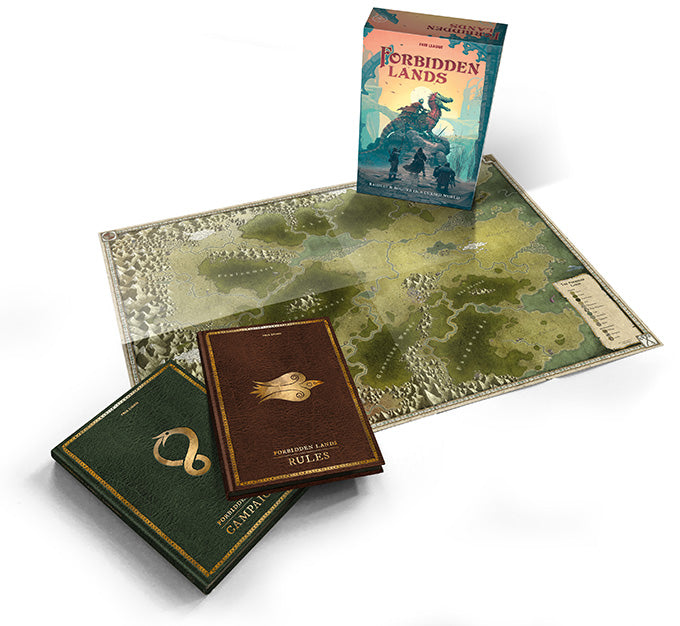
In the sturdy box you will get two hardcover faux-leather books, a Player’s Guide for the players to create their characters and get a handle on their role in the game, and a Gamemaster’s Guide to help the GM fill out the world; A booklet called Legends and Adventurers which helps with fleshing out characters; and a full colour map and a sheet of stickers so that the group can track their progress across the world and add the stickers to mark where they’ve been and what they’ve done.

It’s incredibly well presented. The books are incredibly satisfying to crack open for the first time and the thick pages, excellent black-and-white interior art and 1980s-like layout is really, really nice. It might not be for everyone; I first got into RPGs in the 1980s so this is all familiar, even comfortable, territory for me but the simple layout may not be the tastes of those used to glossy, full-colour interiors. Personally, I think this adds to the atmosphere.


The lore of the game is well thought out and gives the players impetus to get out there and explore. With a world of danger mixed with a little bit of darkness, the setting is something that players who like a bit of grim in their games will enjoy, while not being so dark it borders on the nihilistic. There’s plenty of scope for adventure. I’ll let Free League explain;

‘The core game setting of Forbidden Lands is a vast and remote valley once known as Ravenland, conquered by the spellbinder Zygofer over three centuries ago. When faced by the savage orcs, he opened dark gates to seek the help of demons. That was his undoing. Zygofer was lost to the darkness and he placed himself on the throne of the Ravenland, his daughter Therania by his side.

To keep their vile corruption from spreading, the king in the south built a great wall across the mountain pass and forbade all to ever speak of what had happened. Since that day, the spellbinder’s domain is known as the Forbidden Lands. Zygofer's henchmen, the feared Rust Brothers, still haunt the land, but the spellbinder himself has not been seen for many years. Fearful whispers say he has transformed into a demonic creature called Zytera.

Today, the Forbidden Lands it is a lawless place where demons and dark creatures roam the countryside, while common folk barricade themselves in small villages. Only the brave and the foolish, the raiders and the rogues, dare venture out to seek treasure and glory in the ruins of old.

Written by acclaimed fantasy author Erik Granström, the Forbidden Lands setting is rich and detailed, on the surface based on classic fantasy but with many surprising twists and secrets to discover during play.’

Sounds like a great time, right? Well, it really is. The setting is solid enough to draw you into a huge meta-plot you can get plenty of inspiration from while at the same time giving you enough leeway to explore the world in your own way. The system, inspired as it is by the flexibility of older games, can easily be used for a GM’s own campaign setting. The setting you get with the game is great, but there’s nothing stopping you from using your own - or even an established – setting.

Players can use seven races; Human, Half-Elves, Dwarf, Halfling, Wolfkin, Orcs, and Goblins. They can then choose from eight professions; Druid, Fighter, Hunter, Minstrel, Peddler, Rider, Rogue, and Sorcerer.

They have four attributes; Strength, Agility, Wits, and Empathy. With sixteen skills to choose from it may seem the characters are a little thin on detail, but there is plenty of material such as Talents, which give a character advantages during play, and choices to make sure the PC is fleshed out enough to be unique and fun to play.

The rules are straightforward and players of Free Leagues other games will be in familiar territory; roll a number of D6s, and any die resulting in a 6 is a success with a 1 being detrimental to the roll. The rules are simple and straight forward and easy to get into, even for players new to the system. It was easier for me and my group as we had experience with other games such as ‘Coriolis’ and ‘Tales from the Loop’.

But my reviews of games are never about the rules or how well they work as that is always subjective. The real question is, how did we get on with the game?

The characters were easy to set up – my group’s experiences in the golden age fantasy roleplaying games helped and it was fun to see this game’s take on classic races and careers – and within an hour we were set up and ready to go. We had the advantage of having played ‘Coriolis’ and ‘Tales from the Loop’, so the system was nothing new to use and all we had to do was get used to the tweaks and new approaches to the game engine.

Straight away the players were invested in the game setting. The struggle against a dangerous foe in power, the idea of exploring a land lost to them and being able to play in a game where they could basically look out for themselves and not get too hung up about an overbearing world meta-plot gave them plenty of drive to get out there and explore, delve and fight. I created a simple dungeon and a local legend for the players to get embroiled in and sent them on their way.

In fact, this game seemed to be more action-orientated than the two previous titles we’d played, and even though the game system handled the combat in the game well it was quite dangerous, and sadly the Half-Elf Hunter dies a rather ignoble death in the first hour of the game. Within fifteen minutes the unfortunate player had created a new character and rejoined the fray. The combat system certainly gave my players a reason to pause, and every possible encounter was met with a degree of uncertainty; there are some games where the players can be heroes and throw themselves into the fight with gusto but this game did not feel like one of those games. It was frustrating as the group tried to cover every angle to give themselves the best chance of survival, but it added drama and tension which is something the setting cries out for.

The system was agile and fun and quite easy to use, with very little bookkeeping or page-flipping, and with the players knowing what to do and when to do it - without having to read tables or rely on charts - encounters were easy and a lot of fun.

In fact, it was so much fun we made plans to integrate it into a future ‘Tales from the Loop’ game. We’d joked about what the child characters in the kid-driven sci-fi game would play, and this is it. If we ever sit down to play Tales from the Loop and there are any scenes in which the kids play an RPG, we’ll crack open the Forbidden Lands books and run a quick encounter in the vein of over-excited teenagers. It promises to be a lot of fun.

The game was a joy to play as most of my group are old-school gamers with fond memories of a particular age of gaming. The old-school feel was pleasant but the setting and the new story-driven way to get involved in a game felt very new, and it’s this coming together of the old and the new that gives Forbidden Lands it’s charm. There’s something in here for players young and old.

But let’s not get hung up on the charm the game offers; a system or a setting cannot survive on nostalgia alone, and to rely on that nostalgia to please old gamers does not do much for newer gamers wanting a new experience. Is the system and the world of Forbidden Lands enough to attract and retain players? It’s hard to say. For me it’s yes, because I enjoy the system and I love the setting and for other, newer players there’s a whole new world to explore. But what’s here that will bring new experiences to the table for everyone? That remains to be seen, but new material that Free League has available and in the pipeline promises much.

All in all, Forbidden Lands is an excellent game, setting and overall product. It’s productions values live up to what we expect from Free League, the box is sturdy and the contents are a lot of fun and, even though the books may be laid out in an old-school style, it’s a really attractive package.

The setting is dark and forbidding, but there’s enough room to create your own take and the system is flexible enough to create your own worlds.

The nostalgia is heavy for us older gamers and the story-driven world is attractive to newer players, but the game cannot exist on nostalgia alone so it remains to be seen how the game is supported by following material.

There’s something in here for almost every type of player. Enjoy your dungeon bashes? Love your exploration? Like to get involved in deep narratives? Forbidden Lands has you covered on pretty much every approach.

Forbidden Lands is a heady mix of old-school adventure and grim, dangerous journeys. Players can create three-dimensional characters with plenty of choices to make them unique, and the GM has plenty of room to inject their own material into the mix. There really is something in here for everyone, and gaming groups old and new will get a lot of satisfying gaming out of it.

Friday, 21 December 2018

Have a great Holiday, everyone

Farsight Blogger is on a break now until 2019, so have a great holiday and a Happy New Year!

Image result for cthulhu christmas
Image by Les Edwards

Wednesday, 12 December 2018

Greg Stafford's King Arthur Pendragon RPG returns to Chaosium ownership

Greg Stafford's King Arthur Pendragon RPG returns to Chaosium ownership: Tuesday, December 11, 2018 – For immediate releaseChaosium Inc, original publishers of Greg Stafford's King Arthur Pendragon roleplaying game, will once again become the owners and publishers of the game, it was announced today.All rights to KAP and the Prince Valiant story-telling game have been transferred from the ownership of Nocturnal Media to Chaosium.Greg Stafford, founder of Chaosium and creator of both games, passed away in October this year. The return of these titles to Chaosium has the blessing of Greg Stafford's wife Suzanne and his children. Steve Wieck speaking for Nocturnal Media on the transition of Pendragon back to Chaosium:

'There’s a story behind this story. In the early 1990’s, the staff of Chaosium were celebrating with a feast at Mader’s Restaurant in Milwaukee after a successful Gen Con. At the table next to them, the White Wolf staff also feasted on haunches of meat and steins of beer. My brother Stewart and Mark Rein Hagen, founders of White Wolf, stood and toasted Greg Stafford and the Chaosium crew, “Hail to Chaosium, the pioneers, the seers, the shamans, who ignited the flame of storytelling in our roleplaying hobby”, and the White Wolf table cheered their respect.Naturally, one cannot possibly out-do Greg Stafford, the creator of Pendragon, in matters of feasting etiquette. Thus Greg rose and toasted back with supreme humility, “We were merely keeping the fire lit through the cold... "

Jon Hodgson Launches Handiwork Games

This is great news - Jon Hodgson has created and helped create some amazing things over the years.

Jon Hodgson Launches Handiwork Games

Sunday, 2 December 2018

Cryptic old game design files #2

Once again, as I go through my old work, I find an unmarked file with a page of rules that I obviously designed as a simple skirmish game using a D6. A game I designed recently also uses a single D6, but it's not as simple as this and does not use a square grid for movement.

I think I designed this after playing D&D 4th Edition and enjoying the square grid layout. I can't remember, to be honest. I have a lot of love for single D6 games so this is probably one of many I dreamed up.

It's incomplete - I don't know how the special skills in the classes work, or how defensive combat works - but it seems usable. I might revisit this at some point in the future.

The last time I did anything with this file was Sun, 21 Apr 2013 at 21:46. I can't imagine what that would be for as I don't remember playtesting this at all. Perhaps it's something I could write up as two-page fantasy skirmish game. That might be fun.

~oOo~

ABILITIES

MOVE (How many squares they can move per round)
COMBAT
RANGED
STRENGTH

Each ability score has 3 points, can be changed by lowering one score to increase another, max score 5 min 1.

Roll 1D6 + Ability score

Ability Target number is always 6
Ranged target number is always number of squares, max 6.
Combat target number is opponents Combat score + 1D6

Each hit does 1 point of damage, reduced from STRENGTH score, reaching 0 means death.

CLASSES

Each class has a special skill that helps them with certain problems. Special skills are automatically at score 3.

SOLDIER - Breakdown
ROGUE – Trap mastery
SPELLCASTER - Magic
PRIEST – Defeat undead
RANGER – Precision aim


Each character has 5 equipment slots – if they go over this then MOVEMENT, COMBAT and RANGED are reduced by 1 point for every extra item.

Characters can take:

SWORD
SHIELD (gives +1 to defensive COMBAT rolls)
BOW
ARMOUR (first point of armour uses one slot every 1 point of armour over that reduces MOVEMENT, COMBAT and RANGED by one point and uses up a slot - gives +1 to defensive COMBAT rolls)

Wednesday, 21 November 2018

[Preview] 'Forbidden Lands' from Fria Ligan

I have been perusing the new Forbidden Lands roleplaying game by Fria Ligan, a fantasy game where you play 'raiders and rogues bent on making your own mark on a cursed world'.

I have played two other Fria Ligan products, the amazing 'Coriolis' and the wonderful 'Tales from the Loop', and both games left quite an impression on me. The quality of Fria Ligan's products and the presentation in their games is of an incredibly high standard, and this game is no different.

After the beautiful full-colour illustrations and dynamic layout of the the two previous games I have played, the thing that strikes me with this game is the black and white interiors and the stark, black and white illustrations. In fact, the book has a very old-school feel about it which I find very appealing, being the *ahem* age that I am, and makes the game very clear and easy on the eye. The artwork is excellent and very stylised, and really helps to capture a unique atmosphere that helps to make the game stand out.

And the system? It's a variation of the six-sided die system we've seen in previous games but there's the addition of a D8, a D10 and a D12. There is also a custom card deck available that helps theg ame run more smoothly, but apparently these are not needed for play.

This has been a general read-through of the book and I'm impressed. There's not a lot of detail I want to go into right now as I'll be doing a full review of the game once I've played it, and I don't want to make assumptions without playing thegame properly. However, I think this will be an easy sell to my gaming group as it has the normal fantasy tropes - you can play the standard different races as well as a couple of new ones, and there are classes to choose from, too - but there's a dark twist to the setting that appeals to me as a GM.

Look out for my full review in the future.

'In Forbidden Lands, you and your friends will be playing raiders and rogues bent on making your own mark on a cursed world. Discover lost tombs, fight horrifying monsters, wander the wilderness and, if you live long enough, build your own stronghold to defend.

Forbidden Lands is a legacy game, in which your actions will permanently change the game map, turning it into a living chronicle of your adventures. The unique rules for exploration, survival, base building and campaign in Forbidden lands play can easily be ported to any other game world.

The tabletop RPG Forbidden Lands was named one of the most anticipated RPGs of 2018 by EN World. The crowdfunding campaign raised over a quarter of a million dollars and was the third most successful RPG Kickstarter in the world 2017.


The game is the fourth English tabletop RPG from the Swedish developers Free League Publishing. With art by the internationally acclaimed artist Simon Stålenhag and iconic fantasy artist Nils Gulliksson, lore by fantasy author Erik Granström, scenarios by esteemed game writers such as Patrick Stuart, Ben Milton and Chris McDowall and game design by Free League that created the award-winning RPGs Mutant: Year Zero, Coriolis: The Third Horizon, Symbaroum and Tales from the Loop.

The core boxed game set includes the Player's Handbook and the Gamemaster's Guide - two hardcover books with leather and gold covers, totaling over 450 pages - along with a large full-color map, a sheet of map stickers, and a booklet of tables.'


Saturday, 17 November 2018

Equipment design in RPGs

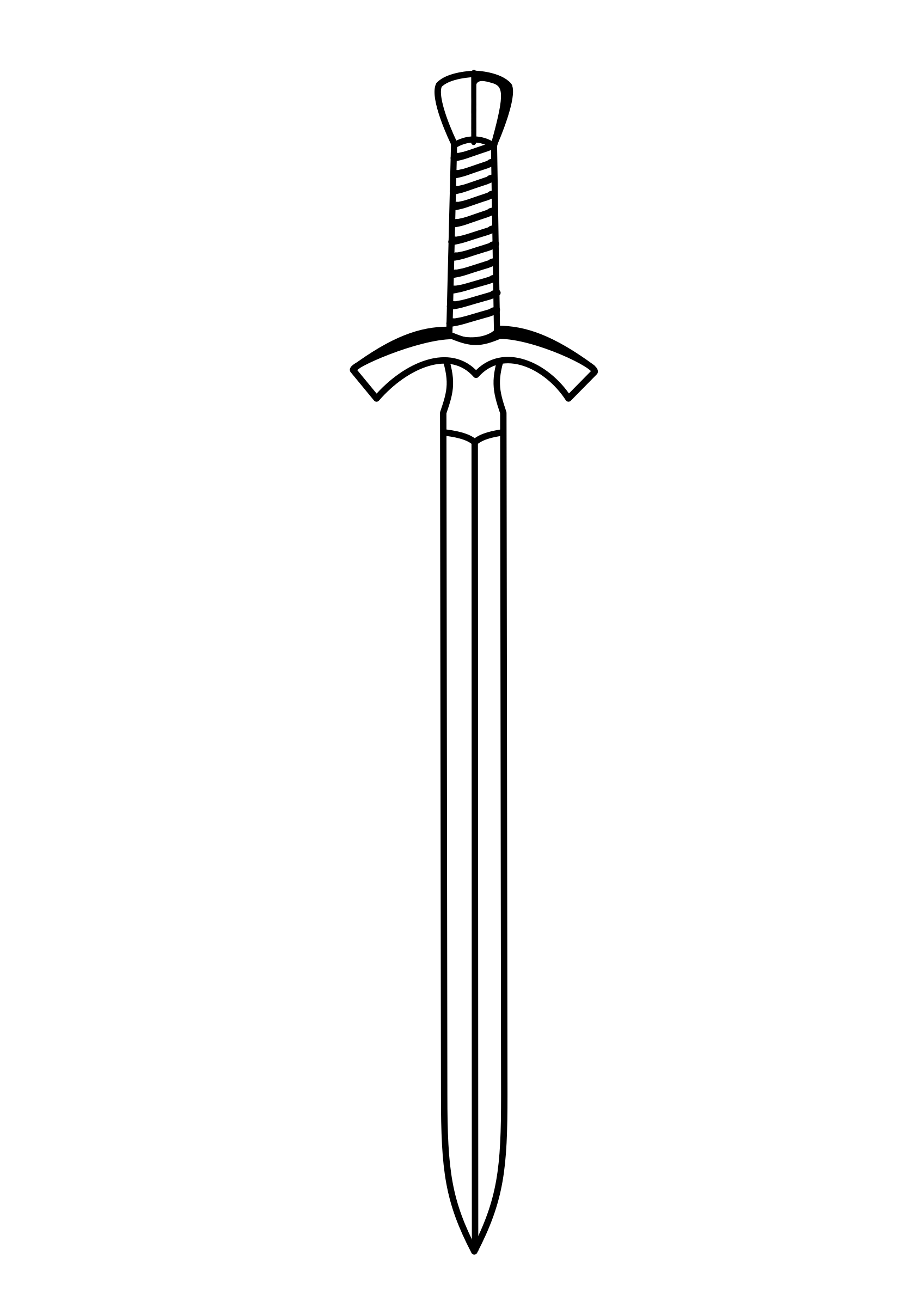
Two-edged Sword by D4v1d
This is a few thoughts I've had on equipment design in RPGs over the years, and how Player and GM designs can change a game. I wasn't interested in specific equipment design as that's a discussion that will vary from group to group and game to game, but I was more interested in how designs can either unbalance a game, give unfair advantages or simply decide situations from the outset, making incidents and encounters dull and predictable.

Roleplaying games wouldn’t be where they are today without players. Players wouldn’t be where they are today without their characters. Characters wouldn’t be where they are today without their equipment because, let’s face it, walking into a scenario with nothing to hand is usually a no-no. You need the tools of your trade to do your job, and without tools there’s not much of a chance of success. Or maybe even survival.

Equipment is a major part of a roleplaying game. Just look at the equipment available in any game and in various sourcebooks and game packs – there’s whole lists of bits and bobs that’ll help the average character get through the day.

One of the bonuses of many games is that it allows GMs to design all kinds of stuff to suit their campaign and gaming group. There’s always going to be situations where the GM or even the players come up with an idea for a new gadget – the problem facing the game is ‘will this gadget make things too easy for them?’

The last thing you want is for a specialised piece of equipment to ruin the balance of a well-designed scenario or campaign. Having the players run into a situation where the swing of a magical sword or the toss of a special grenade gets them out of it in no time at all will not only ruin the pace of the story but it will soon make things dull and unexciting.

‘Twenty Stormtroopers! What shall we do?’ 
‘Don’t worry! I’ll use my never-failing multi-target-repeat-hand blaster to stop them all!’ 
‘Oh. Great.’

STRIKING THE BALANCE AS A PLAYER

Each and every GM and player have their own idea about what would make a handy piece of equipment. You could design a top blaster or a magical axe; everyone has their own ideas as to what will help them get through an adventure. Most will have more than one idea.

As overall referee of a game, the GM must take into consideration what effects a special piece of kit would do. If they’ve designed an incredible security kit that pretty much adds amazing bonuses to a character’s roll and gets them into anything, that might be fine for a couple of adventures. But what about later on down the campaign trail, when the story might call for the players to stay out of certain areas or help them get out of tight situations too easily? What the GM and players have to realise is there has to be a balance between what the item is capable of and what its limitations are. For every bonus it gives a character it must have a flaw  or drawback somewhere, which may make the player loathe to use it or it doesn’t work as well in certain situations. This will make the items special but also keep the game in balance so that the characters don’t breeze through every situation they’re placed in.

For example, let’s say that Brian, a regular player in Bob’s Star Wars D6 games, decides that he wants his character to have a special targeting system that wires from his blaster’s scope to a pair of goggles he wears.

‘Good idea,’ says Bob, ‘what kind of bonus were you thinking of?’
Brian: ‘I’m thinking of additions to my weapon skill.’
Bob: ‘That’s fine. You can either have a high addition but it doesn’t work well against moving targets, or you can have a lower addition which can only be used with one type of blaster.’
Brian: ‘Fair enough. I’ll go for the higher addition, which is only effective against static targets. What about range?’
Bob: ‘Low range at no penalties, or high range at… let’s say…’
Brian: ‘Every time I shoot there’s a one in six chance of the system failing?’
Bob: ‘Sounds good. It’ll cost you three times the value of your blaster.’
Brian: ‘I’ll take it.’

Or:

Belinda decides she wants to purchase a special type of medical unit. She sits down with Bob and they go over the details.

Belinda: ‘What I want is a medical pack that can be used several times and add bonuses to my medical skills.’
Bob: ‘No problem. We’ll say it’s like any other medpac but can be used six times. It can only be used on certain types of species, mind you. We’ll say four different kinds, so that will cover the other players and one NPC.’
Belinda: ‘What about the size of it?’
Bob: ‘It’ll have to be quite large, like a field pack.’
Belinda: ‘I was hoping it could be smaller.’
Bob: ‘Okay… how about it’s the size of a small pack, but because it’s small and delicate it’s prone to damage, say, a two in six chance of it being damaged every time you fall or whatever.’
Belinda: ‘Good.’

STRIKING THE BALANCE AS A GAMESMASTER

Balancing what the character’s equipment can and can’t do, along with it’s usefulness in a game and it’s chances of failure is something best discussed with the players so that you can get an idea of exactly what they want. Of course, you won’t be discussing these things with the players all the time – what if there’s an NPC you’re designing who you want to have a specially designed item?

The first instinct is to design an item that gives the NPC a bonus and then presents a challenge to the players, and that’s fine. A long-range blaster with a great scope, a small tracking device that tracks the players movements, a special grenade that damages organic material and not inorganic – these things would make a great challenge. The only thing is, if they use these items the players will be wise to them, which also means that when and if they defeat the NPC, the special item will fall into the hands of the players! The same bonus-drawback balance has to be reached with NPCs as with PCs – don’t be tempted to simply throw in an extra-special piece of equipment just to make things difficult for the players. It may backfire (so to speak).

NEW STUFF

This doesn’t just apply to modified equipment that exists within the game system. There may be items the players want to create from other sources or from scratch to help their characters out.

Brian: ‘I want a wrist unit to shoot a sticky web-like substance so I can swing about like Spidey’.
Bob: ‘What the…!’

Don’t panic – simply figure out how that item will fit into the game system and then apply any rules that you see fit and that the player won’t feel cheated on. The pros and cons system still applies so make sure that whatever is designed is, at first, even possible.

And then work out the bonuses and drawbacks.

Bob: ‘Okay, the wrist unit can shoot a long stream of synthetic liquid, like a synthrope but more elastic, up to a range of fifty meters, and can lift up to five hundred pounds.’
Brian: ‘Sounds good.’
Bob: ‘But… it dissolves in water, so it’ll be useless in rain. It’ll cost double the cost of a normal synthrope and launcher.’
Brian: ‘That’s fine.’

But there will be some things that will have to refused straight off the bat;

Brian: ‘I also want some shrug-off-short-range-heavy-blaster-bolts armour’.
Bob: ‘Don’t count on it, bub’.

So, as long as you remember what equipment you give out must balance with both performance and the game you have designed then you shouldn’t have any problems. There will be times in a game when an item will save the day – this is unavoidable and, let’s face it, it’s probably what the item was designed for - but if this item saves the day every time then it may be time to reconsider it's inclusion.

You could even make a campaign out of it; if the equipment is so incredibly good, what will NPCs do to acquire it from the player characters? What will the players do to get it back?

Sunday, 11 November 2018

Cryptic old game design files

I do a lot of writing and designing for games and sometimes I'll have an idea for something, type down some notes really quickly so that I don't forget the idea I had, and then promptly forget that I had the idea in the first place.

There are dozens of files on my computer regarding these types of things, to rules ideas, skirmish game designs, adventure notes and general random thoughts on gaming. I've found entire unfinished articles, long detailed world histories and brief character designs, some of which mean nothing to me now but were no doubt incredibly important when I wrote them.

This is both a great thing and a bad thing; great because I've got loads of material I can look back on and mine for ideas, bad because most of it I can't even remotely remember why I wrote the stuff and how it was going to be used. It was obviously important at the time, but not so important that I remember the details five, ten or even twenty years down the line.

Below is an example - I'm sure that I wrote this small D&D conversion to use the red box basic D&D material with elements of the D&D 3rd Edition design. I remember that at one point that I wanted to capture what I loved about old D&D and use the modules but do away with THAC0 and some of the elements of Saving Throws, as well as simplify the experience method. The terrible thing is that not only do I not remember writing this, but I'm even doubting that I wrote it at all, and that these notes are someone else's work that somehow ended up on my computer. However, I do remember creating the character sheet.

If this is of any use to you then go ahead and use it, although there are plenty of OD&D and OSR games that do this already. I have not corrected any abbreviations or errors and this is how it was on my computer.

-oOo-

WHAT YOU WILL NEED FOR THIS GAME:

Basic, red box D&D was the basis for this game, but any old OSR along those lines will do. Bear in mind that the attack rolls do not use THAC0 but the roll target number of 10+AC from 3rd Edition onwards.

ATTRIBUTE ROLLS

You can use the standard 3D6 roll for each attribute, or you can roll 4D6 and discard the lowest number. Add up the remaining three numbers and that is the score you can put in an attribute. Do this six times, once for each attribute. You can then decide which attribute receives which score based on the kind of role you want to play.

Attribute bonuses apply using the following chart:

Attribute Score / Adjustment
3 / -3
4-5 / -2
6-8 / -1
9-12 / 0
13-15 / +1
16-17 / +2
18 / +3

Roll 1D8 for hit points, or 1D4 + 4 if you want better odds.

ADJUSTMENT SCORES:

STRENGTH – bonus to CQ to-hit and damage rolls
INTELLIGENCE – for each +1, choose an extra skill
WISDOM – bonus to WILL saving throw
DEXTERITY – bonus to Rng to-hit score, bonus to REFLEX saving throw
CONSTITUTION – bonus to hit point score, bonus to FORTITUDE saving throw
CHARISMA -

SAVING THROWS

The saving throws 'Fortitude', 'Reflex' and 'Will' are scored at 10 plus the applicable attribute bonus. Fortitude uses the Constitution bonus, Reflex the Dexterity bonus, Will the Wisdom bonus. A successful saving throw is a D20, scoring less than the saving throw score.


COMBAT

Attack rolls are D20 plus the relevant Attack Bonus. Rolling high, the initial target number is 10 or the target’s Reflex saving throw for a successful hit. This is modified by armour, raising the target number, making it more difficult to hit.

The STRENGTH adjustment score modifies hand-to-hand to-hit and damage rolls.

The DEXTERITY adjustment score modifies ranged to-hit scores.

Armour class is based on normal armour in the book but reversed:

Leather: 3
Chain: 5
Plate: 7
Shield: +1 AC

SKILLS

Each player is given three points. They can use a single point to raise an 'Attack Type', this being either Ranged (Rng) for pistols and thrown weapons or Close Quarters (CQ) for fists and hand weapons. Each point spent gives a +1 bonus to their attack roll.


CHARACTER ADVANCMENT

Characters start at level 0 and they must complete the same number of adventures for the level they want to attain. So, when they complete one adventure they go to level one. When they complete two more adventures they go to level two, when they complete three more adventures they go to level three and so on. (or, you can use the experience point system as normal).

For every level the character attains they get another single point to do ONE of the following:

Spend on either one of the attack bonuses
Roll another 1D8 for more hit points.
Add one point to a saving throw score (every 5 levels)


Monday, 5 November 2018

[Interview] Joseph A. McCullough and 'Rangers of Shadow Deep'

Joseph A. McCullough bought us the excellent 'Frostgrave' and 'Ghost Archipelago' skirmish games, and now he delves into dark fantasy with 'Rangers of Shadow Deep'.

I had a quick chat with Joseph about the new game.

'A kingdom stands on the brink of destruction, as the vast realm called the Shadow Deep slowly swallows everything in its path. As the army fights to contain the tide of evil creatures teeming up out of the black clouds, the kingdom’s best soldiers, the rangers, must venture down into the shadows to gather information, rescue prisoners, and ambush enemy supply lines. It is a desperate fight against overwhelming odds, but every little victory brings another day of hope.

Rangers of Shadow Deep is a solo and co-operative tabletop miniatures game, in which players create their ranger, gather companions, and play through a series of missions in their fight to hold back the darkness. If their rangers survive, they will grow in power and ability, and be sent on more difficult, dangerous and intricate assignments.

This book also includes the first supplement for the game, Burning Light. In this mission, the rangers must venture to ruined convent, searching for an ancient artefact. As they choose what order to explore the ruins, and thus the order in which scenarios are played, they must gather clues to the artefact’s location. But they must be quick, for the longer they remain, the more the forces of the Shadow Deep become aware of their presence.'

'Rangers of Shadow Deep' is now available at RPGnow.com and is already making a splash. What was the genesis of the game?

It really started with the words ‘Shadow Deep’. It just popped into my head one day, and then I started wondering what it was. Once I started to realize what a dangerous place it was, I started to wonder who would go down there…hence the rangers. For a while now, I’ve been interested in seeing if I could push wargaming a bit closer to role-playing and to see if I could write a game that really worked for solo and cooperative play. While I could have done this with one of the games I’ve already created, I thought it would be easier to build such a game from scratch than to tack it onto an existing game. So, it was just a case of putting my new setting idea with my game design ambitions.

Image may contain: one or more people

You describe it as a 'solo and co-operative tabletop miniatures game'; what makes 'Rangers of Shadow Deep' different from all the other miniature games available?

I think Rangers really is a hybrid wargame/rpg. You still play the game by pushing figures around on the table, but it isn’t all just about fighting. Some missions are about gathering information, solving little puzzles, rescuing people, and exploring the Shadow Deep. Skills play a big role in the game, and some of the missions use hidden information, so that players really are forced to explore.

Also, the game has a real narrative to it. This is reflected in how the characters grow and develop during the campaign, but also that the world is growing with them. Each mission pushes the whole narrative a little further.

Your previous games are the award winning 'Frostgrave' and the fun 'Ghost Archipelago'. They were very focused player vs player games, so how did you approach the design of this co-operative game?

I have used those games to experiment with solo and cooperative, and those experiments taught me a lot. However, in both of those games, the protagonists can use their powers an unlimited number of times. I think for solo play, it is much more interesting to give the heroes limited powers, than can only be used once each scenario. This brings a lot more decision-making into the game. Do I cast this spell now, or do I save it for later? Also, by adding skills to the system, it means there are a lot more ways to interact with the table. Want to go into that house – you need to make a Pick Lock Roll to open the door, or a Strength Roll to break it down. It forces the player to really think about which figures he is going to send to which areas of the table.

Finally, I wanted to make sure that each game is really telling a story, and that the players feel like they are part of that story. Rangers of Shadow Deep is about a war, and the player have a real chance to effect the outcome of that war.

The game leans much further towards defined characters, making them more than just a playing piece on the tabletop. How can 'Rangers of Shadow Deep' be used as an RPG?

In truth, I think Rangers sits right on that line where RPGs and Wargames meet. You could actually discard the miniatures and I think you would still have a pretty robust set of RPG rules. If you added a games master you could easy expand the game to include what happens between the specific missions. The ‘world’ is a little bit lite at the moment compared to most RPGs, but that will change.

Is there a larger world to explore? Will there be supplements and additions in the future to expand on the kingdom and the lore?

Absolutely. I’ve nearly finished the first supplement, Temple of Madness, which expands some of the magic rules and includes a 4-scenario mission. We learn a little bit more about the Kingdom of Alladore in it, and a bit more about the Shadow Deep as well. And that’s how I plan to approach it - little by little. That way the players get to learn more about the world in the same time that their characters will be learning about it as well.

Image may contain: one or more people

The background to the game is really intriguing and somewhat dark; is the game solely for use in the world you have created or can it be used in other ways?

I think the world would be a great setting for an anthology of sword and sorcery or dark fantasy short stories. And, as we talked about above, it would be very easy to convert the game over to a true RPG. I have even spoken with a couple of people about using it as the basis for a board game. I think there are a lot of directions it could go, but for the moment, I want to finish up work on the core game. We are still working on getting the print-on-demand set-up, and getting Temple of Madness ready to go.

Images used with permission