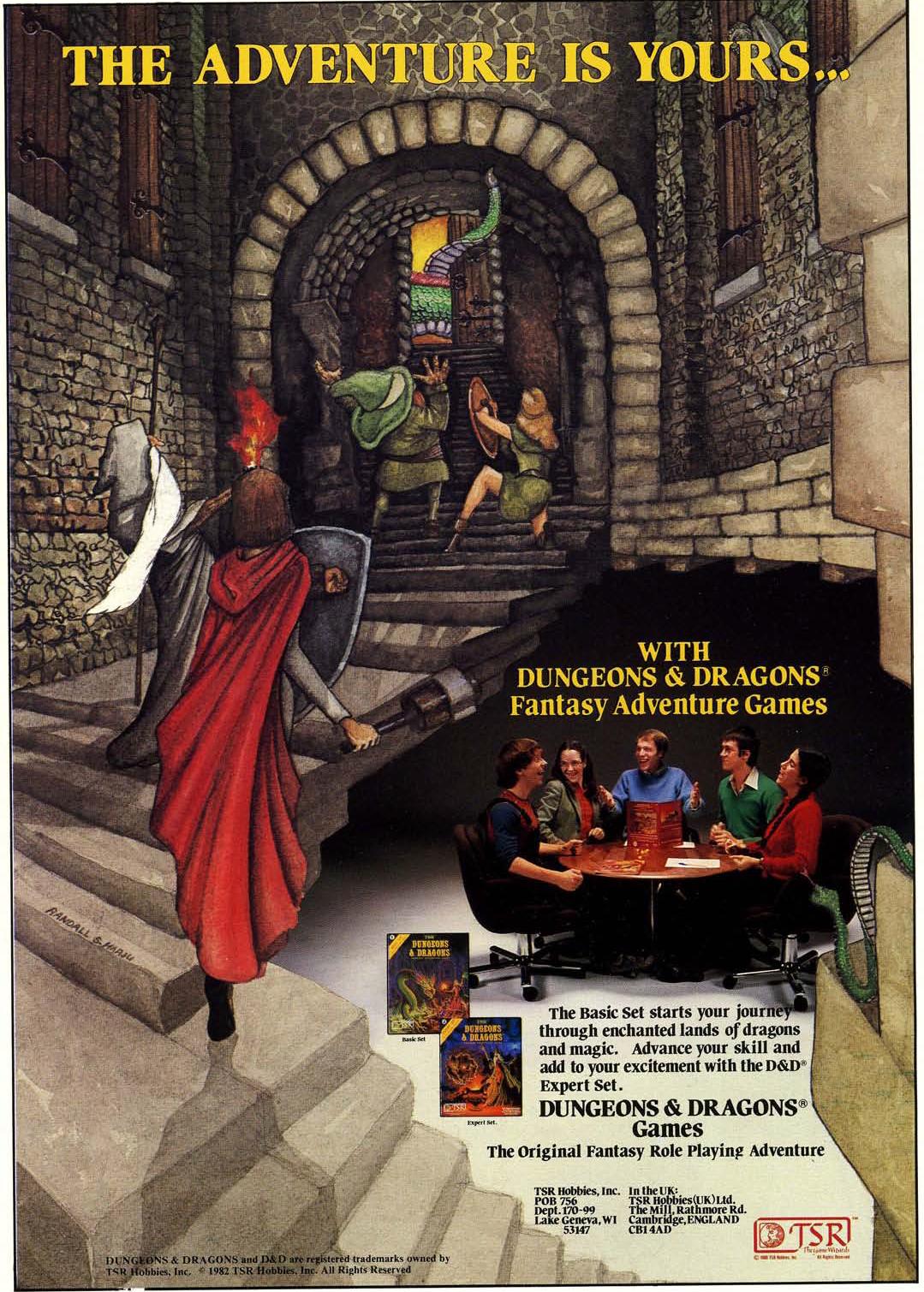
The 'Endless Quest' books were a lot of fun but I was well immersed in my Fighting Fantasy gamebooks by the time I got around to playing my first one. I liked the rules of the Fighting Fantasy books, and it was my gateway to proper roleplaying, but I always remembered this ad. I know that this one in particular was from the magazine 'Imagine'.
Ah, Citadel miniatures. My go-to range for all my miniature needs. Before they went total Warhammer they had probably the best range on the market and I had a foam-lined fold-out toolbox full of them. I was always rubbish at painting the things, so my entie collection was pretty much silver. I also used to get the catalogues and cut out the pictures, mount them on cardboard and stick them to one pence pieces for bases. They made really good little playing pieces. These days, of course, you can print out full-colour counters but back then we made do, and these cut-out miniatures proved perfect as stand-ins until we had enough pocket money saved to buy the real things.
Wednesday, 18 April 2012
Sunday, 15 April 2012
My favourite RPG advertisements from days of old...
I've just found a folder on my computer called 'Old RPG Ads', and it appears I created it back in May of 2005. I appear to have gathered all kinds of scans and photographs of old advertisments from gaming magazines of the early eighties, primarily magazines such as White Dwarf, Imagine and Dragon. I thought I'd spend a few blog entries sharing what I've got with you.
This one above makes me feel about 13 years old, when I hadn't properly gotten into gaming but always wondered what this game was about. The old-school layout and appearance just screams 1980s to me, and makes me want to go to the long demolished toyshop that used to be in our local shopping centre and buy the red box again, whilst marvelling at the miniatures.
This one is well put together and would have definitely sold me on the game, although it appears the players around the table have forgotten their characters sheets but are obviously having a bit of a laugh about it.
This one I remember extremely well but it would be a long while before I got into Advanced D&D, and in turn be put off the game for twenty years. I've recently picked up the 2nd Edition books again and I realise now what I missed out on. The Birthright setting alone would have kept me in campaigns for a decade!
I'll post some more another time. I love these trips down memory lane and advertsiements like this were an important part of our hobby pre-internet. Now we're bombarded by ads, videos and animated banners, so much so that the heart is a little sucked out of new advertisements. Of course, these old ones are cheap and charming but it's all we had back in the day and it's what wet our appetites.
This one above makes me feel about 13 years old, when I hadn't properly gotten into gaming but always wondered what this game was about. The old-school layout and appearance just screams 1980s to me, and makes me want to go to the long demolished toyshop that used to be in our local shopping centre and buy the red box again, whilst marvelling at the miniatures.
This one is well put together and would have definitely sold me on the game, although it appears the players around the table have forgotten their characters sheets but are obviously having a bit of a laugh about it.
This one I remember extremely well but it would be a long while before I got into Advanced D&D, and in turn be put off the game for twenty years. I've recently picked up the 2nd Edition books again and I realise now what I missed out on. The Birthright setting alone would have kept me in campaigns for a decade!
I'll post some more another time. I love these trips down memory lane and advertsiements like this were an important part of our hobby pre-internet. Now we're bombarded by ads, videos and animated banners, so much so that the heart is a little sucked out of new advertisements. Of course, these old ones are cheap and charming but it's all we had back in the day and it's what wet our appetites.
Computer game strategy guides as sourcebooks
I've picked up some very cheap strategy guides for computer games recently, namely 'Warhammer Online: Age of Reckoning' and 'Dragon Age II', and even though I've played both games I never bought them for the help they'd give me.
What I got in the books were detailed maps, characters, weapon ideas, adventure and quest ideas, illustrations and a whole slew of new ideas. The books are like system-generic sourcebooks and, even though I won't be using them in the settings they were intended for, there are plenty of bits and bobs in there I can use for my current Pathfinder game.
Once games have been out for a long time and the strategy guides become pretty useless you can find them in all kinds of places - charity shops, second-hand bookshops, discount bookstores and the like. They might not be an accurate fit for your game but there's bound to be something in there that you can cannibalise. I think I'll be seeking out more cheap books like this in the future to help flesh out my home-made roleplaying campaign settings.
What I got in the books were detailed maps, characters, weapon ideas, adventure and quest ideas, illustrations and a whole slew of new ideas. The books are like system-generic sourcebooks and, even though I won't be using them in the settings they were intended for, there are plenty of bits and bobs in there I can use for my current Pathfinder game.
Once games have been out for a long time and the strategy guides become pretty useless you can find them in all kinds of places - charity shops, second-hand bookshops, discount bookstores and the like. They might not be an accurate fit for your game but there's bound to be something in there that you can cannibalise. I think I'll be seeking out more cheap books like this in the future to help flesh out my home-made roleplaying campaign settings.
Saturday, 14 April 2012
GAMMA CON supports Oxfam - June 10th
We're proud to be supporting Oxfam Book Shop in Lichfield this June 10th - pop in and see me from 11:00 am and let me look after any of your old RPG books or sci-fi and fantasy novels. Oxfam will make sure they go to a cracking home. Go in to any Oxfam store across the nation anddonate and make a difference!
Planning for The RPG Intro at Oxfam Book Shop in Lichfield, UK has now begun and we're looking to run some small games for the younger generation, so if you've got any young kids, relatives or friends you'd like to introduce to the tabletop roleplaying hobby then head over to the website for details or find out how to donate. You can also spread the word by clicking 'Like' on our Facebook page. Lets kill two birds with one stone and lets donate to a worthwhile charity whilst supporting the growth of our favourite hobby!
Friday, 13 April 2012
Dual GMing
I ran a Pathfinder game last night and, as I'm not 100% up to speed with the rules, I asked the more knowledgable players to help me out. Jason, a long time gaming collaborator and close friend, helped me out with some rules interpretations and was a great help during combat. Did he stack the odds in his favour? I don't think so. A fight between five 1st-level PCs and a badly wounded troll went quickly, smoothly and was a lot of fun for all of us.
Did I mind Jason helping me out like this, co-GMing the game? As far as rules are concerned, not at all. I needed the help and with everyone else knowing a lot about the game it was handy I had someone on hand to talk about the rules as well as page-flip as I dealt with other players. I'd have drawn the line at actual rulings but there was none of that, and the few rolls he asked to make didn't unbalance the game at all.
All in all it was a positive experience. I trust him to be right and I hope he trusts me to unfold a good adventure, and having some of the pressure taken off my shoulders was a massive relief. I'm looking forward to next week, now, as it's been a while since I ran a game with a complicated system in which I didn't need to stall the game as I made rulings from an encyclopedic rulebook. It honestly felt like I was running a rules-lite game with a rules-heavy system.
Did I mind Jason helping me out like this, co-GMing the game? As far as rules are concerned, not at all. I needed the help and with everyone else knowing a lot about the game it was handy I had someone on hand to talk about the rules as well as page-flip as I dealt with other players. I'd have drawn the line at actual rulings but there was none of that, and the few rolls he asked to make didn't unbalance the game at all.
All in all it was a positive experience. I trust him to be right and I hope he trusts me to unfold a good adventure, and having some of the pressure taken off my shoulders was a massive relief. I'm looking forward to next week, now, as it's been a while since I ran a game with a complicated system in which I didn't need to stall the game as I made rulings from an encyclopedic rulebook. It honestly felt like I was running a rules-lite game with a rules-heavy system.
Wednesday, 11 April 2012
D&D 3.5 / Pathfinder NPC Generator
I'm lazy by nature, and anything that saves me time creating and preparing for a game is a good thing in my book. Now that I've wrapped up my Dragon Warriors games I'm having a stab at Pathfinder, and trying out a new way of campaign world generation that I'll cover in a later blog entry, but right now I'm impressed with this, an NPC generator I found at www.dinglesgames.com.
It's quick and easy to use and, even though it does take some of your creative input out of the NPC, you can tweak it if you want to. It's certainly saved me a lot of prep time and I heartily recommend it.
Monday, 9 April 2012
The Original Star Wars Roleplaying Game: Why It Worked So Well
When West End Games released ‘Star Wars: The Roleplaying Game’ (SWRPG) in 1987 it was part of the celebrations for the first ten years of the franchise. Ten whole years, and Star Wars was still very popular. It had been four years since The Return of the Jedi had been released in cinemas and the only other media fun to be had were the Droids and Ewoks cartoons.
When SWRPG hit the shelves it was a golden age for roleplaying games. They had matured greatly since the 1970s and there were a plethora of games to choose from. Star Wars, being a new roleplaying game and a holy grail for fans who were drooling at the mouth for more Star Wars material, was an instant success. The simple and free flowing D6 system, which could be modified for any kind of playing style a gaming group wished for, was perfect for the setting and the use of official images from the three movies only served to heighten the enjoyment. Players felt they were taking part in a living, breathing Star Wars adventure.
And that was just the beginning. When West End Games released their first sourcebooks the fans, both gamers and general fans alike, could now see the inner workings of the setting they loved. Not only that, they utilised concept designs that had been created for the original movies and gave them statistics and names; now those unused designs for speeder bikes, starships and weapons were being given purpose. The Star Wars universe had names, details and histories. Suddenly, the Star Wars universe was very real.
The material was all sanctioned by Lucasfilm, which made the designs and histories official. In fact, they were so well regarded that they became the initial foundations for what became the Expanded Universe, so much so that when Timothy Zahn came to write the Heir to the Empire novels he was given a pile of West End Games books and informed that he should use it for background details. The SWRPG had become the go-to source for new Star Wars material for a myriad of authors and artists, and in turn the SWRPG reproduced their resulting creations for the roleplaying game.
What made the game so successful and such a joy to play was its accessibility. For a start it had the fact that it was Star Wars going for it, and everyone wanted to be in Star Wars. The images the first edition rulebook used immediately took you to the Star Wars universe, and the great thing was that when playing you didn’t have to describe what a Star Destroyer, an X-Wing or a Stormtrooper looked like or what they represented – everyone knew the basics, even those not totally versed in the setting. The rulebook was incredibly well written and introduced new players to the hobby with ease and offered some amazing beginner’s advice and it was written in a friendly, easy manner that was a joy to absorb because it was obvious the guy writing it was enjoying every minute of it. The original game was easy to master and play, used general six-sided dice so new gamers wouldn’t get confused by all those strange polyhedrals, and suited the pulp adventure and cinematic action style perfectly. The rules covered everything from aliens, droids, blasters, using the Force and flying starships. You could do absolutely anything you wanted in the Star Wars universe in any style you chose. It was the perfect sandbox game system for the perfect sandbox science fiction setting. Star Wars: The Roleplaying Game came along at just the right time, when Star Wars was still young and, now that the movies were over, there was a universe out there that the fans wanted to explore. With the SWRPG they could not only read up on the larger Star Wars galaxy as fans they could also experience it as roleplaying gamers.
The first edition of the SWRPG, as it was released in 1987, is in many ways the perfect iteration. The game saw a second edition in 1992, and an excellent revised and expanded edition in 1996, but these game bloated the rules slightly and added more options. The rules weren’t the greatest focus in the original game, the aim was to get stuck in and have some fun and, as such, gamers could mould and change the system to suit their games and make it as complicated or as rules-light as they wanted.
With all this material, product identity, easy-to-learn rules and a wonderful rulebook that oozes sheer enjoyment of the game and setting that’s perfect for new and experienced gamers alike, what’s not to love? If re-released it would be a wonderful way to bring new gamers into the hobby and there’s more than a decade of material to cannibalise and adapt to suit the Star Wars universe as we know it now, as well as plenty of new material to write for the those who already have the D6 collection.
Of course, the odds of this happening are approximately 3,720 to 1.

When SWRPG hit the shelves it was a golden age for roleplaying games. They had matured greatly since the 1970s and there were a plethora of games to choose from. Star Wars, being a new roleplaying game and a holy grail for fans who were drooling at the mouth for more Star Wars material, was an instant success. The simple and free flowing D6 system, which could be modified for any kind of playing style a gaming group wished for, was perfect for the setting and the use of official images from the three movies only served to heighten the enjoyment. Players felt they were taking part in a living, breathing Star Wars adventure.
The material was all sanctioned by Lucasfilm, which made the designs and histories official. In fact, they were so well regarded that they became the initial foundations for what became the Expanded Universe, so much so that when Timothy Zahn came to write the Heir to the Empire novels he was given a pile of West End Games books and informed that he should use it for background details. The SWRPG had become the go-to source for new Star Wars material for a myriad of authors and artists, and in turn the SWRPG reproduced their resulting creations for the roleplaying game.
What made the game so successful and such a joy to play was its accessibility. For a start it had the fact that it was Star Wars going for it, and everyone wanted to be in Star Wars. The images the first edition rulebook used immediately took you to the Star Wars universe, and the great thing was that when playing you didn’t have to describe what a Star Destroyer, an X-Wing or a Stormtrooper looked like or what they represented – everyone knew the basics, even those not totally versed in the setting. The rulebook was incredibly well written and introduced new players to the hobby with ease and offered some amazing beginner’s advice and it was written in a friendly, easy manner that was a joy to absorb because it was obvious the guy writing it was enjoying every minute of it. The original game was easy to master and play, used general six-sided dice so new gamers wouldn’t get confused by all those strange polyhedrals, and suited the pulp adventure and cinematic action style perfectly. The rules covered everything from aliens, droids, blasters, using the Force and flying starships. You could do absolutely anything you wanted in the Star Wars universe in any style you chose. It was the perfect sandbox game system for the perfect sandbox science fiction setting. Star Wars: The Roleplaying Game came along at just the right time, when Star Wars was still young and, now that the movies were over, there was a universe out there that the fans wanted to explore. With the SWRPG they could not only read up on the larger Star Wars galaxy as fans they could also experience it as roleplaying gamers.
The first edition of the SWRPG, as it was released in 1987, is in many ways the perfect iteration. The game saw a second edition in 1992, and an excellent revised and expanded edition in 1996, but these game bloated the rules slightly and added more options. The rules weren’t the greatest focus in the original game, the aim was to get stuck in and have some fun and, as such, gamers could mould and change the system to suit their games and make it as complicated or as rules-light as they wanted.
With all this material, product identity, easy-to-learn rules and a wonderful rulebook that oozes sheer enjoyment of the game and setting that’s perfect for new and experienced gamers alike, what’s not to love? If re-released it would be a wonderful way to bring new gamers into the hobby and there’s more than a decade of material to cannibalise and adapt to suit the Star Wars universe as we know it now, as well as plenty of new material to write for the those who already have the D6 collection.
Of course, the odds of this happening are approximately 3,720 to 1.
Thursday, 5 April 2012
...and that's that
I've really enjoyed writing about my game-changing experiences this last month and a half but I think that particular chain of blog posts has run it's course. They were fun to write but I'm leaning towards getting back into being a bit more random.
Thanks for sticking with them and thanks to those who made comments or sent me messages. I'll see about dreaming up another series of blog posts in the near future. If anyone has got any recommendations as to what would make a good series then let me know.
Wednesday, 4 April 2012
‘You lookin’ at me?’
It can be difficult, sometimes, to realise that certain events that happen in a roleplaying game are just part of the game. A PC arguing with another PC or an NPC is an argument between two characters, not two players. Unfortunately, some gamers don’t see the difference.
Although this has happened to me a few times there are two incidents like this I remember: the first was during a Star Wars game with a new GM, and my friend and I were playing two characters that simply did not get on. There was plenty of in-character sniping and many barbed comments but we’d always help each other out, but one particular argument turned into a shouting match. The GM called time on the game to calm us down and it took us a little while to explain that we were arguing in-character. To be honest we were pulled out of the conflict by the interruption and never really argued or bit at each other again – you’d have thought that the GM would have realised that what we were arguing about and the way we were talking was all in-game but I guess in the heat of the moment you miss those kind of details. It kind of ruined the character dynamic, to be honest, it was a shame.
The second was much worse. I can’t remember the game, I’m sure it was some horror adventure, and an argument began between two player characters about the distribution of equipment. It was very entertaining and the volume went up and accusations started to fly. Now, I don’t remember the game but I do remember the moment when the GM looked at me, his smile dropping and his face a mask of shock, and the words ‘What the fuck?’ spilling from his mouth. One of the players was now red-faced and angry, and his comments had nothing to do with the game. He started to go into detail as to why the player himself was annoying; it no longer had anything to do with the in-game disagreement. Now it was personal. The game collapsed, the campaign was abandoned and both players stopped attending the games. They were pretty good friends outside the hobby and it took a while for them to make up and start talking again. All this because the player couldn’t draw a line between game and reality and was taking the comments of the other player’s character personally, as if he as a person was being directly accused of the antics of his player character.
There has to be defined, clear rules when entering a game where such things might occur. There has to be in-character and out-character indicators, even if it’s just the player saying ‘okay, in-character – what the hell is going on, are you some kind of idiot?’ and the argument or disagreement unfolds from there. Every player at that table needs to understand the line between in-game and out-game, they need to know that what the player is saying is through the mouth of his player character and doesn’t reflect his actual feelings. It’s very easy to do; before you say anything just think about how it will sound or how the other players may perceive it, make sure you’re not just arguing for the sake of arguing and that it’s all to do with the game, with the drama of the moment. Maybe precede your comments by saying, ‘Right, this is in-character’.
Whatever you do, don’t use the ‘it’s all in-character!’ comment to help defend yourself if you intentionally want to act like a dick. Other players, especially seasoned ones, easily see straight through this and it does you no favours.
Although this has happened to me a few times there are two incidents like this I remember: the first was during a Star Wars game with a new GM, and my friend and I were playing two characters that simply did not get on. There was plenty of in-character sniping and many barbed comments but we’d always help each other out, but one particular argument turned into a shouting match. The GM called time on the game to calm us down and it took us a little while to explain that we were arguing in-character. To be honest we were pulled out of the conflict by the interruption and never really argued or bit at each other again – you’d have thought that the GM would have realised that what we were arguing about and the way we were talking was all in-game but I guess in the heat of the moment you miss those kind of details. It kind of ruined the character dynamic, to be honest, it was a shame.
The second was much worse. I can’t remember the game, I’m sure it was some horror adventure, and an argument began between two player characters about the distribution of equipment. It was very entertaining and the volume went up and accusations started to fly. Now, I don’t remember the game but I do remember the moment when the GM looked at me, his smile dropping and his face a mask of shock, and the words ‘What the fuck?’ spilling from his mouth. One of the players was now red-faced and angry, and his comments had nothing to do with the game. He started to go into detail as to why the player himself was annoying; it no longer had anything to do with the in-game disagreement. Now it was personal. The game collapsed, the campaign was abandoned and both players stopped attending the games. They were pretty good friends outside the hobby and it took a while for them to make up and start talking again. All this because the player couldn’t draw a line between game and reality and was taking the comments of the other player’s character personally, as if he as a person was being directly accused of the antics of his player character.
There has to be defined, clear rules when entering a game where such things might occur. There has to be in-character and out-character indicators, even if it’s just the player saying ‘okay, in-character – what the hell is going on, are you some kind of idiot?’ and the argument or disagreement unfolds from there. Every player at that table needs to understand the line between in-game and out-game, they need to know that what the player is saying is through the mouth of his player character and doesn’t reflect his actual feelings. It’s very easy to do; before you say anything just think about how it will sound or how the other players may perceive it, make sure you’re not just arguing for the sake of arguing and that it’s all to do with the game, with the drama of the moment. Maybe precede your comments by saying, ‘Right, this is in-character’.
Whatever you do, don’t use the ‘it’s all in-character!’ comment to help defend yourself if you intentionally want to act like a dick. Other players, especially seasoned ones, easily see straight through this and it does you no favours.
Sunday, 1 April 2012
Ego Schmego
I had a huge problem in my first few years of running roleplaying games. I had a huge ego.
I’ve already covered this in a previous blog entry - when I used to GM I loved to have complete control over the game to the point where the players became mere spectators. But I also had another problem, one that was much, much worse than railroading the game. I used to love my GMPCs. That’s right – I had Mary Sue characters.
There was one particular NPC I had in a Star Wars game who I’d heap adoration onto. The problem here was that this character was also my own PC so, of course, he’d automatically be the cool character in my game. There’s absolutely no excuse here – I’d use my powers as GM to fully control the destiny of my character until it became worse than a railroad game, it became a biography of who my character was and what he could do and the players would watch his life and abilities unfold, as if they were supposed to be impressed or something. This was all about me, at the end of the day. I barely gave a thought to the players and concentrated on how cool it would be if this or that happened to my character. This was a direct result of my PC not getting the limelight in the game in which I played him in, and it was my chance to have his fate unfold as I wanted it to happen.
I wasn’t alone in this – a friend of mine also had a favourite PC he’d run as a GMPC, and we would frequently swap GMing duties. It became a battle between us, who could outdo the other in the Mary Sue department, right down to ‘my GMPC saves the day!’ events. We burned ourselves out doing this and after a climactic PC vs PC fight that ended in a kind of draw - his PC won by skill and my PC won with subterfuge – we kind of realised what it was we were doing and also realised that there was no fun in this, no sense of achievement or fulfilment at all. We were in our late teens when all this happened and so we managed to get it out of our system very early on and thank God we did. Our games improved because of it and we went on to run bigger and better campaigns.
Years later we took part in games where supposedly older and wiser gamers were doing the same thing. We looked at each other knowingly and sat back to watch the Ego Show, and enjoyed letting the GM indulge themselves. My friend even encouraged it, partly for the fun of it and partly because we’d get the same experience points regardless of whether the GMPC won the day for us or not. We got past this phase in our early gaming years but it appears that no matter how much experience a GM has they can still fall into the same habits and traps.
I see this kind of gaming as pure self-indulgence on the part of the GM. There’s nothing positive about it at all and only ever creates dissatisfaction and boredom within the player group. It’s an incredibly selfish way to game and although I still sometimes create a top-notch NPC who I’d like to see do well I have to realise that it’s the player’s characters who are the heroes of the game. To reduce them to trivial spectators or sidekicks makes their entire reason for turning up for the game utterly pointless.
If you’re new to this GMing lark, don’t think you’ll find satisfaction in playing like this. You honestly won’t, even though you’ll think you will. All you’ll end up doing is losing players and looking back on the games with the realisation that running a GMPC as the focus of the game is possibly the most pointless thing you can be doing at that table, and that it’s a massive waste of the time that you could have been spending running a decent game that involved the players and revolved around their characters. You know – the reason why they turned up to play your game in the first place.
I cut my ties with that way of gaming by killing off my ego trip PC completely and it was a great moment as I was able to totally let go of my Mary Sue tendencies.
I’ve already covered this in a previous blog entry - when I used to GM I loved to have complete control over the game to the point where the players became mere spectators. But I also had another problem, one that was much, much worse than railroading the game. I used to love my GMPCs. That’s right – I had Mary Sue characters.
There was one particular NPC I had in a Star Wars game who I’d heap adoration onto. The problem here was that this character was also my own PC so, of course, he’d automatically be the cool character in my game. There’s absolutely no excuse here – I’d use my powers as GM to fully control the destiny of my character until it became worse than a railroad game, it became a biography of who my character was and what he could do and the players would watch his life and abilities unfold, as if they were supposed to be impressed or something. This was all about me, at the end of the day. I barely gave a thought to the players and concentrated on how cool it would be if this or that happened to my character. This was a direct result of my PC not getting the limelight in the game in which I played him in, and it was my chance to have his fate unfold as I wanted it to happen.
I wasn’t alone in this – a friend of mine also had a favourite PC he’d run as a GMPC, and we would frequently swap GMing duties. It became a battle between us, who could outdo the other in the Mary Sue department, right down to ‘my GMPC saves the day!’ events. We burned ourselves out doing this and after a climactic PC vs PC fight that ended in a kind of draw - his PC won by skill and my PC won with subterfuge – we kind of realised what it was we were doing and also realised that there was no fun in this, no sense of achievement or fulfilment at all. We were in our late teens when all this happened and so we managed to get it out of our system very early on and thank God we did. Our games improved because of it and we went on to run bigger and better campaigns.
Years later we took part in games where supposedly older and wiser gamers were doing the same thing. We looked at each other knowingly and sat back to watch the Ego Show, and enjoyed letting the GM indulge themselves. My friend even encouraged it, partly for the fun of it and partly because we’d get the same experience points regardless of whether the GMPC won the day for us or not. We got past this phase in our early gaming years but it appears that no matter how much experience a GM has they can still fall into the same habits and traps.
I see this kind of gaming as pure self-indulgence on the part of the GM. There’s nothing positive about it at all and only ever creates dissatisfaction and boredom within the player group. It’s an incredibly selfish way to game and although I still sometimes create a top-notch NPC who I’d like to see do well I have to realise that it’s the player’s characters who are the heroes of the game. To reduce them to trivial spectators or sidekicks makes their entire reason for turning up for the game utterly pointless.
If you’re new to this GMing lark, don’t think you’ll find satisfaction in playing like this. You honestly won’t, even though you’ll think you will. All you’ll end up doing is losing players and looking back on the games with the realisation that running a GMPC as the focus of the game is possibly the most pointless thing you can be doing at that table, and that it’s a massive waste of the time that you could have been spending running a decent game that involved the players and revolved around their characters. You know – the reason why they turned up to play your game in the first place.
I cut my ties with that way of gaming by killing off my ego trip PC completely and it was a great moment as I was able to totally let go of my Mary Sue tendencies.
Subscribe to:
Posts (Atom)