
Your destination for fast, simple TTRPGs - home of Fireteam, Deep Space, Cyber Streets and adventures for the Those Dark Places RPG from Osprey Games
Monday, 14 January 2013
Interview - Claus Bornich
Please welcome to Farsight Blogger Claus Bornich, a writer and publisher of roleplaying books through Radical Approach.
Welcome to Farsight Blogger. Perhaps you'd like to tell us a little bit about yourself?
Hi, my name is Claus Bornich and I'm a roleplaying game addict. I live in London - south of the Thames - and I write and publish roleplaying books through Radical Approach. I've been playing for about 23 years and tinkering with systems and writing stuff for my games for all that time. I don't remember exactly when I decided to write my own system from scratch, but I think it was a year or two after the millennium that I started to pull together my notes and tried writing down my ideas in a language that might be interpreted and eventually deciphered by others. Long story short, I ended up creating Radical Approach which has since published several books and is still going strong and now in an exciting new partnership with Chronicle City.
Tell us about your RPG history - what got you into the wonderful world of tabletop roleplaying?
I think my very first roleplaying experience was either Cyperpunk or a Swedish game called Drakar och Demonar, but it was when a friend of mine handed me the boxed set of MERP (Middle Earth Role Playing) and told me that I had to GM because he didn't want to read all the rules that the hobby really sank its claws into me. As a consequence I became a huge fan of the Lord of the Rings and all of Tolkien's works (I only discovered Michael Moorcock, Clark Ashton Smith, Robert. E Howard and H.P. Lovecraft much later, but I'm now a huge fan of their writings as well) and I ran campaigns that lasted for years using Rolemaster and Spacemaster, as well as playing in all sorts of games such as Star Wars, Ars Magica, Earthdawn, Shadow World, Heavy Gear, Wereworlf, In Nomine, Mage, Vampire: The Masquerade and a bit of Call of Cthulhu.
What is it about the tabletop RPG hobby that attracts you? What do you enjoy most when playing a game?
I love all sorts of games from roleplaying games to computer games, but I'm having the most fun when I can fully engage my imagination in designing, creating and writing games. One of the most wonderful aspects of tabletop roleplaying games is their open-ended potential and complete freedom to take the game in any direction the group wants. I'm also quite enamoured with sandbox games at the moment, although I also quite like games which have sharply framed scenes and episodic structures. There is also so many great settings and systems out there that I struggle to maintain focus on any one game, but I really enjoy long running campaigns where you get properly immersed in the world and your character. I have a soft spot for dark settings and quite unbelieavably I have yet to play in a post apocalyptic sci-fi horror!
What's your favourite game? What games that are out there at the moment float your boat?
This is an impossible question. There are so many different games that I love for so many different reasons, but I'll try. Of course the games you have never played often seem a lot sexier, and both Transhuman Space and Blue Planet are two games that I often eye on the bookshelf when the wife is not looking. Primarily for the settings, although Blue Planet's Synergy System looks very solid. My most recent flirt is with Eclipse Phase and right now I'm thinking that this could be the one... I am also really hot for playing Hot War or Cold City, a couple of really fantastic indie games by Malcolm Craig. Another indie game I'm looking forward to playing is Durance by Jason Morningstar which I picked up at Dragonmeet and was funded on kick starter apparently. It gave me lots of ideas just reading it. Then there is the neat little indie game Witch: The Road to Lindisfarne which I first encountered at IndieCon and I now own a copy of! As for games I've actually played I have to name The One Ring my favourite this year. Not only is it beautifully produced, but the system works really well to promote the feel of Middle Earth and it is fun to play. I also had the privilege of playing a dark session of Cthulhu 7th edition with Scott Dorward at this year's Dragonmeet and the group of us playing enjoyed it so much we're thinking of getting together again for more punishment. I've also been working on my own Sci-Fi Dice system and I've just let me imagination and creativity go a bit wild and I'm dying to try it out soon.
Do you still get time to play? What are you playing at the moment?
Yes! There is never enough time, but you have to make it a priority. If it matters enough to you then you will find the time. It helps if you're open minded about trying new games with new people. With friends living so spread out I do a lot of my playing online or at conventions.
The real difficulty is finding a time that others can also fit in and where everyone has the energy to actually enjoy playing. It should be fun after all! I recently tried to get an online Sandbox game off the ground for Crimson Exodus (using Fantasy Grounds II virtual tabletop software) and gathered together a small group of players spread over Western Europe. Right from the very first session it was a struggle to find timeslots and then get everyone to show up. Overtime and an energy draining day at work is the biggest killer, with family a close second. Obviously both of those are incredibly important and I would never be upset with someone for prioritising either, but it can make it hard to schedule a game. Even so, it has been a good year for me gaming, roleplaying and writing, and my new year resolution will be to do even more roleplaying next year.
The tabletop roleplaying hobby has been through a lot changes over the years and it seems that its death-knell is always sounded when newer hobbies come along, such as collectible card games and online computer games. It still seems to be able to hold it’s own, though – what do you see happening to the hobby in the future? What changes, if any, do you think will have to be made to ensure its survival?
I think there are more quality and innovative roleplaying games being created today than ever before and the industry is vibrant and exciting, if not very profitable. There is a whole new industry of indie games that has been developing and I'm really enjoying all the clever new games being published, and often self-published at very high quality. It can often be hard to get new people interested in roleplaying because of all the investment in time to read rules and gamebooks, but many of these new games are designed to be run without any preparation in a single evening, and often with no need for a game master. I would think this should help a lot of people get into the hobby.
I also mentioned the virtual tabletop Fantasy Grounds II in my previous answer and that along with online forums, google documents (and google wave, R.I.P.) and so on have meant that I have played more games with more people than ever before. I'm a bit of a transhumanist and I love new technologies and I think tabletop roleplaying games can and will benefit, even if you still sit around a table most of the time. I see people using tablets for battle maps or to save themselves from dragging around a heavy backpack of books. There are clever google apps for organising and scheduling atmospheric music and sound effects aimed specifically at roleplaying, virtual 3D dice rolling apps on your phone and much more. The Fighting Fantasy books were some of the earliest forms of roleplaying and now they are having a revival with interactive books on your tablet. All these new technologies and ideas create new communities and opportunities for new ways to roleplay.
I have played my fair share of MMORPGs and some have good stories, some have fun gameplay (for a while), but none of them are anywhere near as creative, open and exciting as a good roleplaying game. I always feel restricted and forced in my choices in MMORPG and online games all have in common that they are very repetitive and don't allow for much, if any, creativity. I also know several people who were introduced to roleplaying through MMORPGs and then progressed to tabletop roleplaying. Online games will keep getting better and will challenge tabletop roleplaying, but I hope that eventually the line between a tabletop and an online MMORPG will become blurred rather than one killing the other. Eventually, I'm sure there will be engaging and interesting virtual roleplaying worlds and we might use augmented reality devices to really immerse ourselves around the gaming table. I look forward to seeing how it all develops.
Out of all your projects, what are you most proud of?
Probably Crimson Exodus. My first published roleplaying game and a very comprehensive system and fantasy setting. If I had understood how much work would be involved I would never have attempted it, but I'm proud of the result. Over the years I have spent a stupid amount of time on games and settings that ended up in the bin or in an archive never to see the light of day again, but I think you need to experiment and all that background material has given Crimson Exodus a rich setting with some depth. Not least because I spent a lot of time thinking about the history, interaction and purpose of the various races, kingdoms and empires. Also, without Crimson Exodus the Fantasy Dice system would never have been published and I think that would have been a shame.
I'm also very proud of Trauma, which although it was a side-project, made it into second edition by the time Crimson Exodus was finished. Trauma is a roleplaying wound encyclopedia and post trauma game system which I spent years researching because I wanted to write the most accurate possible gaming book on human anatomy and all the horrible ways we can be hurt. I find it a really handy tool for bringing in some realism when someone is shot in the stomach or get an arrow in the knee. It's always fun to terrorise players with a sucking chest wounds or acute kidney failure! I know, I'm cruel.
You’ve no doubt mixed with other great names in the roleplaying community – do you have any stories or anecdotes to share? Any horror stories? Be as frank as you like!
One of the things that have kept me going all this time is all the friendly support and advise of people in this industry - both online and at conventions. Anyone interested in roleplaying games, and especially in writing them, should attend a few conventions every year and get to know other like minded people. It really helps morale, and it has been invaluable in getting inspired with new ideas or just the will to keep going sometimes.
Getting into a partnership with Angus Abranson (Chronicle City) was a big moment for me. I have a lot of respect for everything he has done and been involved in from Cubicle 7 to Dragonmeet. I was also honoured that the Collective Endeavour was willing to share a stall with me for a few years and there I got to meet some great game designers such as the always friendly Andrew Kenric who wrote such terrific games as Dead of Night and Lost Days of Memories and Madness. Neil Gow (Duty & Honour) and briefly meeting the man behind Hot War and Cold City Malcolm Craig. I was also very happy to get to play in one of Gregor Hutton's games, a tribal take on his simple but fun 3:16 Carnage Among the Stars, and I've enjoyed getting to rub shoulders with many other writers and game designers at various conventions. I have also really enjoyed working with artists on my books, and especially Chris Pritchard who did much of my artwork for Crimson Exodus and Forest Immel and Robert Altbauer who created some wonderfully terrifying artwork for Echoes of Death and a very cool map respectively.
What are you working on at the moment?
I have just finished Fantasy Dice and that along with Trauma is due to be printed and circulated by Chronicle City. Fantasy Dice is the revised rules from Crimson Exodus and is designed to be a fast and elegant gaming system with some crunch that focuses on roleplaying and tactical gaming. For more take a look at the Radical Approach website.
Even more recently I've finished Crimson Exodus 2nd Edition as well as the first stand alone adventure Echoes of Death - again both which will be printed by Chronicle City. Echoes of Death has been playtested and worked on for over a year now and I've had a lot of fun writing and running it. It can be set in most fantasy games, but it was written based on the lore of Crimson Exodus and stars a party of four orcs and a dwarf stuck together for survival deep in the underground warrens of the mountains near the Rocky Seas (obviously it can be also be played by any other party but those are the pre-made characters). It is my favourite game to run at cons even though it can easily last for two sessions if there is a lot of group conflict or getting lost. I speed it up a bit by running the Turbo Dice version which is a fast-play, turbo-charged version of Fantasy Dice and will be released for free in the new year.
I'm also a software developer so I've create a Fantasy Dice ruleset for Fantasy Grounds II that I'm proud of and will be releasing in the new year, although a few people have already got their hands on it and I use it in all my online games. I also host a site for sharing your Fantasy Dice characters online, and it even has a simple chat room with dice rolling features. It's completely free to use and you can find it here.
PDFs of all my books are always available from DriveThruRPG / RPGNow, as well as from Chronicle City where you can get it together with the printed version.


Sunday, 13 January 2013
Interview - Jay Stratton
Please welcome Jay Stratton, lead designer for Pantheon Press!
Welcome to
Farsight Blogger. Perhaps you'd like to tell us a little bit about yourself?
My name is Jay
Stratton and I am Lead Designer for Pantheon Press – a small RPG publisher in
New York City.
Our main product
line is the Fortune’s Fool RPG. Fortune’s Fool is an innovative fantasy RPG
that uses the Tarot deck as a resolution mechanic. The system has been praised
by critics and players alike and even won an ENnie award in 2011!
I count myself a very lucky man. In addition to writing for RPGs, I am a
professional actor – traveling the country performing everything from
Shakespeare to the most cutting edge modern theatre. When I am at home in New
York, I also work as an adjunct theatre professor at a local college.
Tell us
about your RPG history - what got you into the wonderful world of tabletop
roleplaying?
I have been
playing some version of RPGs for as long as I can remember. A child of the 70s,
I grew up in a wooded suburb of Seattle. While other kids were going to soccer
practice, my friends and I were crashing through the woods killing orcs and goblins.
My closest friend (Tom) was a huge consumer of fantasy and sci fi literature.
His ever growing lexicon was the source material for all our early adventures.
In the two acre woodland beside my house, whole kingdoms were invented. We
assaulted castles, stole magic relics, and slew every mythical beast
imaginable! I still can’t play soccer worth a damn, but I wouldn’t trade those
experiences for anything.
What is it
about the tabletop RPG hobby that attracts you? What do you enjoy most when
playing a game?
Where do I
start? I guess for me, three things come to mind: Storytelling, Friendship, and
Laughter. Tabletop RPGs give me and my friends a chance to create amazing
stories! They are active and social; and they are just great fun. I like
movies, books, and plays; I enjoy a good restaurant, and I love a good bar; but
give me a chance to sit at a table with five of my friends to play an RPG and
there’s nothing I’d rather do.
What's your
favourite game? What games that are out there at the moment float your
boat?
Not surprisingly, my favorite game is Fortune’s Fool, but since I wrote it,
that’s a little like saying I think my baby is the cutest!
Beyond that, I really liked the d20 version of Star Wars that was around a few
years ago. I am not a fan of d20, but that one was mega fun – and a rare
example of a genre that really worked with those mechanics.
Also, while it
can’t really support a campaign, the Dread mechanics are awesome!
Do you still
get time to play? What are you playing at the moment?
Boy, I don’t get
as much gaming as I want! I am away from town for the next six weeks working,
but when I left, I was running a campaign of Fortune’s Fool. Our last adventure
ended on a pretty dark note (one of those demoralizing bloodbaths, though mercifully
not a TPK), so I am looking forward to getting back to NYC to drive the story to
a more positive resolution.
The
tabletop roleplaying hobby has been through a lot changes over the years and it
seems that its death-knell is always sounded when newer hobbies come along,
such as collectible card games and online computer games. It still seems to be
able to hold it’s own, though – what do you see happening to the hobby in the
future? What changes, if any, do you think will have to be made to ensure its
survival?
The RPG market
is a niche, make no mistake. And people in niche markets tend to cry 'Doomsday'
whenever a newer different niche comes around, but they are almost never right.
Finding a genre escape through card games or computer games or even Peter
Jackson’s last Tolkien offering is great, but none of these things provide what
Roleplaying games do! Only through an RPG do you get the sweet mix of an
active, collaborative, social experience. You get to be present with your
friends, and create a story together has never been told before! There’s
nothing like it.
Beyond this, the RPG community is filled with forward thinkers and early adopters. We've embraced digital sales, for example. It's easier than ever to get a PDF of both new and old games. I think we'll continue in this vein in the future, as a lot of different people are looking to make virtual gaming spaces a reality. But the heart of the community will always be sitting around a table with friends.
Beyond this, the RPG community is filled with forward thinkers and early adopters. We've embraced digital sales, for example. It's easier than ever to get a PDF of both new and old games. I think we'll continue in this vein in the future, as a lot of different people are looking to make virtual gaming spaces a reality. But the heart of the community will always be sitting around a table with friends.
Out of all
your projects, what are you most proud of?
I am very proud
of Fortune’s Fool and its supplements. I love the game because it has really
innovative mechanics that truly enhance the gameplay. It’s actually a pretty
traditional tabletop game – fantasy, largely European setting, dwarves and
goblins – but the mechanics are so new and fun that it plays like honey!
You’ve no
doubt mixed with other great names in the roleplaying community – do you have
any stories or anecdotes to share? Any horror stories? Be as frank as you like?
I have had the
opportunity to rub shoulders with some big industry gamers, but I think I am
going to invoke Thumper’s Rule on this one… No hard feelings, certainly.
What are you
working on at the moment?
I am typing my
fingers off writing Tales From the Ganges, the next supplement for Fortune’s
Fool! Tales from the Ganges will be an Indian themed supplement with lots
of fun new character options like Brahmin wizards, Sikh warriors, and Rakshasas
as a playable race. It will also serve as a sourcebook for GMs who want to lift
their campaigns out of Europe and journey to exotic Hindustan.
Friday, 11 January 2013
Basic D&D forces creativity
The very nature of Basic D&D's pre-high level player character meatgrinder means that for any kind of campaign idea to outlast unlucky die rolls, the gaming group needs to be on their toes and ready to change tack pretty much on the fly.
Last night's D&D game was a test session. Big J, our usual DM, wanted a night off so I stepped in with a throwaway idea to do a 'Game of Thrones' inspired game. While the players created their human-only no magic characters, I quickly drew the game map, a Europe-sized land called 'Nurthund'. Players were allowed to create their own family House names and the first ready for play could choose where their kingdom was, the second could choose next, etc. Then I filled in the last few kingdoms with random House names, designed a capital with a High King and then we rolled randomly to decide how the Houses felt about each other. On a single D6 a 1-2 meant they were 'OK' with each other, a 3-4 meant they disliked each other, a 5-6 meant they were openly hostile.
The players were also allowed to come up with a basic culture for their House and kingdom based on the real world, so one player who had placed his kingdom further south opted for a Greek/Persian-inspired design, the player on the mainland chose Medieval Europe, and the other, from the north, chose a Nordic feel.
Then we had to decide why they were together. As the three Houses they were from were at odds, I decided that a small kingdom to the south, who basically acted as bankers for the realm and who the Kings and the High King were in debt to, demanded diplomatic help with raiders and undesirables who were coming up from the unexplored southern lands.
In an attempt to stop, or at least slow, the fracturing of the realm - strangely, most of the Houses had rolled a 5 and 6 in their relationship with the High King, telling everyone that the kingdoms were hostile to him and this threatened bloody war - the High King's advisor instructs the three most temperamental Kings (ie, the player character's fathers) to send their youngest princes who would band together and, in a show of unity, travel to the south and deal with the problem.
There was an hour of wrangling as each son argued, made demands, threw tantrums, and tried to con each other. They played their characters as they had rolled them and the conflict between their houses bled into their group dynamic. It was great to game, and everyone had a hand in the creation of the campaign setting and direction that we made up there and then. That's a great night's collaborative gaming.
They finally got themselves onto a boat to head south to the small kingdom, with plans and ideas at the ready. Sadly, they were boarded by pirates and, after a series of disastrous rolls not helped by high damage rolls and low hit point scores, they were all killed.
Well, damn.
All was not lost, however. There were still three sailors on the boat after the raid ended. So, the players rolled up three new characters and I suggested that these new PCs were the surviving sailors who, in an attempt to gain riches, notoriety and a half-hearted attempt to stop the realm from collapsing around their ears, are going to attempt to pass themselves off as the princes and complete their mission to the small kingdom.
Basic D&D forces a gaming group to be creative. We didn't want to let go of the central premise but also didn't want to restart the campaign with the same characters. So, what we end up with is the same ideas and goals but with a huge twist on the story and meatgrinder Basic D&D was pretty much responsible for that. All the players have to do now is get through the next couple of levels without dying, but I think the fact that I allowed them maximum possible hit points might help.
Ahem.
Last night's D&D game was a test session. Big J, our usual DM, wanted a night off so I stepped in with a throwaway idea to do a 'Game of Thrones' inspired game. While the players created their human-only no magic characters, I quickly drew the game map, a Europe-sized land called 'Nurthund'. Players were allowed to create their own family House names and the first ready for play could choose where their kingdom was, the second could choose next, etc. Then I filled in the last few kingdoms with random House names, designed a capital with a High King and then we rolled randomly to decide how the Houses felt about each other. On a single D6 a 1-2 meant they were 'OK' with each other, a 3-4 meant they disliked each other, a 5-6 meant they were openly hostile.
The players were also allowed to come up with a basic culture for their House and kingdom based on the real world, so one player who had placed his kingdom further south opted for a Greek/Persian-inspired design, the player on the mainland chose Medieval Europe, and the other, from the north, chose a Nordic feel.
Then we had to decide why they were together. As the three Houses they were from were at odds, I decided that a small kingdom to the south, who basically acted as bankers for the realm and who the Kings and the High King were in debt to, demanded diplomatic help with raiders and undesirables who were coming up from the unexplored southern lands.
In an attempt to stop, or at least slow, the fracturing of the realm - strangely, most of the Houses had rolled a 5 and 6 in their relationship with the High King, telling everyone that the kingdoms were hostile to him and this threatened bloody war - the High King's advisor instructs the three most temperamental Kings (ie, the player character's fathers) to send their youngest princes who would band together and, in a show of unity, travel to the south and deal with the problem.
There was an hour of wrangling as each son argued, made demands, threw tantrums, and tried to con each other. They played their characters as they had rolled them and the conflict between their houses bled into their group dynamic. It was great to game, and everyone had a hand in the creation of the campaign setting and direction that we made up there and then. That's a great night's collaborative gaming.
They finally got themselves onto a boat to head south to the small kingdom, with plans and ideas at the ready. Sadly, they were boarded by pirates and, after a series of disastrous rolls not helped by high damage rolls and low hit point scores, they were all killed.
Well, damn.
All was not lost, however. There were still three sailors on the boat after the raid ended. So, the players rolled up three new characters and I suggested that these new PCs were the surviving sailors who, in an attempt to gain riches, notoriety and a half-hearted attempt to stop the realm from collapsing around their ears, are going to attempt to pass themselves off as the princes and complete their mission to the small kingdom.
Basic D&D forces a gaming group to be creative. We didn't want to let go of the central premise but also didn't want to restart the campaign with the same characters. So, what we end up with is the same ideas and goals but with a huge twist on the story and meatgrinder Basic D&D was pretty much responsible for that. All the players have to do now is get through the next couple of levels without dying, but I think the fact that I allowed them maximum possible hit points might help.
Ahem.
Wednesday, 9 January 2013
Review - Traveller: The Third Imperium – The Spinward Marches

By Martin Dougherty
Mongoose Publishing
'The Spinward Marches lie on the edge of Imperial space, an
area that borders rival interstellar governments that directly oppose any
further expansion. Far from the major centres of power the local rulers have
more practical power than the Emperor himself. It is here that bands of daring
individuals can take advantage of the hostile factions in order to carve out a
fortune for themselves. The Spinward Marches offer untold adventure for those
willing to seek it out.'
This is a complete campaign sourcebook for The Spinward
Marches and the general ideas is that it’s an area of space where pretty much
anything goes… you can keep your political wrangling, your feuding houses and
your squabbling feudal worlds; out here, on the edges of ‘civilisation’, is
where the money and the adventure is.
THE BOOK
To be used in conjunction with Mongoose’s ‘Traveller’ core
rulebook, The Third Imperium – The Spinward Marches is a 142 page softback book
with full colour covers and a black and white interior, with greyscale artwork
and an easy to read font.
The presentation is very good but the one area that lets it
down is the artwork; there are some nice images in here but some of the art
simply doesn’t suit the setting at all. There’s one thing that pulls me into a
game world and that’s the artwork as it gives a visual representation of what
the world is like. It’s easy enough to ignore the art – and heaven knows I’ve
done that with a lot of books – but incompatible art can affect how a work is
perceived. The full colour cover, a mixed race crew standing around a starport
as a starship touches down behind them, is excellent and is much more inkeeping
with the style of the setting.
THE CONTENTS
The book is laid in several chapters.
First of all there’s the Introduction, which covers the
concepts of the book and how it can be used with existing game worlds. There’s
a nice section on the different Traveller Universes; Official Traveller Universe
(OUT), My Traveller Universe (MTU) and Your Traveller Universe (YTU). It’s
basically telling the reader not to worry about canon or continuity. Once you
get this book, it’s yours and nobody can tell you how to run the game, which
also means this book can be used with any previously compatible Traveller games
or settings and you shouldn’t worry about contradiction or inaccuracies. It goes
on to talk about space and how to navigate it, travel, trade and the standard
Traveller intelligent species. This is all a primer to set you up for the next
chapter.
The next section, The Third Imperium, covers the history of
the galaxy and explains the rise and fall of the first two Imperiums, all the
way up to how the Imperium stands today, the law, the worlds, and the
megacorporations. It also goes into detail about the noble families, the
houses, the military and religion, which is a great source of ideas for
characters and adventures.
The Spinward Marches chapter goes into detail about the area
of space where the games will take place in, and gives you a rough outline
about the area and it’s history and the states that rule there. There’s a lot
of useful information here, especially on how the Imperium interacts with the
Spinward Marches and the attitudes of the races that live there. If you’ve been
GMing games nearer the heart of the Imperium and fancy a change of scenery,
pace and attitude then this is the place to go.
The chapter on Subsectors of the Spinward Marches is 66
pages of details on the sectors of the Marches and their worlds, with hexagonal
charts to position and map the locations. There are 16 subsectors in total,
each with it’s own history and averaging about 20 systems each, two of which
are detailed; that’s a lot of exploring to do! The worlds are given very brief
statistics and it’s up to the GM to fill in the details, but there’s plenty of
places to visit.
The next chapter Adventuring in the Spinward Marches gives
you plenty of ideas on types of games you can run; how to use locations as
adventure settings, hazards and problems the adventurers might face, current
events that might spark adventure hooks, and possible jumping-off points; war,
trade, intrigue, mysteries, exploration, colonisation… there are no definitive
hooks or story ideas, but there are plenty of pointers.
The book is rounded out with a much-needed index.
CONCLUSION
This is a fine book with plenty of information on the pages
to fill out an existing Third Imperium campaign or begin an entire new campaign
from scratch. The text gives plenty of inspiration and although the writing
doesn’t specifically detail adventure hooks, ideas or stories, it does contain
a lot of flavour and will no doubt spark the imagination of a Traveller GM.
The book itself needn’t be used just for the Traveller
system; although it is geared towards the core rulebook there are no definitive
statistics in here that would stop you from using it with another gaming
system, other than the finer details of the sector maps.
Something I would have liked to see is an adventure. A
campaign book like this is great for explaining how the setting works but it’s
also nice to be shown, and as the Traveller core rulebook had no adventure
included it would have been nice to have had one in here; after all, one of the
first things a group purchases after buying core rules is a campaign setting
and this would have been the perfect place for an introductory adventure.
In spite of the unsuitable artwork and the lack of definitive adventure ideas, this is good book with great ideas and I can see a gaming group getting many sessions of use out of it. Recommended.
Tuesday, 8 January 2013
Interview - Rick Hershey
Please say hello to Rick Hershey, artist and RPG writer!
Welcome to Farsight
Blogger. Perhaps you'd like to tell us a little bit about yourself?
My name is Rick Hershey, for the last 10 or so years I've been primarily doing illustration and graphic design for the rpg and comic industry. Recently I've expanded in to game design and writing, through Fat Goblin Games. I currently live in Murrells Inlet, South Carolina with my wife and three daughters, and I have a son on the way.
Tell us about your RPG history - what got you into the wonderful world of tabletop roleplaying?
I started playing AD&D (second edition) way back in high school when my friend Jason Stoffa introduced me to the game. He is now my design partner at Fat Goblin Games. From D&D we tackled Rifts, AFMBE, and several home-brewed games. Those early years are what got me into the idea of doing illustrations for games.
What is it about the tabletop RPG hobby that attracts you? What do you enjoy most when playing a game?
I like the world creation aspect and shared storytelling of rpg's. It's a unique experience to share those types of moments with your friends, something I never experienced with other media.
What's your favourite game? What games that are out there at the moment float your boat?
Pathfinder is the game we design for and enjoy the many options the system has built into it. It's really fun playing with their systems and creating new content. I also like lighter games, such as Savage Worlds.
Do you still get time to play? What are you playing at the moment?
With a family and working fulltime, I rarely get time to play, and when I do it tends to be more playtesting then just fun with friends. We have been talking about pulling up those first characters we played and having a reunion campaign.
The tabletop roleplaying hobby has been through a lot changes over the years and it seems that its death-knell is always sounded when newer hobbies come along, such as collectible card games and online computer games. It still seems to be able to hold it’s own, though – what do you see happening to the hobby in the future? What changes, if any, do you think will have to be made to ensure its survival?
I don't see major changes in the industry in the future at all, and never put any credit into the "death rattle" that seems to be always immanent. I see technology becoming more prevalent in the industry as designers and gamers introduce easier ways to run their traditional games, but nothing that will change the basic nature of the game. New systems and design philosophies will continue to push the hobby, and the next big thing will always be around the corner.
Out of all your projects, what are you most proud of?
Our Shadows over Vathak project was an amazing effort that I'm very proud of co-designing. It started as a 24 hour design project and evolved into a 256 page setting book. It was a lot of work, but worth it. I'm also excited by our upcoming Steampunk Musha setting for Pathfinder. SM has been developed for over eight years and after a successful kickstarter we are moving along with the design. It's allowed me to really stretch my writing skills and push my creativity.
You’ve no doubt mixed with other great names in the roleplaying community – do you have any stories or anecdotes to share? Any horror stories? Be as frank as you like!
I have a lot of horror stories, but I don't think sharing those will help my career. Generally, everyone in the industry is pretty great and friendly. I've had the privilege to work with a lot of great professionals, many of them the creators of some of my favorite games, and that's pretty awesome.
What are you working on at the moment?
Beyond Steampunk Musha, we at Fat Goblin Games are working on tons of projects. From our own house system, a children's game, various Pathfinder supplements, we try and stay as busy as possible. You can
always find out the latest on what we are working on at our website or on facebook
Thanks!
Sunday, 6 January 2013
6 Tips On How To Bring Disparate Characters Together
Games and campaigns revolve around a
core group of player characters all working together to either complete their
own agendas or a larger quest. Usually, when the players are creating their
group, they share out careers, abilities, and skills to make a balanced bunch
of PCs who can handle almost every eventuality thrown at them by the GM.
However, this may not always be the case.
While players can work as a team and design their characters that way, they have almost total control over the creation of their PCs as far as personality, trade, and background is concerned. In some cases, GMs may ask the players to create whatever they like and then bring the PCs together in the first game. This gives the players free rein as to how they want their PCs to be, but can create a problem as to how these PCs come together.
So, let's say the players
have designed a group of PCs who comprise of a baker-turned-mercenary, a nurse,
a noble from a high-born family, and a horse thief. What do these PCs have in
common? At first, nothing. So, how on earth do you bring them all together?
Because They Were Ordered To
There's nothing more decisive than the Queen/Emperor/Ruling Faction pointing a long bony finger at the PCs and saying, for example, 'I command you to walk to the Ring of Fire and defeat this evil!' Already the PCs have been given a good reason as to why they should adventure together – they've been given their orders!
Of course, you have to ask the question, in some respects, as to why a certain PC should agree to such a thing. Let's take the example group:
The mercenary might go
because that's his job.
The nurse might go because
the group might need aid on a perilous journey.
The noble might go because,
as a relation to the ruling body, it might be a requirement, a proving of the
ability to defend the family/realm.
The horse thief might have
to go to pay for a crime. 'You will prove your loyalty or you will hang, horse
thief!'
The group has been given their orders by their ruler and will do all they can to win through, even though they are a mismatched group of PCs from very different backgrounds. It makes for excellent role-playing. It's also an excellent way to bring the PCs together and keep them together.
Because They Are Friends
Even though PCs may come from different backgrounds, it is still possible they might be friends. Although there might be a class system in effect in your game world, it is still possible that certain people might go against the grain and mix with whomever they wish and not with their social class or kind.
The noble in our example group might be a man who likes to 'slum it', a PC of great esteem who dresses down and walks the lower streets of the city, mixing with what he would usually see as undesirables. In this group he finds new friends: a mercenary, a nurse from the local physician's guild, and (unknown to him) a horse thief.
Alternatively, the mercenary could have gotten a job as a guard at the noble's castle, the nurse could work as a surgeon there, and the horse thief could 'work' in the stables. As the three mix on a daily basis they get to know each other.
So, when disaster does strike or one or more of the PCs are drawn into a quest, the others are motivated or bound by loyalty to help. Something might happen to them all when the whole group is together and this gives them impetus, as a group, to set out on their quest.
Let's say the PCs are all together in the Great Hall when an attempt is made on the life of the Queen. They might become the only witnesses who saw the assassin so they are sent as a group to track down the enemy.
Because They Are Involved
For Different Reasons
The PCs might come together because they are all after the same thing but for a different reason. They may be searching for a murderer, an enemy who has affected their lives in some way, or an item that has the ability to solve their particular problem. Each PC has their own agenda and reason as to why they are on the quest and they come together to benefit each other.
This might be tricky. Of course, if they are all after the same thing, then when they do finally achieve it they will all have their own claim to it, especially if it involves an NPC. Unlike an object, which may be shared between the PCs, they will all want their own revenge or justice against the enemy – and there is only one of them to go around. This could make for a fantastically charged role-playing opportunity at the end of a long campaign, but it may be best to split enemies up and have them all part of a greater threat so that each PC has their own closure at the end of the game.
So, for example, the mercenary may be after a man who killed his father, the nurse might be after the same man because he stole her family heirloom, a Pendant of Healing, the noble might be after him to stop him from threatening his borders, the horse thief might be after him because he has been hired to. Each PC has a different reason to go on the quest but, ultimately, they are after the same thing.
Because They Are Involved
For The Same Reason
A simpler way to get the PCs together is to have them all go on a quest for exactly the same reason. They can then work together and share any rewards reaped at the end.
This can be anything from 'stop the bad guy' to 'find the treasure'. They all believe in the same thing and that shared belief brings them together. It could be a loyalty to a religion or figure of importance, or they know that there is a lot of gold to be made and it serves them all to work together and split the booty. A shared goal, especially when each player is aware that there is more chance of success in greater numbers, is a fine reason for them all to come together.
For example, the PCs hear in a tavern that there is gold in them thar hills and they all share a common need for more gold. The mercenary is up for a quest because he knows his sword may be needed and wishes to make sure his skills are justifiably rewarded. The nurse might want money for her hospice and joins the quest to help finance it. The noble might join to increase the wealth of his family's and his personal coffers, and the horse thief might join because, hey – it's money, and it sure beats stealing horses.
Because They Have Been
Thrown Together By Fate
Wouldn't you believe it? The PCs are all in the same place when bang! something terrible occurs and they are all forced to work together to solve the problem. Don't you just hate it when that happens?
Starting a game this way gives the PCs something to focus on straight away and also provides an excellent reason as to why they are required to work together.
Each player has their own reasons and agenda, that much is sure, but when events transpire against them and they must rely on those around them then they will still have their illusion of free will but know they have to team up to survive or overcome the immediate problem. Once that problem is solved or avoided, then the PCs with their knowledge of the threat or problem can continue to work together.
For example, they could be arrested together as scapegoats on a drummed-up charge, or be in the same village when it is attacked, or be in the same castle when it is besieged.
Or, let's say the PCs are all journeying across an ocean on a huge passenger ship when suddenly they're attacked by the forward ships of an invasion fleet. The PCs, close together in a confined area, had to fight side-by-side to defeat the threat. The mercenary will fight because that is what he does. The nurse will fight to defend the wounded. The noble will fight because it might be his ship the raiders are attacking, and the horse thief might fight because where there are bodies, there's looting. Saving each other's lives or aiding in battle will introduce the PCs to one another and strengthen their new relationship.
Common Problems With Running
Disparate Groups
Although complete player control over the creation of a PC might be great for the dynamics of the character, it may present some problems the GM may have to overcome.
The Player Runs The PC By
The Letter
As the game progresses, a
player might decide to run their new PC as designed. Therefore, when certain
things happen, the PC might not get involved because 'it is not in their nature
to do so'.
Playing so closely to the
letter can slow a game and create a huge problem for the GM. To combat this,
ask the player two questions:
What can you do as a GM to
get the player involved a little more?
What they are playing the
game for?
It is a game of fun and adventure, after all, unless the group has something else in mind. If the player is going to refuse every road, avoid every danger, and otherwise do the opposite of what is required to complete the quest, then there's not much point in that PC being present.
The Group Does Not Get Along
In Part Or As A Whole
Bringing such different PCs
together may present the players with some great role-playing opportunities.
However, certain PCs from certain backgrounds might not get along for one
reason or another. This may be fun but may also slow the game as PCs bicker and
argue.
To combat this, throw in a
scene where two or more of the arguing PCs rely on each other to complete a
task or save each other's lives. This will change the attitude somewhat and
make for a great story.
Fresh Ideas
As campaigns come and go and
new PCs are created the reasons as to why disparate PCs should come together
might grow thin. Be careful not to repeat yourself or go over old ground. On
the flip side, it may not be important to the plot – the players might just say
'yes, we're all different, but we're mates so let's get on with the game', which
would be nice!
Complicated Plots
Don't try to be too clever
when designing the plot threads as to how the PCs are part of the bigger
picture. Complicated reasons will slow the game as each PC will want time spent
on their own dilemma independent of the group. This depends on the size of the
group, of course, but it's best to try and keep it as simple as you can when
first trying out this method of PC introduction.
Introducing PCs
The problem with
concentrating on new PCs, especially when they are so different as to warrant
special attention, is that time will have to be spent building up their role.
This can be done in two ways:
Run a single game for each
player independently to come to grips with the PC's role and position. This
takes up a lot of time and might be difficult to make sure every player ends in
a position where they will serve the plot or even meet up with the rest of the
group. This is the trickiest of the two and contains the most work for the GM.
Spend a game or two actually
introducing their characters and getting them entwined with the others before
the big picture actually starts. This is easier and establishes a sense of
group dynamic before the game starts proper.
Saturday, 5 January 2013
Farsight Blogger - Blog Header Vote
I've had a few blog headers over the last couple of years - some worked for me, some didn't. My favourite has been the black and white Cthulhu one that I'm using at the moment but I need to decide on which one to use permanently. So, I figured I'd give you guys the chance to choose your favourite, or maybe even suggest another image I could use.
Have a look at the choices below and either PM me, leave a comment here or 'like' the Facebook page and leave a comment there. The image with the highest votes is the one I'll use from now on.


OSR D&D S&P using XXVc with some Mods
Yes, because that title made a lot of sense. Old School Revival Dungeons and Dragons Sword and Planet using XXVc with some modifications.
I've been enjoying the Basic D&D recently and I've also bee having great fun catching up on old classic serials, like Buck Rogers (not the dodgy disco Buck, the original Larry 'Buster' Crabbe Buck), Flash Gordon (not the glorious 1980 movie, the original Larry 'Buster' Crabbe Flash) and Radar Men from the Moon with my old favourite Commander Cody. I've mixed that in with great movies such as 'Sky Captain and the World of Tomorrow' and 'The Rocketeer', and what I've come out the other side with is an idea for a space-faring D&D game.
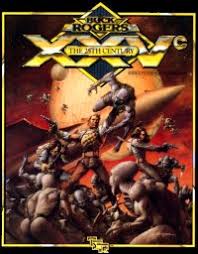
The Buck Rogers XXVc RPG already dealt with this a long time ago - I have the original boxset and lots of supplements and have played and enjoyed it - but that was AD&D based and the Buck Rogers name seemed to have been tacked on to a campaign world that didn't suit it. It was a hard-ish science fiction setting with the trappings of science fiction pulp adventure, down to the designs of the rocket ships, so it felt like two worlds colliding. I always said that they should have simply released the game system as the core rules for a TSR science fiction roleplaying game the same way they did for the AD&D fantasy core books, and Buck Rogers could have been one of the campaign settings for the game. There's no reason why that wouldn't have worked; apart from the slightly dicey rocket ship system, in which your skill as a pilot didn't really have much influence on how your ship performed, it was a solid, dependable system.
I'd like to keep the basics of D&D and shoehorn in the percentile skill system used in Buck Rogers XXVC because I've always thought that was quite innovative and worked really well. If I could get the percentage scores down to single digits as in modern D&D that would be even better, say divide the percentage score by 10 and drop the fractions, then just use a basic difficulty check target number of 15. The careers n the game and the character sheet should cover it all quite well.
There's D&D inspired games out there called 'Stars Without Number' and another called 'X-plorers' I'd like to get my hands on, as well as a new D&D inspired game on it's way called Warriors of the Red Planet that I'm very excited about, that will no doubt help me with that itch I want to scratch. In the meantime, though, I'll see how I get on with my trimmed-down Buck Rogers XXVc idea.
I've been enjoying the Basic D&D recently and I've also bee having great fun catching up on old classic serials, like Buck Rogers (not the dodgy disco Buck, the original Larry 'Buster' Crabbe Buck), Flash Gordon (not the glorious 1980 movie, the original Larry 'Buster' Crabbe Flash) and Radar Men from the Moon with my old favourite Commander Cody. I've mixed that in with great movies such as 'Sky Captain and the World of Tomorrow' and 'The Rocketeer', and what I've come out the other side with is an idea for a space-faring D&D game.
The Buck Rogers XXVc RPG already dealt with this a long time ago - I have the original boxset and lots of supplements and have played and enjoyed it - but that was AD&D based and the Buck Rogers name seemed to have been tacked on to a campaign world that didn't suit it. It was a hard-ish science fiction setting with the trappings of science fiction pulp adventure, down to the designs of the rocket ships, so it felt like two worlds colliding. I always said that they should have simply released the game system as the core rules for a TSR science fiction roleplaying game the same way they did for the AD&D fantasy core books, and Buck Rogers could have been one of the campaign settings for the game. There's no reason why that wouldn't have worked; apart from the slightly dicey rocket ship system, in which your skill as a pilot didn't really have much influence on how your ship performed, it was a solid, dependable system.
I'd like to keep the basics of D&D and shoehorn in the percentile skill system used in Buck Rogers XXVC because I've always thought that was quite innovative and worked really well. If I could get the percentage scores down to single digits as in modern D&D that would be even better, say divide the percentage score by 10 and drop the fractions, then just use a basic difficulty check target number of 15. The careers n the game and the character sheet should cover it all quite well.
There's D&D inspired games out there called 'Stars Without Number' and another called 'X-plorers' I'd like to get my hands on, as well as a new D&D inspired game on it's way called Warriors of the Red Planet that I'm very excited about, that will no doubt help me with that itch I want to scratch. In the meantime, though, I'll see how I get on with my trimmed-down Buck Rogers XXVc idea.
Friday, 4 January 2013
Interview - Joshua Kubli
Please welcome to the blog Joshua Kubli of Imperfekt Games!
Welcome to Farsight Blogger. Perhaps you'd like to tell
us a little bit about yourself?
Hi, Farsight Blogger! My name is Joshua Kubli. I'm a roleplaying game designer and publisher, and my personal publishing imprint is Imperfekt Gammes. I designed the Invulnerable Tabletop Super Hero RPG, and its sourcebook Dauntless. I have a free dark modern fantasy/horror game available online called Dirge. I also write and do layout for Occult Moon's Scifi Toys line. By day I'm a computer technician on the Oregon South Coast, and I love movies (both good and bad), coffee, spicy food, and family. I've got a severely autistic kid who I adore and who keeps me very busy, and a brilliant and beautiful wife (who also keeps me busy).
Tell us about your RPG history - what got you into the
wonderful world of tabletop roleplaying?
I got into gaming in middle school, probably about 1987. My friends and I were kids with huge imaginations in a rural town without a lot to do, and gaming encouraged us to be heroes, play with big ideas, be creative, and be social. Hard things like math became fun through gaming, and fun things like science became better by giving me new concepts to game with.
What is it about the tabletop RPG hobby that attracts
you? What do you enjoy most when playing a game?
I love sitting down with friends, making up our own new characters, and creating new legends with just some paper and dice. What makes RPGs special is that you never know exactly what's going to happen; I can write a short story, even collaborate with others on a story, but these stories don't surprise me the same way that a game session does. Some of my best friends I've made through gaming, and I can't recommend tabletop gaming highly enough to anyone with even an ounce of creativity and imagination.
What's your favourite game? What games that are out
there at the moment float your boat?
I love so many games! My all-time favorites are Champions 4th Edition, Mage, and Amber. I love that each game has a totally different approach and ruleset, but that you can tell almost any kind of story with each of these games, albeit with their own distinct style. I am really looking forward, some time soon, to running something in Larry Moore's Barebones Fantasy game system. Larry's a really cool guy, his product is frankly beautiful, and it's perfect for low-prep games, and for introducing new gamers to the hobby.
Do you still get time to play? What are you playing at
the moment?
It gets harder to find time when you're a parent, and you're writing as well, but I make time to play. Right now I'm running Dungeon Crawl Classics for some friends, and we're having a blast. The chaotic randomness of the game really appeals to us; as much as we try to be serious, it doesn't happen that often, and a game designed to surprise you in weird ways each time is perfect for my group. A friend is currently running me through an Invulnerable campaign. It's always fun to see how your game works in other peoples' hands, and the cool new directions they can take your ideas.
The tabletop roleplaying hobby has been through a
lot changes over the years and it seems that its death-knell is always sounded
when newer hobbies come along, such as collectible card games and online
computer games. It still seems to be able to hold it’s own, though – what do
you see happening to the hobby in the future? What changes, if any, do you
think will have to be made to ensure its survival?
I don't personally think roleplaying games will
ever "die out." Nothing ever dies out, it just changes. The market
needs to adjust, certainly, and it will probably be totally different in a few
years, but I don't see tabletop RPGs going away. The games that do best going
forward will be the games that offer something that MMOs, card games, and the
like can't. MMOs have some of the social aspects of tabletop games, but not the
complete and total customizability. There are a few moves in that direction,
like the custom-built missions in Star Trek Online, but that's a far cry from the
complete hackability of a tabletop game. Card games are quick and portable, but
aren't, on the whole, as good for making characters and telling stories.
More changes are coming. I think the spread of 3D printers will revitalize wargaming, and we'll hear a death-knell for tabletop games yet again; but gaming will mutate and evolve and come back new and different, hopefully keeping in mind everything in the past that made it awesome to begin with.
More changes are coming. I think the spread of 3D printers will revitalize wargaming, and we'll hear a death-knell for tabletop games yet again; but gaming will mutate and evolve and come back new and different, hopefully keeping in mind everything in the past that made it awesome to begin with.
Out of all your projects, what are you most proud of?
I'm rather proud of Invulnerable. I wanted to
make it easy to make any super hero you wanted, with a diverse power set,
quickly and easily. I also wanted to make a game with a gritty combat system,
where heroes need to fight smart to win reliably. And I wanted to make a
setting that called back to all the great classic tropes of comic books, but
which spun them in some interesting ways; a setting where the dark and grim
existed alongside silver age "gosh, wow!" strangeness. There are lots
of truly great supers games out there -- Marvel Heroic, Champions, Wild Talents
-- but I think Invulnerable has something to offer to the right group and
campaign.
You’ve no doubt mixed with other great names in the
roleplaying community – do you have any stories or anecdotes to share? Any
horror stories? Be as frank as you like!
If you remove "other" from that sentence, then it works for me. :) I've met a lot of industry folks online, but family needs and our remote location mean we haven't met as many face to face yet as I'd like. Still, I've gotten to work with some great folks in the field, made friends with a few, and had a lot of fun. The only downside to the game industry is there's a lot of negativity. Creative, smart, driven people take great pride in what they do, and that's great, but some people take very personally the fact that some game products don't agree with their personal design priorities. I don't care to be negative, not even about negativity, but this sort of reaction just alienates people. The answer is always, make good art!
What are you working on at the moment?
I am working on a scifi game called Broken
Symmetry. I wanted to see a starship-based game that focused on cooperation,
set in a plausible, fleshed-out hard scifi setting. The game encourages
exploring and making new contacts as well as ground and starship combat. There are
optional rules for breaking up the GM's duties among multiple players.
You can see a playtest draft of the rules here
I also hope to release a new edition of Invulnerable early next year. You'll be hearing more about that when the time gets closer. Keep an eye on the Imperfekt Games website
Thanks for the opportunity to babble some about my games. Next time, ask me about my 12th-level wizard! :) Have a great day.
You can see a playtest draft of the rules here
I also hope to release a new edition of Invulnerable early next year. You'll be hearing more about that when the time gets closer. Keep an eye on the Imperfekt Games website
Thanks for the opportunity to babble some about my games. Next time, ask me about my 12th-level wizard! :) Have a great day.
Thursday, 3 January 2013
Review - Star Wars: Edge of the Empire Beginner Game
 Star Wars: Edge of the Empire Beginner Game
Daniel Lovat with Chris Gerber
In August of 2012 the Beta softback book of the new Star
Wars roleplaying game ‘Edge of the Empire’ was released to give excited fans a
chance to preview, and be involved with the development of, the rules of the
game. Four months on and they have released the Edge of the Empire Beginner
Game, a boxset designed to not only introduce gamers to the system but new
gamers to the hobby.
THE CONTENTS
The box is a simple flip-top container with rulebooks, help
sheets, character folios and a counter sheet. There’s also a packet of fourteen
custom six-, eight- and twelve-sided dice.
Upon opening the box the first thing is a four page pamphlet
saying ‘read this first’ in large letters. The sheet details the what a
roleplaying game is, including a two-page script-style example, an example of
how to use the maps and tokens and then finishing with the scroll up for the
adventure book, ‘Escape from Mos Shuuta’. As with every book and pamphlet in
the box the pages are glossy in full-colour, with excellent artwork. As ever,
Fantasy Flight Games have outdone themselves with the presentation.
Moving on to the Adventure Book, marked with ‘read this
second’, the adventure ‘Escape from Mos Shuuta’ begins after a brief
introduction that has more information on roleplaying, the contents of the box
and how to use the book in play. The entire book is the introductory adventure
that acts as both a walkthrough of how a roleplaying game works and how the
rules work. It takes the group through the adventure step by step, explaining
how to use the different aspects of the adventure in play. There’s the general
text that talks you through the adventure, coloured text to read to the players,
more that explains the rules and then sidebar notes for extra information and
advice. The adventure is split up into six encounters in the settlement of Mos
Shuuta on the world of Tatooine, where they’ll fall foul of Teemo the Hutt;
straight away we’re on a world that no doubt everyone knows and is familiar
with, so setting the scene isn’t too hard. Each encounter takes the players and
the GM through plenty of incidents that will need each of the rules in the
book, making sue that everything is covered so that the group has been given a
good runthrough of the game system. The starship combat encounter at the end
rounds out the adventure and by the end the group should be well versed ion the
rules and how they work. There’s a handy reference sheet on the back, too.
After this there’s a single sheet to read called ‘The Long
Arm of the Hutt’, which acts as a sequel to the introductory adventure and is
available as a free download from the Fantasy Flight Games website. On this
sheet there’s also an advertisement for the Edge of the Empire Core Rulebook, a
400-page hardback book out in Spring 2013.
Next you’ve got the rulebook which goes into detail about
the rules including more information on the game engine and how to interpret
the dice rolls and advancing your character. There’s section for expanding
combat, skills and talents, followed by equipment, starships and vehicles and a
very modest adversaries section.
Then you have four eight page character folios; Oskara, a
twi’lek bounty hunter. Pash, a human smuggler. 41-VEX, a ‘droid colonist.
Lowhhrick, a wookie hired gun. Each booklet has duplicated stats with the
initial character and the character that can be used in further adventures,
another sheet for use and a talent tree. At the back there’s a brief character
bio. These four characters are the only player characters in the box as there
is no character creation system in here. More on that later.
The large poster-sized maps are next, with one side the
adventure’s YT-1300 freighter in a landing bay, and the other of a cantina, the
spaceport control and a map of Mos Shuuta. These are designed to be used with
the bag of counters that finish the boxset, coloured markers of friends, foes,
monsters and starships.
All in all there’s a decent amount of stuff in this box.
CONCLUSION
I’m not even going to bother to go over the quality of the
product. The card of the box is little on the thin side but that’s my only
gripe; the presentation is excellent and everything is clear and concise.
As an introductory game this is a good product, both for
existing and new-to-the-hobby gamers; everything you’ll need is in here to be
able to run a roleplaying session, and the adventure guides you through the
game system piece by piece, explaining rules, offering advice and supplying
options and hints. The character folios give you all you need to play a
character and the rules are marked out clearly on the sheets for GMs and
players alike. The first gaming session is an all-in experience as the entire
group learns the game, so the GM isn’t swamped with pressure. This also means
less prep time; if the group is willing to invest a chunk of time in learning
the game together they can quickly move onto further adventures. There are
other adventures that the characters can have, with a downloadable adventure
from the Fantasy Flight Games website, and there are plenty of adventure seeds
included to continue the game; you’ll certainly get quite a few games worth out
of this as the system allows for the characters in the game to advance as they
experience the galaxy. This is, of course, a jumping-off point into the full
Edge of the Empire game.
My major problem with the boxset is that there are no rules
for creating your own characters. The four characters supplied with the game
are good and cover the basics of a mixed gaming group but after a while the
players will no doubt want to play with something else, and create their own
personalities. You can use new characters created from the main rulebook,
including the Beta book, but there seems to be very little point. If the box
had even included the basics of character creation, or a way to modify the
pregenerated characters to suit a players preferences, then that would have
added plenty of options immediately and extended the gameplay of the box.
There’s nothing stopping gamers from adjusting the characters and their
backgrounds, but having those very options or the character creation rules to
hand would have been a bonus.
The Star Wars: Edge of the Empire Beginner Game is a very
good introduction to the roleplaying hobby and Fantasy Flight Games’ newest
RPG. It explains the rules clearly and, for old-school gamers like myself who
like their dice numbered, it really helps with interpreting the symbols and
their meaning. It also captures the feel and adventure of the Star wars
universe really well, so even though I do feel as if the character creation
rules should have been included to expand a gaming group’s options, I have no
problem recommending this to new and experienced gamers alike.
Subscribe to:
Posts (Atom)