Monday, 7 October 2013

Interview - Steve Turner of Brittannia Game Designs

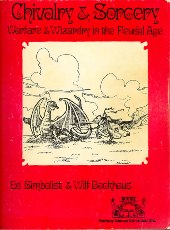
Cs1ed.jpgPlease welcome to Farsight Blogger Steve Turner, the man at Brittannia Game Designs and the gentleman who procured the licence for the classic fantasy roleplaying game 'Chivalry & Sorcery'.


'Chivalry & Sorcery is a fantasy role-playing game that was first published in 1977 by Fantasy Games Unlimited. Originally created by Edward E. Simbalist and Wilf K. Backhaus in 1977, Chivalry & Sorcery (C&S) was an early competitor to Dungeons & Dragons. Historically, the two designers of the game were dissatisfied with the lack of realism in Dungeons & Dragons (D&D) and created the first gaming system derived from it, which they named Chevalier. They intended to present it to Gary Gygax at Gen Con in 1977 but changed their minds once at the Con, where they met Scott Bizar who wrote out a letter of intent. After some final changes to get rid of the last remnants of D&D (e.g. the game contained a table of "Saving-throws" similar to D&D), Simbalist and Backhaus published the first edition of their game - now renamed Chivalry & Sorcery - shortly after the release of the first edition of Advanced D&D.

Chivalry & Sorcery EssenceAccording to Michael Tresca, Chivalry & Sorcery "embraced a realistic approach to medieval France in the 12th century, complete with feudalism and the Catholic Church. Chivalry & Sorcery was most noteworthy for creating the term "game master." It was one of the first games to place the setting at utmost importance over the mechanics of the game." More focused on medieval chivalry than fantasy, Chivalry & Sorcery (C&S) had from its first version a sophisticated and complex set of rules. The game has been published four times to improve its presentation and to modernize its game mechanics. C&S was the first to introduce new concepts like levels for monsters.

The game was reissued by Highlander Designs but when they went bankrupt it was bought by Brittannia Game Designs Ltd. (BGD), a company based in England and directed by Steve Turner. The fourth edition of C&S, called "The Rebirth" was born a few months later. The result was the return of some medieval references and some gameplay mechanics (such as "bash" or "Targeting" for spells) adding this degree of realism that was lacking in the previous edition. Moreover, many additions to the rules (such as "Laws of Magick") brought novelty to the game.

The core rules had several extensions, including the "Knights Companion", "Armourers Companion," "Dwarves Companion" and "Elves Companion". '


Perhaps you'd like to tell us a little bit about yourself?

I am rapidly approaching 50 and have been gaming for 40 years or thereabouts.  As well as running Brittannia Game Designs Ltd (more on a part time basis) I also run Turbo Business Services Ltd, an Accountancy Services Provider for small business.  My background is 30 years in Credit Management and debt recovery.  I am also learning to murder songs with my guitars (my mid life crisis).

Tell us about your RPG history - what got you into the wonderful world of tabletop roleplaying?

I started our gaming as a wargamer using Airfix miniatures moving from WW2 to Ancients via Napoleonic. Then in 1979 I was introduced to the GW print of AD&D and thus began my forays into RPG (although my wargaming heart still beat strong).  The whole excitement of first person adventuring into the unknown was a big attraction.  Over the years the group of friends I gamed with spread their wings into other systems, Chivalry & Sorcery, Traveller and many others.  In 1982 out of one game came the first scribbles that became the Dragon Reaches of Marakush (DRM).  I then became involved in UK Gencon writing scenarios and GMing tournaments.  This led to me becoming an RPGA Regional Director, one of the remits being to run a local convention.  Thus was the "Dudley Bug Ball" conceived which ran for a number of years culminating in a three day residential con at the Hilton Metropole NEC in 2002.  

It was during this time that C&S was brought back with third edition and I approached the then owning company with a view for a licence for supplements.  We produced and released DRM and then found out the owners of C&S were in difficulties.  We managed to secure the IP and bought the game to the UK.  Following the last DBB my wife and I were suffering burn out so we stepped back into the shadows. Following a hiatus and a need for a break from RPG gaming I went back to miniatures with GW.   Then in the last couple of years with the changes in POD and the likes of Drivethrurpg we decideded to start dusting of old manuscripts and start producing again.

What is it about the tabletop RPG hobby that attracts you? What do you enjoy most when playing a game?

What attracts me to Tabletop RPG is the sheer variety of what you can do in so many settings, and the social aspects, the chance to meet up with friends and chat over drinks and food.

What's your favourite game? What games that are out there at the moment float your boat?

My favourite games over the last 30 years have been C&S, Call of Cthulhu, Harnmaster, Traveller, Savage Worlds, Leagues of Adventure and Star Wars.

Do you still get time to play? What are you playing at the moment?

I manage to game twice a week, currently playing Star Wars Edge of Empire, various Savage Worlds and look to run Leagues of Adventure.  I also currently play Flames of War, WH40K and looking forward to some Kickstarters that are due the end of this year.

The tabletop roleplaying hobby has been through a lot changes over the years and it seems that its death-knell is always sounded when newer hobbies come along, such as collectible card games and online computer games. It still seems to be able to hold it’s own, though – what do you see happening to the hobby in the future? What changes, if any, do you think will have to be made to ensure its survival?

I dont see the RPG hobby dying anytime soon.  This can be seen by the uptake on kickstarters.  However, from a publishers viewpoint there have been many changes.  The notion of printing, selling to wholesalers etc I dont think is sustainable in the long term for small publishers.  POD through outlets like Drivethrurpg or as co-operatives like Chronicle City is going to be the way forward.  Small Publishers are now being forced to deal direct with the end customer or Bricks and Mortar Stores as distributors do not make it financially viable to deal through them.   This is going to make word of mouth via the internet and social media more important than traditional advertising.
Dwarves Companion
Out of all your projects, what are you most proud of?

Out of all of our projects I am most proud of the Dwarves and Elves racial supplements, the cover art worked so well and Wiggy's writing is superb (as can be seen with how well his own company Triple Ace Games has fared).  I am also proud of C&S Rebirth (C&S 4), although I do feel it didn't quite hit where I would have liked it to have reached.  We hope to rectify this with 5th Edition.

Tell us more about Chivalry & Sorcery, it's history and where you are with it at the moment. What was the attraction in acquiring and developing the game?

Well, C&S has a long history. Suffice to sat we now have our hands on the game which is a registered trademark.  The future looks strong with our ongoing print partnership with Chronicle City.  The main attraction for acquiring C&S was the history of using the 2nd edition for DRM, my original campaign, and being in the right place at the right time.  Also, the chance to mould an exisiting recognised game system with the addition of a british twist (correct spelling of English for a start).  Future plans include getting 5th edition out there, and polishing the many other manuscripts that we have waiting to be worked on.  What is against us is time, not enough of it.  We can be found on Facebook  and also at Drivethrurpg.

Sunday, 6 October 2013

Lord of the Rings Online

I've been playing a lot of Lord of the Rings Online this year and I've concluded that it's the best free-to-play out there at the moment. I'm a huge Lord of the Rings fan, I've been following it since the late 1970s, so an MMO based on the property had a lot to live up to as far as I was concerned.

I'll be writing a series soon regarding this; why I played it, my history with Lord of the Rings roleplaying (from MERP to Decipher to my own Dragon Warriors and Cthulhu: Dark Ages versions), what Lord of the Rings means to me and why it's a great game for lovers of these kind of online RPGs to get involved in.

Sunday, 29 September 2013

Review - 13th Age

By Jonathan Tweet and Rob Heinsoo

Recently, I figured out that I was playing basic Dungeons & Dragons for mainly nostalgic reasons. I do like the game and I have great fun playing it with my gaming group, but I’ve recently started to drift away from the system and I’ve been looking at more story-driven games. Oh, it’s easy to play a D&D game and have it story driven but the mechanics don’t really support it, and if the gaming group isn’t on the same page it can be difficult to do such a thing.

So, this game has come around at a good time for me. I wanted to do more story-driven and dramatic games but the group was loathe to drift away from a system they like to play, and 13th Age pretty much covers both those bases.

THE BOOK

The hardback 320-page colour rulebook is impressive. It’s robust and hardy and I’ve always liked a book that’s bound in such a way that you can lay it out on the table so that it sits nicely at the required pages, without having to weigh down the edges of the book or crack the spine. The glossy pages are in an easy-to read font, very clear and concise. It’s a very well laid out book with some really good artwork – I can find very little to criticise about the presentation. The cover image alone certainly made me want to play, and the full colour maps on the inside of the covers are quite exciting, to be honest, as it immediately opens a whole new world to game in.

THE CONTENTS

Chapter 1, ICONS, details the great influential characters of the game. They’re there to lead certain factions and areas present in the constant power struggle that envelopes the land, and the relationship between the Icons and the player characters unfolds the world is shaped. This means that player characters aren’t simply gaming in the world, they’re helping to shape it as they interact with, defy or aid the Icons.

Chapter 2, CHARACTER RULES, is the character creation part of the game. It’s what you already know about the D&D game with some changes to suit this particular incarnation. You can roll for or point-buy character stats which gives players greater control over the abilities of their characters. There is no skill list but a general background description that a player is allowed to choose via a points system, so you could choose something like ‘Wild Mountain Tribe’, and this will enable skill checks to be modified should the PC encounter anything to do with mountains, such as survival or climbing rolls. Skill rolls are made by Rolling D20 + relevant ability modifier + level + the number points in a relevant background versus a difficulty number set by the environment. It’s a neat skill system that doesn’t let a player simply choose a skill they feel they might need, but makes them consider why they are skilled in that area and maybe even add a bit of detail or flavour to the history of the character.
You’ve got plenty of Feats to choose from, too. General Feats, which everyone can choose form, Racial Feats for your chosen race and Class Feats for your chosen profession.
Characters progress from level 1 to level 9. Starting as a level 1 Adventurer, once they reach level 5 they become a level 1 Champion, and get plenty of extra benefits. Upon reaching level 8 they become a level 1 Epic character, with even more benefits. As the levels grow, so does the drama…
My favourite party of the chapter, probably the entire book, is the ‘One Unique Thing’ section and this is what moves the game from a simple set of rules for moving playing pieces around to a much more story-driven game. It not only gives the players an impetus to heavily participate in the unfolding drama of the game but it can also help create a detailed, dramatic background for their characters. The One Unique Thing cannot influence or change abilities or rolls and it cannot give the player any benefits that might influence skills. It has to be something that will give them a specific trait or quirk and it will, through the story as the game progresses, create a larger, possibly world-changing plot device that the GM can weave using the Unique Thing about the player character. It enables story hooks and plot paths that directly affect, and can be directly affected by, the PCs. This helps build drama, suggests the relationships with the Icons and how they can be handled, and allows players to set their character apart not only from the normal people of the world but also from other heroes. Players really can create their own ‘special snowflake’ of a character and the game encourages them to do so.
There are plenty of examples in the book but I’ll use one that one of my players used while I was running this game. His One Unique Thing was ‘Lost in the eyes of the Emperor’s favourite’. Quite simply, this meant that he had fallen in love with a lady in the court of the Emperor who the Emperor himself loved. As the player was also a devotee of the Emperor and had already blood sworn his service to him, making him very close to the Icon and resulting in a barely suppressed father/son relationship, you can see why this would create some incredible drama later on. Maybe the PC decides to elope with her. Maybe she desperately tries to make him love her as she loves him but he denies her because of his duty to the Emperor, making her desperately bitter and making her vengeful. Maybe they meet in secret and the Emperor finds out… who knows what will happen? The actions of the player will help decide, so even though I’ve already had thoughts as to where the story could go it becomes very much a collaborative effort on both mine and the player’s part. I think it’s a fantastic inclusion and will make for some seriously excellent melodramatic roleplaying opportunities.
The rest of the chapter provides some very simple goods and equipment lists and some excellent advice for players to really get into their roles.

Chapter 3 details the playable RACES of the game; Human, Dwarf, Dark Elf, High Elf, Wood Elf, Gnome, Half-Elf, Half-Orc and Halfing. As the Icons are scattered across the alignment board from Lawful Good to Chaotic Evil it gives you plenty of scope as to what kind of race to choose. There are some guideline for optional races, too, and these are Dragonic/Dragonspawn, Holy One/Aasimar, Forgeborn/Dwarf-forged, and Tieflings/Demontouched.

Chapter 4 deals with the CLASSES; Barbarian, Paladin, Fighter, Cleric, Sorcerer, Rogue, bard and Wizard. This gives you the details of each class, the base stats, level progression details, gear, abilities and tier talents from Adventurer to Champion to Epic. It also includes the spell lists for the relevant magic-user classes. There’s some very nice flavour in here and, for the first time ever, it made me want to play a Bard. I honestly can’t tell you why; it just looked kind of cool.

Chapter 5, COMBAT RULES, is a simplified and streamlined version of the general D&D combat rules. It still suffers from a little of the problems I feel that D&D combat suffered from and that’s the switch from story game to conventional dice-rolling wargame; for me that’s a slight shock to the system as the flow of the roleplaying is interrupted for lots of dice rolling, but there’s plenty of options that you can do with or without. I found that by stripping combat back and asking players to describe hard hits, killing blows or their reactions to being severely injured helped. This honestly depends on the group and how they like to play, but it’s a good system and it’s what you’d expect from D&D.

Chapter 6 is all about RUNNING THE GAME, and this details Icon Relationships and how they can affect the character and the story, how to run the three different tiers of play, advice on traps, environments and levelling, campaigns, treasure and magic items, and the gaming world in general. This is all very good support material to help in running a game and there’s some good advice on how to make the game your own.

Chapter 7 is the MONSTERS section and here you’ll find all your monster rules and stats. There’s plenty of beasties here that’ll keep you going in adventures and encounters for months. The statistics are wonderfully simple, literally a title, a few lines of description, stats in the nature of Level, Initiative, Attack and Armour Class, Defences and Hit Points. If it needs them there are also some special rules for magic or special abilities, and that’s pretty much it. The monsters have symbols and icons to represent them; I’m a bit of an old-school gamer and I like to have proper illustrations next to my monsters so that I can hold them up to show my players, but the monsters are your generic fantasy beasts so there should be no difficulty.
There’s a cool little section for DIY monsters, too, so you can create your own foul beasties.

Chapter 8 tells you all about THE DRAGON EMPIRE, the lay of the land and the primary points of interest. This is the default setting of the 13th Age but, as with D&D in general, you can set it wherever you want. However, the realms of the Icons of the 13th Age are detailed here and it’s all filled with flavour. The maps really make me want to explore this place and adventure in the uncharted areas of the realms, both as a player and a GM. It’s a general fantasy setting open to plenty of modification by the GM and the gaming group, if they so wish. There’s also the potential for different kinds of gaming; high adventure, horror, warfare, grim and dirty, politics… the game allows for all kinds of adventure styles.

Chapter 9 gives us MAGIC ITEMS, to both help and hinder the player characters. I’m not sure why this wasn’t included in Chapter 2 along with the equipment but I guess there’s plenty of stuff in here to warrant a section of it’s own.

Finally, Chapter 10 is the introductory adventure BLOOD & LIGHTNING. It helps to introduce the Icon relationship and combat systems, which is great for gamers who are new to it, but it is otherwise a standard cover-all-the-beginner-points adventure for level 1 player characters.

The book is rounded out by a character sheet, an index and glossary, and some charts and tables.

CONCLUSION

First things first – I think this is a great game. It’s wonderfully presented, colourful, full of flavour and brimming with great ideas that can not only work for 13th Age game but pretty much any roleplaying game, D&D or otherwise. I like the Icons idea as they can add some seriously good depth to the game, and even though it’s only a small part of the game I really like the background skills as it adds even more depth to characters. The proof of the pudding is, though, the One Unique Thing that defines a character and makes them special. This can create all kinds of fantastic discussions around the table regarding the events that led up to the One Unique Thing and the possible repercussions. These conversations alone can spark the imagination and inspire GMs to come up with adventures, plots and courses of action they may not have otherwise even considered. Not only that but these One Unique Things can affect not only the adventure or the campaign but the world as a whole as the Icon relationships unfold, change and progress. It makes for some great roleplaying and allows interesting and creative collaboration between the GM and the players. Usually I’d steer my players away from creating a ‘special snowflake’ of a character. In many ways this game encourages it without compromising the game or the group.

I could see this system being used in any of the D&D settings; Greyhawk, Forgotten Realms, any of them. If you want to use the One Unique Thing idea in your existing D&D campaign world I see nothing that stops you from doing that. You will no doubt benefit from the other ideas and changes in the book, as well, so it’s worthy getting even if you’ve got an established D&D game on the go using your favourite interpretation of the system. It’s not simply tied to the world of The Dragon Empire or the rules in the 13th Age book.

The system is D&D and, even with the tweaks and changes they’ve made, it is how we all know it. In fact, I like the changes they’ve made and would recommend this even without the Icons or the One Unique Thing implementations. It’s still a great game in it’s own right and I find the system much more playable with enough detail to make the game feel very rounded and full but not too much to make it feel overly complicated. There is a feeling, however, that this game has been designed with experienced players in mind. Whenever I read a new game I always come at it from the perspective of a first-time roleplayer, a person new to the RPG hobby, and I never got the feeling that this really caters for gamers who have never picked up a roleplaying game before. It’s written as if the reader is already familiar with RPGs and D&D in particular.

Another thing I liked was the little snippets of personal out-the-game information and examples supplied by Jonathan Tweet and Rob Heinsoo. They give you insights into how to use the new ideas, how they used them in their games, and lots of other stuff besides. It’s very handy and work well as examples as to how to implement certain rules into your game. It’s handy, informative and makes the game feel very personal.

I can very highly recommend 13th Age, both as a general OGL D&D game - as the changes and streamlining of the rules is very good - and the new Icon and One Unique Thing rules make for an incredibly well put together story-driven system that marries narrative games with old-school roleplaying goodness.

Sunday, 22 September 2013

Review - X-Wing Miniatures Game

Along with Jedi News Editor Mark Newbold, we were thrilled earlier in the year to be invited to play test the new Fantasy Flight Games X-Wing Miniatures Game by the gang over at Titan Games in Lichfield.

We had a fantastic battle, the results of which you'll see in the video and we're pleased to report that the game is fantastic and comes highly recommended. Here's a brief video review, featuring the music of the awesome James Semple.


Genesis

This photo was taken today while I was accompanying my son to a swimming lesson at the secondary school I used to attend in the 1980s. The set of windows on the ground floor tucked into the corner is Room 1A; well, it was back then, I have no ideas what it is now.

I went to Netherstowe Comprehensive School from 1982 to 1987. It wasn't the greatest time of my life and nor was it the worst as I simply kind of existed there, I never got involved in any of the groups and I pretty much kept myself to myself. School came and went.

I was already into fantasy and science fiction before I came here and it was something that I did on my own. I never had a solid circle of friends and those I did know weren't really into the same things that I was. I met my best friend Mark in 1983 and we soon hit it off with our shared love of Star Wars.

But in 1984 I was invited to Room 1A at the school to take part in 'Dungeons & Dragons' club. And for the first time ever I mixed with like-minded people who wanted to use their imaginations and indulge in the stranger things in life.

And for the first time, I actually felt comfortable. I didn't mind talking about what it was I enjoyed doing and I shared my love of all things strange and fantastical. I never felt awkward and I never felt like I needed to hide my passions. I felt liberated, and a great sense of relief washed over me; I wasn't alone.

It was all thanks to this room. I've not stood here, on the grounds of the school, for 26 years, more than quarter of a century. Seeing the room and remembering what happened in there hit me pretty hard and I started laughing as the memories washed over me.

A couple of people looked at me like I was crazy. But I didn't care.

Sunday, 15 September 2013

Press Release - Dragonmeet 2013

Dragonmeet 2013

Dragonmeet is once again descending upon Kensington Town Hall in London, this year on the 7th of December.

The event has a new website (www.dragonmeet.co.uk) and a new Facebook page.

This year Dragonmeet organisers are planning to build on last year's increased footfall and tip over the 1000 attendee mark.  Dubbed "London's friendliest one day gaming convention", Dragonmeet offers roleplaying, board and card games, special guests, seminars, trade hall, artshow and a charity auction.

Tickets for Dragonmeet go on sale soon, so keep an eye on the website (www.dragonmeet.co.uk), Facebook page (https://www.facebook.com/dragonmeetconvention) and Twitter account. (@dragonmeet). Further information can be had by emailing dragonmeet@cubicle7.co.uk.

Hold on - have I reached the level of Role Playing Grand Master?

I've just realised something momentous. Possibly Earth-shattering. Screw that, Universe-shattering.

I've been having a fond look through my old gaming books and I dug out Gary Gygax's book Role-Playing Mastery, in which he offers all kinds of hints, tips and ideas to help improve your roleplaying experience. He knew what he was talking about, did Mr Gygax, and even though some of it doesn't really speak to the way I game anymore there's still some great stuff in there.

I was flipping through it and I came to the back of the book - 'An Overview of Progress Toward Mastery'. Here it listed the things that a player should attempt and conquer to reach a level of a Grand Master roleplayer - yeah, I know, it's a bit daft and being a 'Grand Master' in a hobby so subjective as tabletop roleplaying is something of a silly concept. Still - I wanted to see what Gygax himself considered as the pinnacle of gaming so I pressed on.

INDIVIDUAL EFFORT AND PLAYER MASTERY - Oh, yes; from Fighting Fantasy to Basic D&D and beyond I've definitely learned a lot and know what's expected from me at the gaming table. I even wrote articles about it, and published them in a book

PLAY GROUP EXCELLENCE AND MASTERY OF THE ROLE OF THE GAME MASTER - I can certainly say that this is true; after 30+ years of gaming I've mastered a lot of systems, especially Star Wars D6 and Warhammer FRP. I've played in them and run them for many different groups and players over the years.

CONTRIBUTIONS TO AND MASTERY  OF THE CHOSEN GAME SYSTEM - As the chief GM of almost every game system I ran in the 1990s and 2000s, with my games being actively sought after in the 1990s especially, then I can say this is true. Or maybe it was because I was the only GM for miles around... no, I'm going to go with my ego on this one.

CONTRIBUTIONS TO AND ACTIVITY WITHIN THE GREATER GAMING COMMUNITY - I ran convention games, I put on my own convention GammaCon, I reported on other conventions, ran my own store, ran RPG workshops and introduced dozens of people to the hobby, I edited my own webzine, I got involved with the industry on several levels and I take part in the community via this blog and other mediums. Yes, I'd say that this was covered.

So... is this it? Have I attained the level of Roleplayer Grand Master? Well, according to Gary Gygax - yes I have.

So therefore, I am:


* And no, before you say anything I'm not being serious - I just remember reading this book way back in the 1980s and thinking 'Wow, I'll never get to that!' because I took it all far too seriously. It all seems quite quaint, now.

Thursday, 12 September 2013

Book review - The Carpet Makers by Andreas Eschbach


'KNOT AFTER KNOT, DAY IN, day out, for an entire lifetime, always the same hand movements, always looping the same knots in the fine hair, so fine and so tiny that with time, the fingers trembled and the eyes became weak from strain-and still the progress was hardly noticeable.'


I first read this book a few years ago, just after my son Bruce was born. It was the book I read during his first two weeks of freedom from the womb and, in between the nappy-changing and feeding, I sat with my son in my arms and read The Carpet Makers.

'Since the time of prehistory, carpet makers have tied intricate knots to form carpets for the court of the Emperor. These carpets are made from the hairs of their makers' wives and daughters; they are so detailed and fragile that each carpet- maker finishes only one single carpet in his entire lifetime. This art has descended from father to son since the beginning of time itself. But, one day, the empire of the God Emperor vanishes... and strangers begin to arrive from the stars in search of the hair carpets. What these strangers discover is beyond all belief, more than anything they could have ever imagined... '

A string of open-ended and seemingly unconnected stories are - dare I use the pun - 'woven' together to create a universe so compelling, so shocking, that it is only now that I have decided to pick it up and read it again. 

I can't recommend this book enough. The Carpet Makers is a story so rich in detail and depth that it practically is a door to another time and another universe. The stories are all connected but each one is also a snapshot of the life of a subject of the God Emperor, the man who has, as far as anyone is concerned, ruled the universe for all time. People familiar with vast universes of Paul Atreides or the Emperor of the Warhammer 40K Imperium will find the setting familiar, a vast galaxy-spanning Empire that's almost inconcievable in it's size and influence. 

Andreas Eschbach creates characters with surprising depth in the few short pages that they have and that's a mark of quality writing; if the author can draw you in with nothing more than a few pages of story, detailing a character who won't be mentioned again for the rest of the book and still carry the overall story along with careful attention to the core idea... it makes me wonder what a full length uninterrupted novel must be like. After reading this, I can't wait to find out.

This is the reason why I waited for several years before reading it again; the sheer size of the concept and the reason for the existence of the carpet makers was staggering and it took me a long time to even begin to grasp the enormity what had happened in the pages of the book. This means that I can't even hint at the plot of the book without giving some small fact away that might ruin it for you. You'll just have to trust me and get a copy and find out for yourselves.

This is a huge book in every sense of the word, starting small but slowly building into an explosion of epic proportions; Andreas Eschbach takes you by the hand and slowly walks you through his world before dragging you into the finale. This is an excellent read from an excellent writer and I am definitely going to hunt down more of his work.

I urge every science fiction fan to buy a copy and lose themselves in the Empire of the God Emperor and his carpets made from human hair.

Tuesday, 10 September 2013

Nerd Stuff I Kinda Forgot I Had: Part 3

It's an Imperial seal of purity, man! And it's magnetic!

When the computer game Space Marine came out I absolutely loved it - I had it on PS3 and the gameplay, story and music was just great. Yeah, it got a bit samey in some places but the story and characters really worked.

In fact, the cutscenes were a thousand times better than the God Emperor-awful 'Ultramarines' move that came out, the official Games Workshop WH40K film (I was going to review that 'movie' but too much negativity gives me the shits).

In the collector's boxset for the game was this, an Imperial seal, the sort of thing you'd see hanging off the armour. I never bought the boxset, I was given this by a great mate who knew that I coveted it.

It's a great little piece of kit, with the litanies on the ribbons and the mock-wax seal looking the parts. And did I say it was magnetic? Cool! I'd stick it on my power armour, if I had any. But I don't. Because I'm not an eight-foot tall genetically manipulated super soldier.

Which is a bummer.

Tabletop RPG Review - EPOCH, an RPG of character-driven survival horror

EPOCH
Published by Imaginary Empires
Written by Dale Elvy

There comes a time when you just want to sit down and blast out a quick game that everyone can enjoy, and in which you don’t have to spend much time and effort preparing for. There comes a time when you want to let the pressures of GMing go for a little while and let the game and the players do the work for you. There comes a time when you just want to do a fast, fun one-shot.

Welcome to the ‘Experimental Paradigm of Cinematic Horror’ – or EPOCH, the character-drive survival horror roleplaying game.

EPOCH emulates pretty much one thing; those horror movies in which a bunch of people get thrown in to a horrible situation, usually involving monsters, aliens or crazed slashers. You know the films; ‘The Cabin In The Woods’, ‘Alien’, Jason and Freddy movies… pretty much any movie where the protagonists are picked off one by one by a scary, dangerous foe that’s supernatural, insane or out of this world. Or worse, all three. Have you ever wanted to set up a quick game where your players take the role of these unfortunate fools that get themselves into this dire situation? This game lets you do just that, but there’s an elegant little twist that decides who lives and who dies by the end of the game…

This card-based game from Imaginary Empire is a nice little 147-page softback book with colour covers and a black and white interior. The print is easy on the eye and the art, while sparse, is attractive and suitably gruesome. It’s a great little book that’ll fit nicely in your gaming bag in case you need it at a moment’s notice and takes up little room, so you can always have it with you if you need it. The copy I have also came with the card deck that you’ll need – these can be downloaded and printed as a PDF or ordered as a POD. There are 130 cards in total, more than enough to suit even a moderately large group although six is the perfect number (and I suggest getting the POD cards as they’re sturdy, well made and you’ll get a lot of use out of them).

Playing EPOCH is easy and, most of all, a lot of fun. Games are split into Tension Phases, where investigation, character interaction and general gaming takes place; and Challenge Rounds, where the characters are faced with an obstacle or threat that they must overcome. Let’s take the movie ‘Alien’ for example – the Tension Phase is the buildup; waking up to find that you’re still eleven months from Earth, Kane, Dallas and Lambert going into the hold of the crashed ship, trying to get the Nostromo operational again. The Challenge Rounds are for when stuff happens; Kane attacked by the facehugger, Brett attacked by the alien, Dallas attacked in the vents. The pressure is built during the Tension Phase and the Challenge Round releases that pressure as a dramatic explosion.

This is where you get to play your cards – there are no dice with EPOCH.

Cards, when played, help the story along and decide when a character lives or dies (or worse). They detail your traits, strengths, and weaknesses, and they detail the relationship that you have with the other player characters – family, friends or colleagues. All of these cards can be used to help yourself, help others or hinder others. I can guarantee that everyone will be dead by the end of the game except the player who played their cards cleverly, secretly and most of all dramatically. It’s part of what makes EPOCH a lot of fun – not only do you get to roleplay and run around having screaming fits about anti-social aliens and killer clown with axes, you also get to play a cunning game of strategy as you try to be the one who makes it to the end of the scenario alive. This is perfect one-shot material, and the game rules are simple and well explained so you could have a game up and running very easily at a moment’s notice with gamer friends who have never played this before. It’s perfect for single quick games and ongoing stories that might even feature the survivor(s) of the previous game - it’s no wonder it was nominated for 3 ENnie Awards including Best Rules, Best Electronic Book and Product of the Year.

The three scenarios that come in the book, ‘Fever Pitch’, ‘Sunshine Falls’, and ‘Price Slash’ cover the basics of the most popular horror flicks. There are others you can download, too, but it’s very easy to create your own based on your favourite horror movies. Up to yet I’ve run games inspired by Alien, It, War of the Worlds, The Evil Dead, Critters, The Walking Dead and a whole bunch of Cthulhu Mythos adventures. It really covers everything.

Not only that but there’s a lot of information and advice at the beginning of the book regarding running and taking part in games; this covers the distance between a player and their player character and how the closer they are together equals a much more immersive game, how GMs can get their players much more into character and to invest more into the personality they are playing, how to deal with those moments where problems arise that might ruin the atmosphere and how to manage the game with notes and proper preparation. Its really good advice that relates to immersive gaming in general and not just to EPOCH.

EPOCH is an excellent game that suits its horror movie subject matter perfectly. It has an incredibly clever system and a unique approach to narrative in which the GM, the players and the cards that are dealt all influence the outcome of the game. This requires the group to think fast and be on their toes and for the GM to be able to react to sudden changes in the flow of the story, but the nature of a horror survival flick – a small group in a small location with few avenues of escape – certainly makes this much easier to control.

Great fun and a great way to spend an evening with like-minded friends. Highly recommended.