Saturday, 4 November 2017

My Original Star Wars RPG designs from 1987/1988

30 years. Wow.

So, for your viewing pleasure, here are some of my first ever game designs for West End Games Star Wars: the Roleplaying Game, from way back in 1987/1988.


This one is very first map I drew in 1987, the day after I bought my copy of Star Wars: The Roleplaying Game. I wanted my own Rebel base, and I created a small one on an idyllic world of boating ponds and woodland walks. It was designed as a retreat, a place where player characters could go to rest and recuperate, pick up missions and generally hang out.


These two were created in 1988, and the image on the left is a downed starship being used as an outpost. At first it was controlled by smugglers, but after being outed the Rebels used it as a small strike base deep in the Mid-rim territories. I remember liking to idea of it but don't remember getting much use out of it.

The crash site on the right is a downed Star Destroyer, the impact of the mighty starship hitting the ground devastated the land for miles around, but the crash also bought trade and industry as the locals used it as place of interest and melted parts of the destroyer down to use - they were a pre-industrial race and they needed the metals for their own wars. By this time, the Empire and other scavengers had already taken what they could and left the rest to rot.


Finally, another Rebel base on the left and a space station on the right. The base was a complicated warren of abandoned tunnels and caves in what was one of many single towers of land on an otherwise ocean world, and as the world had no natural resources of note it was ignored by the Empire. What the Rebels didn't know is that the original inhabitants of the world were returning, and they wanted their homes back...

The research station was created for a standard 'trapped on a station with killer aliens' game. You know... Aliens. It is much larger than you can see in the picture, but the game was pretty derivative and didn't really go anywhere. I always liked the design, though.

You know, I might use all of these again. The 1980s were a great time to be a tabletop roleplayer.

This post originally published 17-12-2015

Friday, 3 November 2017

NEVERLAND - Here Be Monsters!

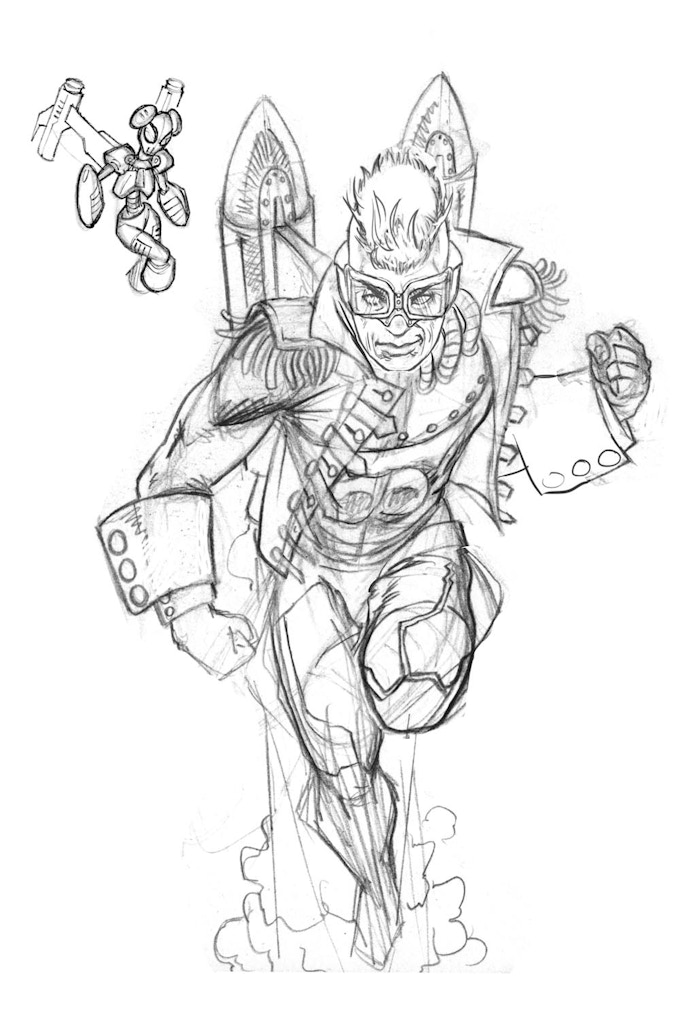
Peter Pan and Tinkerbell reimagined by Kev Crossley
Peter Pan & Tinkerbell
concept by Kev Crossley
Here's something that looks like a lot of fun...

Imagine that Wendy from the Peter Pan stories was on the Titanic, got separated from the other survivors and washed up on a mysterious island where Peter Pan wears a jetpack and Tinkerbell is a tiny robot. Oh, and there's dinosaurs.

Sounds weird? Damn straight it does. That's why it's cool.

Gamebook author Jonathan Green - who I interviewed a few years ago and was a thoroughly all-round downright decent chap - is hoping to bring us this insane story as a gamebook with full rules for interacting with the denizens of Neverland.

The Kickstarter is running now as of this post.

From the website:

"NEVERLAND is a brand new adventure gamebook - a multi-path book, very much in the style of Choose Your Own Adventure or Fighting Fantasy Gamebooks, in which you choose the course of the story - inspired by both Peter Pan and Wendy, by J. M. Barrie, and The Lost World, by Sir Arthur Conan Doyle.

It's Treasure Island meets Jurassic Park! It's Cutthroat Island meets King Kong! It's Pirates of the Caribbean meets The Land That Time Forgot! It's Pirates versus Dinosaurs! And you can play as either shipwreck survivor Wendy Darling or automaton avenger Peter Pan. Anybody who has read and played The Wicked Wizard of Oz or Alice's Nightmare in Wonderland will have a very clear idea of what to expect!

At 11:40pm on the 14th April, 1912, during her maiden voyage, en route to New York City, the RMS Titanic struck an iceberg and in the early hours of 15th April the passenger liner sank. 1,503 people died, including passengers and crew, but 706 people survived, among them Wendy Darling and her dog Nana...

Separated from the rest of her family, Wendy's lifeboat drifts for days until it washes up on the shores of a mysterious island - a place lost in time, home to creatures long thought extinct, a forgotten tribe, and a boy who can never grow up.

But the notorious pirate Captain James Hook and his crew have also found their way to Neverland, and the island is angry..."

Jonathan Green is an author, editor and games designer, best known for his Fighting Fantasy adventure gamebooks, as well as YOU ARE THE HERO - A History of Fighting Fantasy Gamebooks, and the Pax Britannia steampunk novels.

He's got some serious pedigree in this area, so this is a project well worth getting involved in.

The handmade, leather-bound journal, the traditionally sewn Jolly Roger pirate flag, the dice and dice bag, and the pirate's treasure chest - just some of the rewards on offer with the NEVERLAND Kickstarter.

Thursday, 2 November 2017

My first ever Basic D&D game design

This is the very first page of my very first Basic D&D adventure I wrote 33 years ago, when I got into D&D and the RPG hobby became one of my favourite things.

I created my own campaign world and the idea was that as the players explored they opened up new areas of the setting. Sadly, it wouldn't get used for another five years in a short-lived campaign I can barely remember.


I do remember a fight in a keep on an island just off the coast, and an attempt to slip a knife to a PC so that he could cut a man free who was about to be executed. The adventure was incredibly railroaded, if I remember, as I had the main story perfectly laid out and the players were, for the most part, along for the ride.

There was also a cave with the skeleton of a dragon inside, and a small used campfire within it's rib cage. It was really important for some reason. I think the dragon used to guard the hidden entrance to a massive dungeon, but I don't know if I'm remembering that correctly. Why you'd hide an entrance and then attract attention to it by putting a dragon there to guard it I have no idea. Teenage logic.

The rest of the document is quite detailed, with every location mapped and every point of interest in that location described and statted. I liked to think that I was ready with a foe or an encounter no matter where the players decided to go and so I'd design accordingly. I was a first-time DM then, and I'd try to plan for every eventuality. I also had this 'me-against-them' view of the game as I was new to the hobby and still had the boardgame mentality, as if I was challenging the players to defeat my adventure. I still have that in me in some ways, but now I'm less interested in them beating my scenarios, and more interested in seeing how the players react to them.

This post originally published 20-07-2014

Wednesday, 1 November 2017

I've discovered a new D6 System game - Exilium

Gorgeous cover, too
This looks really interesting - Exilium from Fire Ruby Designs, a science fiction roleplaying game using Open D6.

The D6 system is one of my all-time favourite systems, my personal preference being the simple WEG Star Wars D6 First Edition rules. It was fast, intuitive and you could really modify it as you saw fit. In fact, by just using the WEG Star Wars D6 First Edition rulebook I was able to create games in most genres. It's excellent.

Now I've come across Exilium, a sci-fi game with quite the setting (which I've copied further down). I've downloaded the Player's Introduction and had a read, and although it doesn't go into any proper rules detail so I can't comment on how the D6 System has been utilised, I can see on the free character sheet that the stats are Might, Wit, Agility and Charm, with just a very few skills in use. It seems that the system is simple with very little additions.

It does give some background on the setting itself, as well as some player pointers. If these are the opening chapters of the main book then it's clear, well laid out and has some excellent artwork. The setting sounds incredibly intriguing and, while I always prefer open character design and don't always like being told what I'll be playing and why, there seems to be plenty of scope here.

There also seems to be some support for the game on the store page, too, at really cheap prices. I think I'll add this to my ever growing list of games to get hold of.

The game blurb is below:

Something has awoken.

What you know...

Increasingly you feel you are not in your own body. Dreams have come that shake your belief in yourself. Your sleeping mind is full of incredible hints at higher realities, snatches of a heavenly existence, and the pain of a terrible fall from grace. Now this place where you live no longer feels like home. And the Dreams are getting stronger, and stranger…

What you have been told...

The thing that calls itself the Envoy has told you that something has awakened inside of you. And with that awakening comes a realisation that you were once something more than human; you were a god, a post-human, one of the Numina.

Your world was called Elysium – a paradise beyond this reality. Separated from the material realm, your kind found delight in watching and manipulating the lesser beings trapped in a material existence on the Flame Worlds, playthings created for your pleasure. You called it Dreaming, an endless source of entertainment and intrigue.

But times change. You committed a crime.

And for that you were thrown out, ejected, named an Exile. Now even in your awakened state Elysium seems little more than a vague memory.

Now that this truth has been revealed to you, it seems an obvious thing.

But there is hope. The Envoy offers a way to resolve the guilt of your crime. Increasingly you see that this is the only way you can return to Elysium. Under the Envoy’s guidance you invoke your one-time comrades, the Numina, and through them reveal more of your home and your past. Doing so risks psychosis, but the Envoy gives you the black pills to help with that.

This is where you are – the Flame Worlds, a place of death and intrigue, among billions of souls trapped in this mundane existence. You and your fellow Exiles must accept the Envoy’s offer, and meet others of your kind to do his bidding. What will you discover among the Flame Worlds? Who knows, but if it ends your exile, it is worth it.

Tuesday, 31 October 2017

[WOIN] What's O.L.D. is N.E.W. Starter Kit

As a huge 2000AD fan I've been paying close attention to the ‘Worlds of 2000 AD’ Tabletop Adventure Game, coming soon from EN Publishing. I was more interested in how the material would be handled than the system they were going to use, but I've now spent some time having a read of the starter kit for EN Publishing's house rules, the 'What’s O.L.D. is N.E.W.' game system.

The handy starter pack is available from RPGnow and there's a supplement coming out that has me very interested called 'Xenomorphs: The Fall of Somerset Landing', which is running a Kickstarter at the time of this blog post (and smashed it's target). It's inspired by Aliens... well, I say inspired by, it is pretty much Aliens, but it looks like a fun game and certainly the kind of thing I'd like to play. The influences may be there, but it's how it plays that counts.

And talking about things being pretty much like it's source material - I've had a read of the starter pack and I like the look of it. It does feel like a re-tooled version of the D6 System, one of my favourite systems of all time, and no matter how things are re-worded in the rulebook it plays in pretty much the same way. However, the idea of life-paths during character creation and the other additions sound like fun and are most likely something I'll like to tinker with. The feedback on the game itself has been positive and it's done well enough to get hold of the 2000AD licence so it's doing something right.

I'll look forward to putting the starter pack through it's paces soon, and may even look at the core N.E.W. rulebook so that I can have a go at the Somerset Landing game. This is something I'll keep on my radar. Well, motion detector.

A gritty universe of sci-fi survival horror, including the full core rules and a setting/adventure.

Monday, 30 October 2017

Hints & Tips - 5 Tips On Using Dreams In An Adventure

Dream Catcher by GDJThere are many great stories that talk of the destinies or paths of the heroes, and these paths are sometimes described in a manner that every person can relate to in one way or another – dreams and nightmares.

How many times have you woken from a dream so vivid that you felt as though you are still within it? How many times has a nightmare moved you to an emotional response?

It is said that dreams are an indication of the subconcious thoughts and feelings of the individual (there are plenty of books on how to interpret dreams in circulation) that are given form in the subconscious. There is also a supernatural quality to dreams and nightmares that has been addressed in many writings as views of possible futures - and this is what makes them great as a role-playing tool.

Although I will use the term 'dream' throughout the text, it also refers to nightmares, which are a stronger, more violent version of a vivid dream. The one you use will depend on the game you're running, but basically they have the same effect.

Dreams As A Plot Device

What has been, what is, and what is yet to come. These are the three strongest indications of the past and possibility a dream might deliver to enhance the dreamer's situation and possible future. By splitting the dreams into these three areas you can decide how they will fit into your story.

What Has Been

The character dreams of things that have happened to him/her in the past. These might be just situations and encounters the character has had and can be used as a reminder to the players of what has come before.

It can be more entertaining to remind players of past plots instead of simply sitting down and explaining the story up to that point, and it's also handy for trying to inform the PCs of an important item or plot point they have missed or disregarded during play.

Dreams can also be useful when a character dreams of things that have happened to other people or places he/she might never have seen or visited. Wouldn't it be spooky if you dreamt of a man you had never seen before who leans towards you and says 'I love you, son'? This creates a mystery that might be unraveled as the plot unfolds. Perhaps the PCs are chasing someone they believe to be a threat and yet the dreams are trying to tell one of the PCs that they are chasing the wrong person and that what they see in their sleep is what actually happened. Remember, we face the future by learning the lessons of the past.

What Is

This is the least used of the dreams as it is simply an indication of what the character is going through at the current time. What it might be used for though, is to indicate whom the PC can trust or to provide a hint as to the true nature of other personalities, PC or NPC. This does not necessarily mean that the character who appears in the dream will change their ways immediately – wait a few games down the line for when the dream has been pushed to the back of the mind and the character shows their true colours. Remember, we have the ability to change the now to improve the future.

What Is Yet To Come

This is the most widely used yet tricky type of dream to use in a game. You don't want to show too much of what is to come and give the PCs lots of avenues of success, and you don't want to ruin any surprises that are coming.

To combat this, keep the images cryptic and have dreams be more of a series of symbols. For example, a symbol of a threat to the PC's face, perhaps a clawed hand reaching from darkness or the trademark great Flaming Eye, might be an indication that the enemy is closing in. A symbol of a tearful Elven maiden standing in the charred smoking ruins of a wood might be an indication that something terrible is about to happen to the Elven Kingdoms.

A great way to alarm dreaming players is by having a known major NPCs shown in great danger or laid out dead. Use this not to indicate what is going to happen to the NPC personally, but as a symbol of great peril to come.

For example, a dream of the PCs' King might show him being crushed to death in the icy grip of a huge gauntlet – this might not mean that the King himself is in danger, but the Kingdom as a whole. As the dreams continue the larger picture slowly start to emerge, so the players, having thought that just their friend's life was at stake, start to realize there's a greater peril.

Also, the dreams could show the PC's future if they fail – the enemy crushing their armies, enslaving their people, destroying their lands. This acts as a plot device as it makes sure the players see what it is they are fighting to stop and gives them impetus to stop it. Remember, the future is always in motion and is subject to change, for better or worse.

The question that will be asked at some point is this – why are the dreams coming to the PCs? What is making them have these dreams which have such a diverse affect on their futures? This can be answered whichever way you choose, but the main plot points can be:

A powerful ally could be sending the dreams, not able to get directly involved but surreptitiously trying to influence the direction the PCs take.

A powerful enemy is trying to mislead the PCs by sending them information that is detrimental to their success.

One or all of the PCs have a destiny to fulfil and the dreams are fate's way of guiding them.

A natural/racial gift is possessed by a PC that enables them to have these dreams.

An item one of the PC's possesses enables the PC or the whole group to have the dreams.

The Gods are deciding to interfere in the fate of mortals.

(My personal favourite) The PC having the dreams is simply a bit of a nutter and it takes three games of running around for the group to realize his dreams don't actually mean anything.

Dreams As An Atmosphere Enhancer

The supernatural quality of dreams might help the plot by giving it that sense of otherworldliness, a vision of a reality that everyone sees because our dreams are of the same construction, a bundle of images and noises that do not wholly connect but have an impact on our thoughts and feelings.

All the players at the table might have their own idea of what the game world is like and how it is represented in visual terms, but the inconsistency of the content of dreams makes it palatable to everyone. It's not necessary to go into minute detail as far as the dream is concerned. Just give enough to give the player the images they need.

Most images we see when sleeping flash by and only the more vivid ones leave a lasting impression, like a snapshot of a moment in time. This should be the way with the dreams you describe – quickly say what they see and then move on. If they miss it, well, they can always dream about it the next game-time night. If you want to go into detail then by all means do so, but remember that you run the risk of giving away too much. Unless the PC can go into a lucid dream or have control over their interaction with dreams, then it's best to keep them as observers and nothing else. This not only works as far as trying to show the impact of a vivid dream, but also enhances the fantasy atmosphere these kinds of dreams help create.

Dreams As Road Signs

Dreams are a great way of getting the players on track, or even back on track. Let's say that they've been hunting the Pearl of Wisdom for a couple of games but they have hit a dead end – they've missed or forgotten about a vital piece of information. However, just reminding them GM-to-player or through an NPC seems a little contrived.

Instead, a PC could dream of a great fiery mountain surrounded by water guarded by the hordes of darkness. This image means very little at the time of the dream, but as the plot continues hints are dropped to the existence of such a place and the players realize that this is where they must go. It's not a good idea to have a blatant dream where a gnome with a road map jumps out and says 'go this way, the pearl is in a big volcano' as this is just telling the players what to do next with no realization or deduction on their part.

Dreams are handy as reminders of forgotten facts or items in a roundabout kind of way. Don't get me wrong – thinking that the players are having a problem and having them dream their way out of it every time is not a good idea as this cheapens the effects of dreams and their meaning. See Tip 5 – Dreams at the Gaming Table for more information on this.

Dream Team

The question is – who has the dreams? It might be a character trait that one of your players has and this is the PC the dreams are channelled through, for better or for worse. This means singling out one player and giving them the information. This might take the form of notes or direct telling. Notes are a good idea as you can prepare them ahead of time and hand them to the player and let them read it.

If you want the dream to be more realistic you could take the note from the player after a certain time and they will have to remember what they can – this reflects the fact that dreams fade with time. Other than that, you can take them from the room, sit them down and tell them what they dream. What they then choose to communicate to the other players (what they remember, that is) is up to them.

Group dreams are a little more complicated but do add an extra dimension to the game. If all the PCs have the same dream then there's definitely something weird going on! Group dreams also help because each player will remember different things. You might even want each player to have a different dream which, when combined with the other dreams of the other PCs, makes more sense. This is hard work though, and might lead to misconceptions and then errors in judgment. It's usually a lot simpler to give them all have the same dream and then let them decide on its meaning from there. Group dreams can make for some long, interesting discussions as interpretations differ.

Dreams at the Gaming Table

Here are some hints on the actual use of dreams and nightmares in a game.

Don't make it a regular feature - A dream every night or even every game can be overkill and it reduces the importance of such dreams. It might get to the point where the PCs roll their eyes and mutter 'oh, great, here we go again'. Make it a special moment that heightens the drama and creates another dimension for the players to deal with.

When explaining a dream to a player, don't just reel it off and then get on with the game - Get them to sit and relax, close their eyes and place their hands on their laps. Then explain in a soft calm voice what it is they are seeing. If it's a nightmare, slowly raise your voice and keep it menacing.

If you pass a note to a player that tells them what they are dreaming, make sure that the text is kept to a minimum - All you want is imagery and symbols. A long, flowing, descriptive narrative will distract the player from what it is you want them to remember.

Make sure the players are comfortable with the genre you are playing in before introducing the concept of dreams - Dream interpretation is sometimes a serious subject and you don't want to confuse anyone.

Make notes on what it is you want to say, how it will affect the plot and then stick to it - You don't want to give away too much information and hand the story to the players on a plate.

Use dreams as a plot device and not an escape route - If there's a problem with the forward momentum and the players are a little stuck, don't just have one of them dream up the answer to their problems. This cheapens the effect of dreams and characters with some kind of skill in the area might use it to solve situations off-hand. Always remember that dreams are supposed to be special. Having them like they were going out of fashion with each one helping the PCs out of a mess will ruin the impact.

Saturday, 28 October 2017

Sitting down to write

This is what I'm writing at the moment,
and these books are all I'll need 
Whenever I sit down to write there are four things I like to have happen, just to be sure that my head is in the right place for creating and that I'll be comfortable while doing so.

1 - Reference materials. This kind of goes without saying, but I do like to make sure that I have to hand the books I need and nothing more. There was a time, especially when I was designing Star Wars D6 adventures and stories, I would have as many books as I could possibly need stacked next to my desk. I had almost every WEG product published, so I'd have books about starships, bases, organisations, period details, characters... it was huge. The problem was, instead of just getting on with the writing I'd spend a lot of time flicking through different books to find details that I thought I'd need; it was a massive time waster. So now, I just have the books I really will need to hand and then worry about details once I've finished, usually during editing. One or two main books, that's enough.

2 - Food and drink. This isn't as weird as it sounds. I hate having to get up every now and then because I feel a bit thirsty or peckish. It's a small thing but it can be distracting. These days I have a flask and a packet of nibbles to hand so that if I do get into a flow I can minimise distruption when my stomach growls for attention.

3 - Music or ambient noise. If there's a bunch of whistling workmen outside with jackhammers, I'm not going to get much done. If I'm in a dark fantasy mood and someone is playing happy pop tunes loudly, I'm going to lose my focus. I either make sure that I'm not distracted, or I choose some relevant music to write by. I don't mind wearing headphones, although the little ear buds are much less distracting, but I'd rather not if I can help it. Having the correct atmosphere goes a long way.

4 - Being in the mood. If I watch the Star Wars trilogy and then immediately sit down to write a Fighting Fantasy adventure, I'm not going to be in the right state of mind. After watching the Death Star being annihilated - twice - I'm going to be buzzing on science fantasy and laserbolts and not general fantasy and spellcasting. I have to be in the right mood to write, and if that means spending time reading the rulebooks or source materials, or exposing my brain to the genre or listening to relevant music to capture the correct feeling then so be it. I have to be in the correct headspace to get things down on paper, which can be annoying at three in the morning when I wake up excited about a certain genre for no reason, but then I'm too tired to do anything about it.

Of course, there is a fifth entry - stop writing blog posts and just get on with the damn writing.

Thursday, 26 October 2017

Fighting Fantasy Gamebooks - my entrance to the hobby

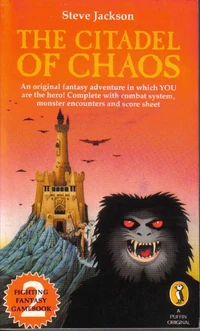
Image result for citadel of chaosFighting Fantasy Gamebooks were what got me into tabletop roleplaying games. I started with book 2 – ‘The Citadel Of Chaos’ – and played it to death. I’ve still got it, the cover all faded and the pages yellowed with age, the spine heavily creased and the centre of the pages smudged and marked by all the thumb-flipping I did. I was hooked on these books all the way through the 1980s, and when I couldn’t get a tabletop RPG on I’d turn to my gamebooks for my fix. I bought them all, even the ‘Sorcery!’ series and ‘The Clash of the Princes’.

The gamebooks also gave rise to the introductory roleplaying ‘Fighting Fantasy’ and I have used this system to introduce new players to the hobby more than once. It’s not a great system. In fact, the later RPG editions that called themselves Advanced Fighting Fantasy were in fact a little broke, but for a beginning game it was perfect. The system has now been smoothed out and improved upon by Arion Games.

The adventurers statistics, just as in the gamebook, were SKILL, STAMINA and LUCK. Skill and Luck were a number from 6 to 12 whereas Stamina (hit points, basically) was a score up to 24. Using two six-sided dice the game could progress at a tremendously fast pace. All that was required during combat was a single roll of 2D6 which would determine who won the round. Some actions were determined by the Skill level and a single D6 was used for other actions, a target number between 1 and 6 chosen by the GM depending on the difficulty of the situation. Luck could save a character’s life and help them out of sticky situations.

It’s a perfectly simple system. The dice rolls were simple and you could resolve a battle with even a large group of characters in minutes. There were hardly any charts or tables to peruse and everything a player needed was listed on single sheet. Pure simplicity and a rules-light fan’s dream.

To accompany the system was a vast world that had been created and explored throughout the Fighting Fantasy gamebooks – Titan. Three continents covered a diverse range of lands, races and cultures. You could play the equivalent of a historical European Knight, a Samurai, a Pirate, a Viking… the choice was fantastic. There were monsters and bad guys crawling out of every corner of the world and it had a detailed history. Two books, ‘Titan- The Fighting Fantasy World’ and ‘Out of the Pit’ were filled with details, histories, monsters and locations and could keep you in games and adventures for weeks. There was certainly plenty of material to use and abuse.

Image result for fighting fantasy introductoryThe great thing about the system is that you can take one of the gamebooks and use that as your setting, not just the Titan world. If I wanted spaceships I’d haul out my copy of ‘Starship Traveller’ and use the spaceship rules in there. Mad Max game? ‘Freeway Fighter’ fits the bill. The gamebooks could act as little scenarios/sourcebooks in their own right.

Titan, and especially the primary continent of Allansia, was ripe for plenty of high-fantasy adventuring yet the system itself did not really lend itself to long-term play. You could play characters for a long time but the limitations of the system did not really allow for advancement. What little advancement there was ended up being restricted by the system. Fighting Fantasy worked excellent as an introductory game but it was mainly a stepping stone on to other more detailed RPG games and systems. The world of Titan is an excellent place to adventure and rivals many of the worlds created for modern games, but it needs a system that suits it and allows for character advancement. The Fighting Fantasy rules are perfect for introducing new blood and they have a huge gaming world for budding new players to run around in, but I can’t help but think that the system is nothing but basic training before new gamers go out and discover newer and better RPGs.

I still love it, though. I love the simplicity and it allows me to explain how game mechanics work in a rolepaying game without scaring anyone away. I’m not wielding a huge scary 600-page tome of comprehensive rules, I’ve got a little paperback with which to ease new players into the game. I’ll continue to use the Fighting Fantasy rules for new players, especially the younger ones, and I can highly recommend that anyone thinking of doing the same thing use these rules.

They've now been re-released by Scholastic, with new layouts and new artwork, so a whole new generation of gamers are there, waiting in the wings, and what better way to get them into the tabletop roleplaying than with a game of Fighting Fantasy - The Introductory Roleplaying Game.

Tuesday, 24 October 2017

RPG MUSIC REVIEW: Fanfare for the Chosen - An Exalted 3rd Edition Music Suite

‘Fanfare for the Chosen includes inspiring soundtrack themes for each of the ten types of Exalted (Solars, Lunars, Sidereals, Dragon Bloodeds, Abyssals, Exigents, Getiminans, Liminals, Infernals, Alchemicals), to set the tone as you encounter these Exalted in your games or are seeking inspiration for new stories.

About the composer:

James Semple is a composer for media (tv, video games, websites and films) specialising in ultra-realistic digital orchestration. He has created soundtracks for the Trail of Cthulhu, 13th Age, Unknown Armies 3rd Edition, Esoterrorists, and now Exalted 3rd Edition RPGs.’

An epic game for an epic setting requires epic music. In the RPG Exalted, players take on the roles of powerful heroes in a world of entities with the power of gods, and the world will be shaped by their wars and whims.

Now in it’s Third Edition, Exalted is ‘the tale of a forgotten age before the seas were bent, when the world was flat and floated atop a sea of chaos. This is the tale of a decadent empire raised up on the bones of the fallen Golden Age, whose splendor it faintly echoed but could not match. This is a tale of primal frontiers, of the restless dead, of jeweled cities ruled openly by spirits in defiance of Heaven’s law. This is a tale of glorious heroes blessed by the gods, and of their passions and the wars they waged in the final era of legends.’

Using music in tabletop RPGs has been around for a long time, and I used to use music from movie soundtracks quite extensively during my sessions. If the game we were playing was licensed and I had a suitable soundtrack that could be identified with the setting then so much the better. Williams' ‘Star Wars’ music and Goldsmith/Horner’s ‘Star Trek’ OSTs got a lot of airtime in my house.

Now there’s no need to match existing music soundtracks to the game you’re playing. Now games have their own OSTs, and one of the leading composers in this field right now is James Semple.

James Semple has given us ten pieces of music to use in our Exalted games, each one acting as an introduction to a session or a scene. While not designed for ongoing play, like background incidental music, they are perfect for the scene-setting introductions that GMs love to do. With this music playing in the background as this week's scenario is introduced it turns each session into an episode, with the track as the title music. It helps set the scene, helps set the mood and, most importantly, it helps get the players into the adventure.

Nearly a year went into composing, arranging and producing this soundtrack and it shows – the arrangements are of a high standard, with a huge orchestral roar bellowing out to the most rousing pieces. The production standard is excellent, well produced and is a polished recording of a very high quality.

Return of the Solar Exalted : A huge orchestral piece, this track feels like the opening credits music to a huge fantasy show. Playing this as you recap the adventure is a great way to get back into the campaign. That can be said of any of the following pieces, depending on the mood you’re trying to invoke. These are the heroes of the game and deserved a rousing theme.

Rise of the Infernal Exalted : Are you looking for a darker edge to this weeks adventure? Have the players just arrived at a dangerous location, or has a NPC with evil in their heart just walked on stage? This starts dark but still has an edge of urgency to it. The demons of the world drip with dark character.

Birth of the Liminal Exalted : Although a softer track for those moments of relative peace, this piece still has a touch of mystery and danger, as if it lingers at the edges waiting to pounce. This represents the wondrous, tragic and doomed creation of these constructed golem types, complete with a heartbeat in the bass starting halfway through the track.

The Alchemical Exalted – Ex Machina : Touched with an ethereal feel, this music marches like a clock, representing the mechanical, android side. This is almost entirely metal instruments representing these clockwork Exalts and nods to their almost Eastern Bloc state with a huge Slavic brass theme.

The Getimian Exalted – War in Heaven : Quick, fast paced and steady, almost like riding a horse. This track gives us the passion and drive of these warriors. It’s more heroic than many would have expected representing their war against the gods and contrasting dark and light.

Rage of the Lunar Exalted : Deep beating drums and horns lend power to this track, and gives us an excellent tribal feel to the game.

The Abyssal Exalted – Death’s Lawgivers : Beginning with a powerful, religious tone and followed by the bell of what sounds like doom singing, this piece reflects tragedy and sorrow and, in fact, is my favourite piece.

The Sidereal Exalted – Lesser But Safe : This would suit those games with investigation, calculation and confrontation. In fact, it sounds like the opening of a TV detective show and would be perfect for those games where roleplaying takes the lead.

The Exigents – Power of the Exigence : The newest thing in Exalted gets it’s own track, and it even starts out unsure showing their humble, normal beginnings and then their true power revealing in a huge wondrous crescendo as the music grows in confidence and power.

March of the DragonBlooded : Another piece that starts out soft, with an oriental air to it, but then the drums kick in and the power is revealed, leading to another huge crescendo.

Although each of these are between 1:49 and 2:10 long they make for great introduction tracks, and they help capture different atmospheres and game types. Are you looking to run something epic? Then begin the game with track 1 Return of the Solar Exalted. Mystery and darkness? That’s Track 3 Birth of the Liminal Exalted put to good use. Action and adventure? Track 5 The Getimian Exalted – War in Heaven would make a great intro.

They may be short but they’re perfect for the game. Yes, you can probably loop them in the background and that should work out fine, and it’s a shame that they aren’t designed that way as I feel that a long, ambient background track would go a long way... however, the good news is that such a thing is in the works, so I’m looking forward to that. They are designed as short, punchy deliveries for each of the Exalts. They are designed to be inspiring, to give you that boost before play starts, or to give you inspiration when designing a game.

Fanfare for the Chosen is an excellent soundtrack for one of the most popular roleplaying games on the market, and the music is suited to the gloriousness and the darkness of the setting. It’s another worthy addition to the RPG soundtrack collection and another excellent selection of music from James Semple.

Highly recommended.

Sunday, 22 October 2017

RPG REVIEW: GATEWAY - The d20 Tabletop Roleplaying Game


GATEWAY - The d20 Tabletop Roleplaying Game
By Aurican's Lair

From the website: 'GATEWAY is a simple, fast-paced, rules-light and universal D20 Roleplaying Game framework that is perfect for introducing new players to tabletop RPGs. The system allows for any theme or setting, from Fantasy to Cyberpunk, from Horror to Noir, for whatever your imagination can create. The light rules and open world provide a great format for ‘One Shot’ adventures with your fellow veteran players and Game Masters.'

As I get older I find myself having less and less time to design, prep, and sometimes even run roleplaying games. As a result, I try to find games that are quick and easy to run, so that I can concentrate on what I think is important (such as the story and the unfolding plot) and less on the mechanics and statistics.

Unless it's a game system that me and my group knows well I don't usually delve into my thick, comprehensive rulebooks that much these days. I have my favoured systems to introduce new players to the hobby, and these are pretty generic, but every now and then there's a group who wants to experience the system that dominates the RPG market; the D20 system. Or, to be specific, the D&D game.

Usually I'd use the starter pack, but for those quick and easy games I've found a new and even easier system, one that emulates the D20 game and addresses some of it's key features, and yet is so stripped back that it takes no effort to set a game up.

GATEWAY is an introductory game that takes the standard D20 stats and make them the key focus of the game. At 16 pages it covers everything you'll need to run a game, and not just in the fantasy genre. It's a really good little system. What stops it from being great is that it's lacking a lot of polish and some focus, and I feel a re-write and restructuring of the layout would help immensley.

It works like this; a character has the standard D20 system abilities - Strength, Dexterity, Constitution, Intelligence, Wisdom and Charisma. Instead of being given scores, each is given one of three types of roll; Proficiency, Deficiency or Normal. Each ability is also given a selection of skills.

When called upon to make a roll, the player rolls D20s; if they have a Proficiency in the ability, they roll two D20s and keep the higher result, very much like the D&D 5th Edition advantage roll. If they have a Deficiency, they roll two D20 and use the lower result. A Normal ability is a straightforward D20 roll. The target number is determined by the GM, from 2 to 5 for really easy, up to 20 for impossible.

And that's it in a nutshell. There are small tables for working out Armour Class and Hit Points, but in general that is the entire game, and as it's simple to print off you can have a small sixteen page document, or you can download it as an app and keep it on your phone or tablet. In fact, with a form fillable sheet and a dice rolling app there's no need for any pencils or paper, and interested parties can download the rules and be ready to go in a very short period of time. And the greatest thing of all? It's free.

Now, I really like it. I like the idea of numberless abilities and using the proficiency angle as it just gives a dice roll and that's it, and even though you won't get an incredibly well-rounded character you will get a playable PC you can use for a few sessions. I like the simplicity of the rules and the idea that you can use it for anything, although I do feel it's more angled to fantasy games than any other genre, and I like the freeform feel of it all. It's a nice little system.

But what lets it down is the presentation, both in the free downloadable rules from the Aurican's Lair website and in the app itself. The rules are badly laid out in a very basic format, with some errors in the text, and the rules are spaced out in different areas which lends a little confusion, such as explaining how to roll against target numbers and then not having the target numbers explained until well into the rules section. There's also a lot of GM advice, but this is supposed to be a gateway into tabletop gaming so without a proper explanation of what tabletop RPGs are about these are somewhat superfluous. If the system is for existing GMs to use to introduce new gamers to the hobby, then this section is pretty pointless.

There's also a lot of attention on the saving throws covering incidents from being blinded to being unconcious, and this seems like a lot of wasted effort and betrays the focus of the game - to be simple and easy - and complicates things somewhat.

With some polish, some better imagery and layout, with a huge edit and much more focus on what and who the game is aimed at, GATEWAY could be an excellent introductory game, and may even be used for longer campaigns for experienced groups who just want to dive in and out of a game. It is a great little system, and it's one I have no problem in using on gamers who want to experience D&D or roleplaying in general for the first time, but the general presentation lacks finesse and may put some people off, and that's a shame because the core idea here is really quite good.

Recommended.